There has been a new release on Glow Blogs, making some changes, dealing with some issues and updating themes and plugins.
Changes
Site Creation
This will have no effect on existing sites.
We have changed the default site created to use the block editor and the Twenty Twenty Five-Five theme, a block theme.
In the Blog creation form there are two choices: Classic or Blocks
Choosing Classic leads to the site being created with the Twenty Fourteen Theme and the Classic Editor being set.
Choosing Blocks leads to the site being created with the Twenty Twenty Five theme and the block editor being set.
You can have the same choice as before but the default has changed.
You can choose Classic if you wish. You can also change Editors and theme at any time so you can use the block editor with a classic theme after the site is created.
Theme Switch
We have changed the default theme when you choose Blocks from Twenty Twenty Three to Twenty Twenty Five. The Twenty Twenty Five theme is a lot less opinionated than the Twenty Twenty Three theme. The Twenty Twenty Three theme came with a fair amount of ‘boilerplate’ that is not suitable and over complex for the bulk of the type of sites typically created in Glow Blogs. Until recently we have been ‘protected’ from this problem by a bug with templates that our developers have just fixed.
The Twenty Twenty Five theme is the fastest and most efficient on the front end, loading less style sheets and other dependencies.
You can of course switch to Twenty Twenty Three or any other theme at any time. We have more information on themes and switching on the Themes Glow Blog Help page.
Quick Start Videos
We have added two Quick Start Videos to the Site Editor page. These show how to get started quickly with the site editor. One for simple blog type sites that consist in a series of posts, the other a school site that will be made up mostly of pages and organised hierarchically.
Editors
You can also change editors whenever you wish. You can also allow the switching of editors so posts can be made with either editor on the same site.
The Block editor was introduced in 2018 and to Glow Blogs in 2021. We would advise activating the block editor. If you are very familiar with the classic editor it is quite different so it would be a good idea to try it out. More information.
We have quite a few resources to help with the block editor, including a screencast demonstrating how to quickly create a school website using the site editor. We will be expanding that help over the next few weeks.
Fixes
Slow Menus problem
The problem with sites with a very large (>50) menus items having a problem with the menu editor has been fixed.
Missing Shortcode block
The problem with the shortcode block not being available on sites with a classic theme and using the block editor has been fixed.
Pupils Display Name
The problem with pupils not being able to set their display name to anything other than their first name has been fixed.
We would recommend that staff advise pupils either to stay with that option or to set a nickname.
Updates
Plugins
The Following plugins have been updated, mostly small bug and security fixes.
Draw Attention
H5P
WP Accessibility
Post Ratings
Themes
The Make theme has been updated to support more recent versions of WordPress. We would still advise thinking carefully about using the Make theme. It uses its own editing system. content created may not convert if the theme is changed. Skills learnt in the Make editor are not transferable to the classic or block editors.
The Virtual Community Center is a database of, well, virtual communities. Take a look and see who you find there. Tell us about them, or another community that is not there, but you think should be. Find out more about the initiative from Howard Rheingold if you are interested.
I hopped over to Davey D’s Hip Hop Corner to find out about The Hardest Working Man in Hip Hop. Sadly the links to his speeches and interviews are lost to the world, but it looks as if he was (is?) a busy man – or at least he was in 2009.
During the month of August I will be participating in Blaugust, a month long blogging challenge.
Today’s TDC says:
The DS106 was on the schedule the past three months for Equity Unbound’s MYFest26 (Mid-Year Festival). We set it up so each Daily Create was announced in their Discord Channel and also offered a drop in and create together session in July and in August.
This week is the last one for MYFest26…. so how about making some art to say Thanks for Coming to the Daily Create (spelling need not count)?
I’m not sure if any of them contributed there, but I hope they had a nice time. I asked NightCafe to design:
A thank you card for a mainly invisible group of people.
Here’s what it gave me – I doubt if they’ll notice the spelling mistake!
All the very best to all who are back for a new session.
I had a busy end to my part-time consulting year! And then a useful chance to simply potter about and reflect. Had great fun watching World Cup too in Scotland and France.
I am a few blog posts behind.
Here is a quick look at what I’ve been up to:
Holyrood Communications: I had the privilege of speaking on the transformative role of AI in Education, exploring both the opportunities and challenges it brings for learners and teachers. Mainly how assessment needs to change. But have a close look at the presentation on skills you and learners need to develop to make the most of AI tools.
#OER26: Connected with the open education community to share ideas and insights on the future of open educational resources. I focused on the practical things that open education advocates and their organisations should be doing to be open. Extended blog to follow.
Very timely as the Scottish Government has finally got behind Open Practice. Caught up too over the summer with the team leading on this work. Worth a read - if I was still working at a public body or at an institutional level I'd be figuring out how we start the journey towards sharing more resources publicly with an appropriate open licence and discussing this with all stakeholders.
The #openscot community and Association for Learning Technology have lots of experts on hand who could help.
Quality Systems: Delivered a session for Northampton College on familiar territory of quality systems internal and external quality assurance for their engineering academic team.
Île de Ré: Balanced the busy schedule with a fantastic summer break on the French coast, enjoying the quiet beaches, cycling routes, food, wine, and plenty of sunshine (perhaps too hot this year).
Glasgow Commonwealth Games: Spent an unforgettable time volunteering on the ground, soaking in the vibrant energy of the events. Some memorable moments: the Ugandan team (on a rainy day) telling me how beautiful Scotland was in the autumn and being surprised it was summer. The Cook Islands team singing and playing their music on their hotel balcony each evening. Above all, working with a great set of volunteers and welcoming so many different people into the City of Glasgow.
RSA Scotland: Supported the Commonwealth Reception in Trades House of Glasgow, engaging in fantastic conversations with fellows and partners celebrating regional and international connections and handing the baton on to the Indian delegation.
Mentoring: Continued supporting senior leaders on driving change, leveraging digital tools while staying human, and leading authentically. If you role-play being a rotter, you risk getting stuck in that mode, and we have more than enough angry leaders in the world right now!
Looking forward to ALTC in Cardiff, meeting new ALT Scotland Exec members, and supporting Instructure Canvas (including Canvas Con in November) and moving on a few other projects that will keep me occupied into the new year.
This week’s group post asks us about our motivation to blog, and Krikket gives us a set of prompts. Here they are, with my answers.
Q: What tricks do you use to keep yourself motivated when something feels impossible?
Bricolage. Roughly -breaking things down into managable chunks and keeping check lists and other tricks to keep me realising that I am moving forward.
Q: What are your blogging goals? Do you think participating in Blaugust is getting you closer to where you want be?
I don’t have any blogging goals. My aim for this month is to blog my daily create (rather than just completing it), and I suppose Blaugust is ensuring that I keep to that.
Q: What do you think you’ll get out of completing your Blaugust goals?
I am often motivated to blog because of community activities. So this group project motivated me to write this post. More generally, then if I feel like blogging, then I blog. If I don’t, then I don’t. I don’t feel worried or guilty if I am not blogging. I have some regular posts so my blog is never quiet for long- every Sunday I post my Silent Sunday image to my blog, and most months I post a slideshow of my daily photos.
Q: Are you happy with your Blaugust so far? If so, why? If not, why not?
My Blaugust? I don’t know what that is. I can see a bunch of really good people working behind the scenes to make sure Blaugust is a good experience though, and I appreciate that.
Q: How important is goal setting & reaching your goals to you overall?
Well, this post has caught me as I am expected to set my SMART objectives for work next year, so I am pretty anti goal setting at the moment. My aim there is to set objectives so mundane and trivial that I can’t help but achieve them – that usually works.
Q: Did you read any posts during Blaugust (or before) that you found particularly inspirational? Share them!
I’ve read some and enjoyed them. The thing that inspired me most was the conversation in the Discord that led to me writing this post.
Hello! As I briefly mentioned last time, today’s update will focus on the concepts of episodic and semantic memory. These are widely-discussed concepts in psychology, but I rarely see them covered in education courses or CPD.
Memory in education
A starting point is the definition of memory as a concept. If you ever find yourself trying to defend the relevance of memory to education, it’s worth noting the breadth of its definition as seen by mainstream psychology and cognitive science.
By this view, the role of memory goes far beyond the retention of facts. Human memory is involved in (Squire, 2004):
Perceptual learning
Skills & habits
Emotional responses
Memory for events
Facts and understanding
And more … In short, anything that has a lasting impact on what we know and can do.
The role of memory in pedagogy or studying, therefore, should not be reduced to meaningless rote memorisation. When learners repetitively try to remember facts (which obviously can and does happen), this involves applying memory in a very narrow way, and one that fails to take advantage of how learning works best.
In most situations, we remember things far better if they are meaningful, contextualised, and practised in varied ways.
Associative links
When what we learn forms associative networks of understanding, we are using semantic memory – memory for what we know and understand. A new stimulus is linked to or contrasted with existing knowledge and skills. By forming such associations, new ideas become meaningful.
In contrast – as proposed by Tulving (1972) – remembering a specific event or piece of information leads to an episodic memory. This is a memory for a specific event or happening, such as the first time we were told something or when we experienced something in our lives.
For example, knowing that rivers are filled with fish or that you can sometimes swim in them draws on your semantic memory. You know it, but perhaps don’t recall a specific occasion when you learned these things. Recalling a particular time that you fished or swam in a river (if you ever did such a thing) draws on episodic memory.
If the previous points are not entirely clear, try testing yourself on the five statements below. For each one, ask yourself: “Can I vividly recall the event of learning this?” or “Do I just know the fact?”
What you had for dinner last night.
A bicycle has two wheels and pedals.
The weather on your last birthday.
That Paris is the capital of France.
A conversation you had last week.
When I’ve shown these to learners who are new to theories of memory, most find it easy to recognise that some of these things involve semantic memory and others episodic memory.
And although researchers have moved towards seeing the systems as closely intertwined, the idea that they have distinct features has persisted (Renoult et al., 2019).
In education
In education, goals are usually more aligned with deep knowledge (semantic memory) than with retaining isolated facts (episodic memory). What we really want from our students is a deep, interconnected understanding of how things work.
However, the experiences that lead to this knowledge can result in episodic memories. At the end of a class, for example, the students will leave with a memory of the specific activities and conversations that they have just had.
How does the learner get from one to the other?
This is an interesting and complex question, and one that is sometimes studied with reference to the brain systems involved. I won’t get into that aspect, but in general terms, the specifics and the conscious episodic memories tend to fade over time (at least for most people) while the gist of a concept is incorporated into semantic memory.
What can help this to happen? Educational experiences that cause us to notice differences, to make sense of tasks and to reflect on meaning. For example, one benefit of interleaving (see update #96) is that it involves contrasting subtly different examples.
Examples like interleaving show that while the process of semanticisation (yeah – what a term, right?) is not conscious, it can be supported via careful pedagogical choices.
Another example, famous for decades from the work of Piaget, is that children benefit from disequilibrium, as this forces them to reorganise their knowledge in order to accommodate conflicting information. In more everyday terms, they try to make sense of something that seems weird, and their knowledge changes accordingly. Such experiences don’t have to happen in the classroom, but they can.
As some of you may realise, all of this shows that semantic memory is based on schemas (see update #59), and that developing it involves the organisation and interconnection of knowledge (e.g. knowing what things link to and why they matter) just as much as it involves taking in new knowledge.
The ultimate goal, often, is expertise, and it has been widely recognised that experts differ from novices in the organisation of knowledge as well as in the amount that they know.
I hope you are enjoying Memory and Metacognition Updates. Subscribe for free to receive new posts and support my work – and consider sharing it with colleagues!! Thank you!
Please note that my slides and similar materials are shared under a CC BY-NC 4.0 license. This means you can use or adapt them with attribution for non-commercial purposes. If you wish to use my materials for other purposes, feel free to get in touch.
What message would you like to see fly by overhead toted by an airplane? It can be about #ds106, #MYFest26, or any other message you feel the world should look up say. Go big! Or Silly.
What do children’s books, imaginary Old English influencers, video games, and knitting instructions all have in common? These are projects that my linguistics students have submitted instead of traditional essays. In this blog post I reflect on the difference between the interdisciplinary learning that students undergo in the process of producing these submissions, on the one hand, and interdisciplinary teaching, which was not something I offered explicitly. Rather, we followed the principles of alternative assessment - which prioritises feedback over traditional grading - prevalent in interdisciplinary teaching. I’ll try to make sense of all this by formulating what I call “Principle 626”, or the “Stitch Principle”: that institutions encourage interdisciplinarity only when it’s siloed off and cannot challenge any structures. To outline a way forward, I’ll first say a bit about my teaching and my students’ learning, then highlight some connections from the 2026 Interdisciplinary Learning and Teaching Conference, and conclude by suggesting that while not all teaching can be interdisciplinary, the best assessment will be.
When interdisciplinarity comes from student coursework
I work in cognitive science and linguistics at the University of Edinburgh. The research I’m involved in is often interdisciplinary, although my teaching is usually situated within one discipline or sub-discipline. I also work in the scholarship of teaching and learning, with an emphasis on principles and methods of “alternative assessment”, a move away from grading and ranking and towards growth and collaboration. One way I’ve put alternative assessment into practice is by allowing open-ended projects or unessays: assessment whose format and content are developed by the student, usually through dialogue with the instructor. While an individual course or module might be grounded in one discipline, that’s not to stop students from learning about the world through additional lenses.
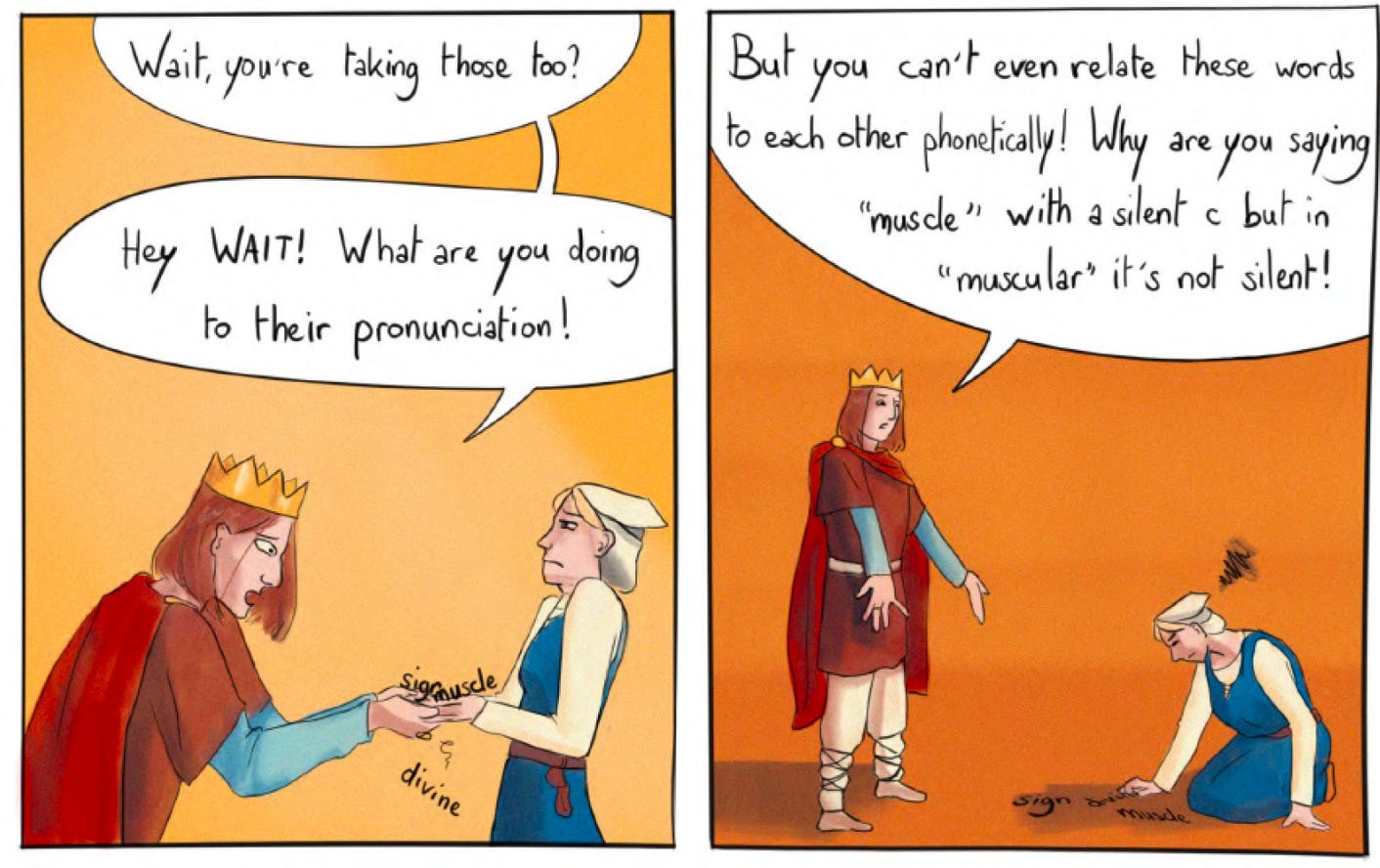
Excerpt from “The layered lexicon of English”, a comic strip by Violette Daures.
Since 2021, my students have submitted final projects in a range of formats, including comics, podcasts, mockumentaries, video essays, knitting essays, Instagram linguistics influencers, soliloquies, art projects, TikTok videos, children’s books, video games, designs for psycholinguistic experiments, BuzzFeed-style quizzes, meme “listicles” and op-eds (I’ve not yet seen interpretative dance, music pieces or board games, but I imagine this is only a matter of time). The content has also been varied: from in-depth explorations of the material discussed in class, via additional subjects that we didn’t have time to cover in the course, to high-level overviews for a general audience. Students enjoyed this assessment format very much, including the process of developing and scaffolding it. Importantly for our current discussion, some of these assignments produced novel provocations that spoke to multiple disciplines. In other words, students took intellectual and creative risks in their work.
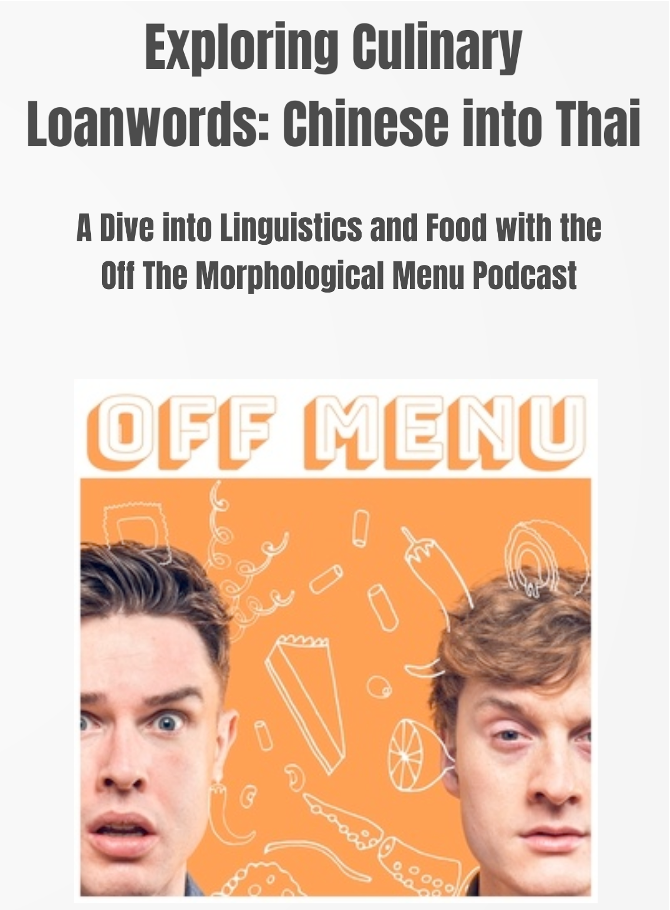
Cover image for “Off the morphological menu”, a podcast by Narusiri Jaowanaridhi, Fangxiao Liu, Fiona Spencer and Athena Wen.
But one does not simply tell a student to take intellectual risks. Students must trust that the instructor really is interested in the students’ own hot takes, rather than in them giving the “right answers”. And they must rest assured that their grade won’t suffer as a result. This is where the core insight of the alternative assessment movement is relevant, and while it’s based on decades of empirical research and theoretical nuance, I’ll summarise it as follows: Grades. Ruin. Everything.
Cover page of “Angus asks: what does it mean to ‘slay’?”, a children’s book by Amy Faircleugh, Gemma Smith, Indira Nijssen and Leo Findlay.
Yes, marks and grades buy you some compliance, some control, and some short-lived external motivation. And yes, there will always be variance between individuals. But by and large, grades shift the mindset from learning - which is collaborative, interdisciplinary and joyous at its most natural - to trying to get the best grade (which can lead to many of the things we dislike about our job, including unnecessarily adversarial relationships between staff and students). A substantial literature dissects these issues and related ones, like the inherently inequitable practice of ranking people against each other.
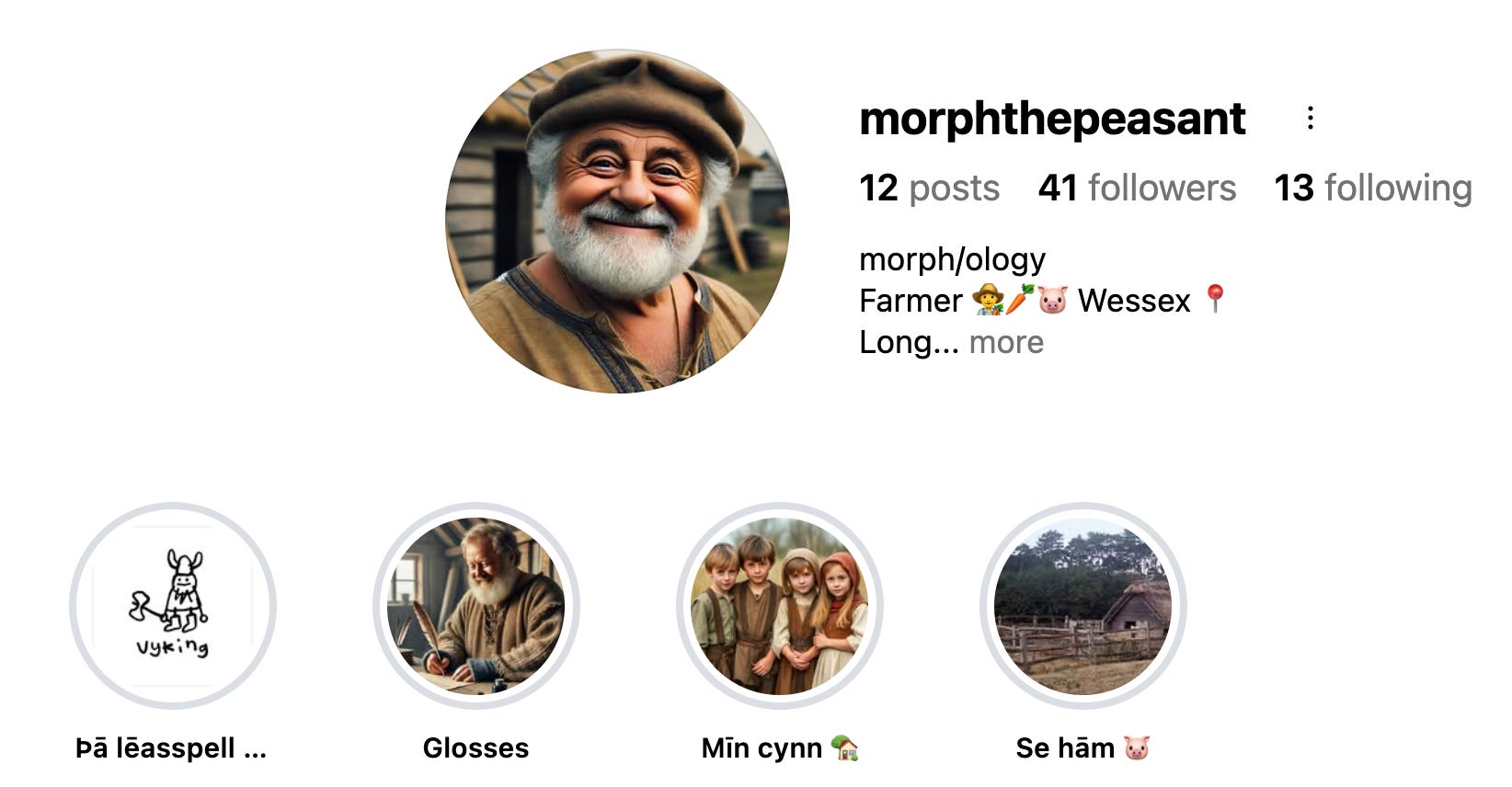
Account of @morphthepeasant, an Instagram page by Sally Keith, Josie Lord and Pablo Tufnell.
I won’t try to unpack these issues here, or give you a blueprint for implementing alternative assessment and unessays (although I will mention one specific method below, namely self-assessment). Instead, I want to look back at some highlights from the 2026 conference and see how alternative assessment fuelled some of my favourite talks. I’ll then discuss what we can learn from that in terms of how our institutions work.
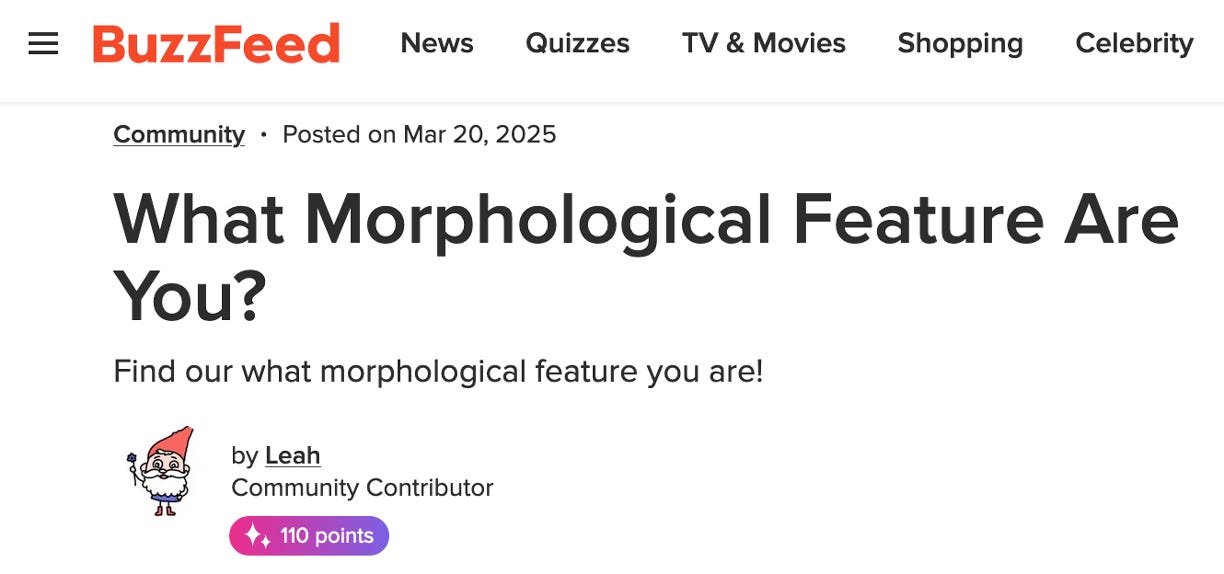
Header of “What morphological feature are you?”, a BuzzFeed quiz by Cameron Byrne, Beth Hartley, Freya Keane and Leah McGregor.
Selected highlights from the 2026 conference
The conference kicked off with Helena Good’s delightful keynote. She mentioned how meetings around education are often ones where colleagues react with “Yes, but”, when ideally we want everyone to be saying “Yes, and”. This reminded me of the pushback many alternative graders get when we suggest more authentic assessment methods. Another interesting point had to do with the World Economic Forum’s “Future of Jobs” report and its top 10 skills for future jobs, which led to a discussion of how these skills are themselves interdisciplinary in nature. This summary looked to me a lot like the Times’ Top 100 Graduate Employers report, which noted that “Very few, if any, of the country’s top employers recruit graduates based on their academic record [...] move away from academic achievement to demonstrating the broad range of skills”.
Excerpt from “8 memes for an overview of African morphology”, a collection of memes by Ross Glencross, Hazel Hughes and Megan Stewart.
One of the perks of attending a conference slightly out of your area - like this one was for me - is getting to learn about concepts and frameworks you aren’t familiar with. Christopher Shoop-Worrall’s presentation was very helpful in framing “student vs learner”, with an explicit nod to equitable assessment. Another parallel arose in Courtnay McLeod’s talk, where she highlighted that 100% of graduates in Bauer Academy’s master’s programme in senior leadership received a Distinction. For an alternative grader like me, this seemed natural: if students come to learn and we do our job guiding them, then they should do very well. A grade distribution that is heavily skewed towards Firsts seems like a much more desirable outcome than any “normal” distribution.
These issues really came together in two other presentations. The first was Peter Hochenauer’s account of commitment-based assessment in his master’s course. Hochenauer made a number of great points, including that creative energy doesn’t emerge automatically but can be facilitated through appropriate choice of assessment, which ultimately means more transparency and more agency for the students. I agree completely, having run courses that rely on self-assessment for a number of years now (also called ungrading or collaborative assessment). The second presentation was the final panel by Jenny Scoles and students Sara Albakri, Sora Choo and Polly Dipper, whose interdisciplinary course was similarly ungraded, and likewise helped give students agency.
Noticing these cases in the same conference led me to wonder whether there was anything distinctly interdisciplinary about the design of these courses. In the spirit of interdisciplinarity, I think the answer is a combination of “yes” and “no”, as I explore in the final part of this post.
Why interdisciplinarity?
The question I pose for our concluding discussion is why we find alternative assessment in interdisciplinary teaching. We can identify an answer by looking at individuals and at institutions. Instructors who work and teach in interdisciplinary frameworks might be more open to being reflective about their own teaching, or to trying new things. There could be many reasons for this; for reasons of space, I want to follow the thread to structural issues instead.
When thinking about our higher education institutions, I propose that alternative assessment is easier to swallow when it’s cordoned off in the part of the curriculum designated as “creative”. Especially in the UK, universities have been argued to work primarily within a corporate mindset, rather than as institutes of knowledge, collaboration, learning and growth. This attitude leads to low resourcing of pedagogy, and accordingly poor understanding of it at the managerial level: why promote self-assessment, for example? Sounds dangerous. At the same time, if a programme is labelled as “interdisciplinary”, that label can send a signal to students, parents, colleagues, managers and regulators: the students want to do something loopy so we let them, because this is the part of the university that allows experimentation and creativity; don’t worry, we promise it won’t happen anywhere else! I half-jokingly call this the Stitch Effect, or Principle 626, after the misunderstood super-powerful alien Stitch (”Experiment 626”) from the film Lilo and Stitch: institutions tolerate interdisciplinary teaching and interdisciplinary learning, which inherently includes alternative assessment, only when it’s tightly sealed in a box and won’t escape.
Stitch (Experiment 626) in his cage. Image source: Disneyclips.com for non-commercial use.
Interdisciplinary learning is all about taking intellectual risks. Scholars of education have come up with many useful ways to think about these issues: constructivism, bricolage, critical pedagogy, self-determination theory, alternative assessment, and so on. I would say that all true learning is interdisciplinary learning in some way, which means that those of us with expertise in assessment and those of us in interdisciplinary teaching have the same goals when challenging the structures we work in. Interdisciplinary studies are a natural fellow traveller for decades of work on education, and in particular for the growing movement of alternative assessment. Let’s help Stitch out of his cage.
—
Thanks to my students for their collaboration and inspiration, and to Carine Abraham and Peter Hochenauer for comments on a previous draft.