The Guardian published a giggle generating list of 18 terms describing the current state of tech. Use at least 5 in an uplifting poem or maybe a motivational poster?
The sheer amount of hand-holding that comes with ordering a package online is frankly unnecessary. You can expect to receive messages informing you of every single step in the process. Officially you will receive the “We’ve got your order!” email, the “Your order is on the move!” email, the “Your order has reached our network!” email, the “Your order is progressing through our network!” email and the “Your order will be delivered today!” email. Unofficially, you will also receive the “We attempted delivery!” email (accompanied by a photo of the corner of a shipping container nowhere near your house), and the email telling you to collect it from a depot 20 minutes away.
I asked Nightcafe for:
a brown paper parcel tied up with string. It has arms and legs and a big smile. It has speech bubbles coming from it saying “I will be here soon”, “nearly there”, “can’t wait to meet you” and “what is your pet called?”
You can see the result, including typos not made by me, at the top of this page.
Draw and shape or explore preset ones and watch/hear it turned into a drum sound. I think that’s what Eigendrum does, it’s as nerdy as one can get with the physics / math of drum shape / sounds.
Of course I drew a cat, and you can hear what it sounds like by clicking on the cat image here.
I blogged my responses to the TDC thoughout August, and I kind of missed doing that today so here’s this one. Today’s TDC says:
Today is the first day of meteorological autumn in the northern hemisphere. Make us something autumnal – maybe a picture or a poem.
I don’t have any autumnal photos for this year yet – though we noticed that the trees were starting to drop their leaves when we visited Mugdock earlier this week I didn’t take any pics. But here’s a pic I took yesterday of a fat, juicy, ripe blackberry against a bule sky.
Another 31 days of daily photos checked off. One photo a day, every day, uploaded to Flickr. A moment where I pause each day and appreciate where I am.
Way back in late 2025 I wrote a post on practitioner action research, and mentioned that I would later dive further into the issue (see update #131, “Promise and Pitfalls of Practitioner Action Research’).
It’s taken me a while, but I’m finally back with part 2 of that topic! I think that sharing this in the late summer is actually a pretty good time, given that many projects will be undertaken across the coming academic year. Perhaps you already have research in mind – if so, I hope this provides food for thought.
A brief recap – what is action research?
By action research, I mean research that reflects on and attempts to inform one’s own practice. It is carried out by the practitioner, rather than someone external, on their own students and in their own context. Overlapping terms that are widely used include practitioner research, practitioner enquiry, or teacher research.
Projects tend to be narrower and more classroom-focused than a lot of other education research. There are many things that could be researched, but examples might include:
Checking to see whether a change in classroom organisation impacts on student behaviour or motivation, for example by giving questionnaires to students;
Trying out a new form of group work and analysing the outcome based on test scores;
Interviewing parents about their children’s experiences with primary-to-secondary transitions.
It’s easy to see the potential of doing very grounded research in real contexts. How much better does it sound to find out about behaviour in my own class than from the broader research literature, for example? This is the promise of practitioner action research.
However, as I raised in my earlier post, there are real risks of bias. Many interventions are studied by practitioners that already think that they are a good idea.
Consider, for example, the idea of flipped classrooms or technology use – they tend to be researched by enthusiasts rather than sceptics. Coupled with rather wobbly research methodology, and there is a lot of potential for educators to see what they want to see. Learning myths may persist because people find this pseudo-evidence from action research. These are the perils that I referred to before.
Most action research in education involves real classrooms. Image source here.
Why Errors Occur: A Scenario
Let’s consider a scenario to further illustrate how flawed conclusions can be drawn from action research:
Bob decides to explore the spacing effect (seeupdate #39). The class does one task with spaced practice and one without, and test results are then compared using a statistical test. Bob concludes that spacing has not made a difference.
How should Bob respond? According to the logic of action research, they have a finding that is relevant to their unique context, and should decide not to apply the spacing effect in future because it (apparently) didn’t work. They may also be encouraged to share this with others as an example of good practice (🤯).
That would actually be a major mistake. We know from the broader research literature that the spacing effect does work. This leads two possibilities:
There is something about Bob’s context that is so unique that it overturns decades of research on learning and memory.
The experiment was flawed, leading to a false negative. For example, the sample size (limited to the numbers in a class) could be too small to detect a statistical difference, the tests may have differed in their difficulty level, or a lack of experimental control might have distorted the findings in any number of ways.
I would be very strongly inclined to believe possibility #2! Of course, the same logic holds if the teacher does find an effect. This is perhaps even more misleading and hard to avoid – people expect intervention X to work, their results show a difference of some kind, and so they conclude that their research has provided evidence for intervention X.
The problems are exacerbated by the fact that most teachers are not experts in research methodology and statistics, and may lack experience, too. That is before we consider issues about research ethics, which are also riskier with inexperienced researchers.
It might sound like I have really changed my mind about teachers engaging with research, but that’s not so. My 2019 book The Teacher’s Guide to Research (more here) does not suggest that teachers should blunder into research projects without ethical scrutiny, make changes on the basis of tiny samples, or share findings that lack sound evidence to support them. It also doesn’t suggest ignoring the existing theory and evidence on an issue!
In fact, The Teacher’s Guide to Research does not focus just on teachers doing research, but also engaging with it. There will often be more to be gained by engaging with existing research evidence on an issue than by carrying out your own project.
Take reading, for example. I think that a primary school teacher would be much better off reading reputable systematic reviews of research into reading than trying to figure out how reading develops via action research with their own class.
However, once a teacher has begun to understand the theory, the existing evidence as well as key areas of uncertainty, they may start to generate important questions that can help the education community as a whole understand how ideas are best implemented.
On balance, is action research a good use of time?
There no doubt are cases where good projects are done and where teachers have learned something useful. But we have to balance the time spent on this with other things that they could have been doing, such as:
Reading up on learning and memory;
Working on their classroom management skills;
Developing better explanations and questioning;
Upgrading their curricular knowledge;
The points are arguably more core to successful pedagogy than the majority of action research topics.
However, I still believe that engaging with research is highly valuable and motivating for teachers – at times even transformative. Even a poorly conducted study can be a good learning opportunity, and act as a stimulus to read evidence and to engage with the science of learning community.
And if we want to start engaging with research, then trying it out ourselves is definitely one of the best ways to understand the methodology of the research that we read.
So, I’m perfectly happy for all educators to engage in action research. I’d just warn against reading too much into findings – at least while one’s understanding of methodology is still developing.
This leads me on to the final part of this series of posts – where I talk about guidelines for successful projects. You can check it out next week!
Please consider sharing this post with relevant colleagues! Thank you!
I hope you are enjoying Memory and Metacognition Updates. Subscribe for free to receive new posts and support my work – and consider sharing it with colleagues!! Thank you!
Please note that my slides and similar materials are shared under a CC BY-NC 4.0 license. This means you can use or adapt them with attribution for non-commercial purposes. If you wish to use my materials for other purposes, feel free to get in touch.
Most of my study is sinister, as I am left handed. Here’s my left handed clock – bought as a joke, but my brain’s now got used to it being ‘back to front’.
The Duke of Wellington statue stands outside GoMA, and is a Glasgow icon. He usually has one cone on his head, sometimes more. Recently it’s being taken to ridiculous extremes, and some people are not happy about it. And – worse – our trend has spread to Edinburgh, and they are horrified.
Find a statue, or a photo of one, and decorate it with a traffic cone. Be safe as you do it!
I chose a pic I had taken earlier this year of one of my favourite statues, the gargoyle at the Heritage Hotel in Glasgow, and downloaded a pic of a traffic cone to add to his head. Powerpoint was all that I needed to quickly do this, then I screenshot the result and uploaded to Flickr.
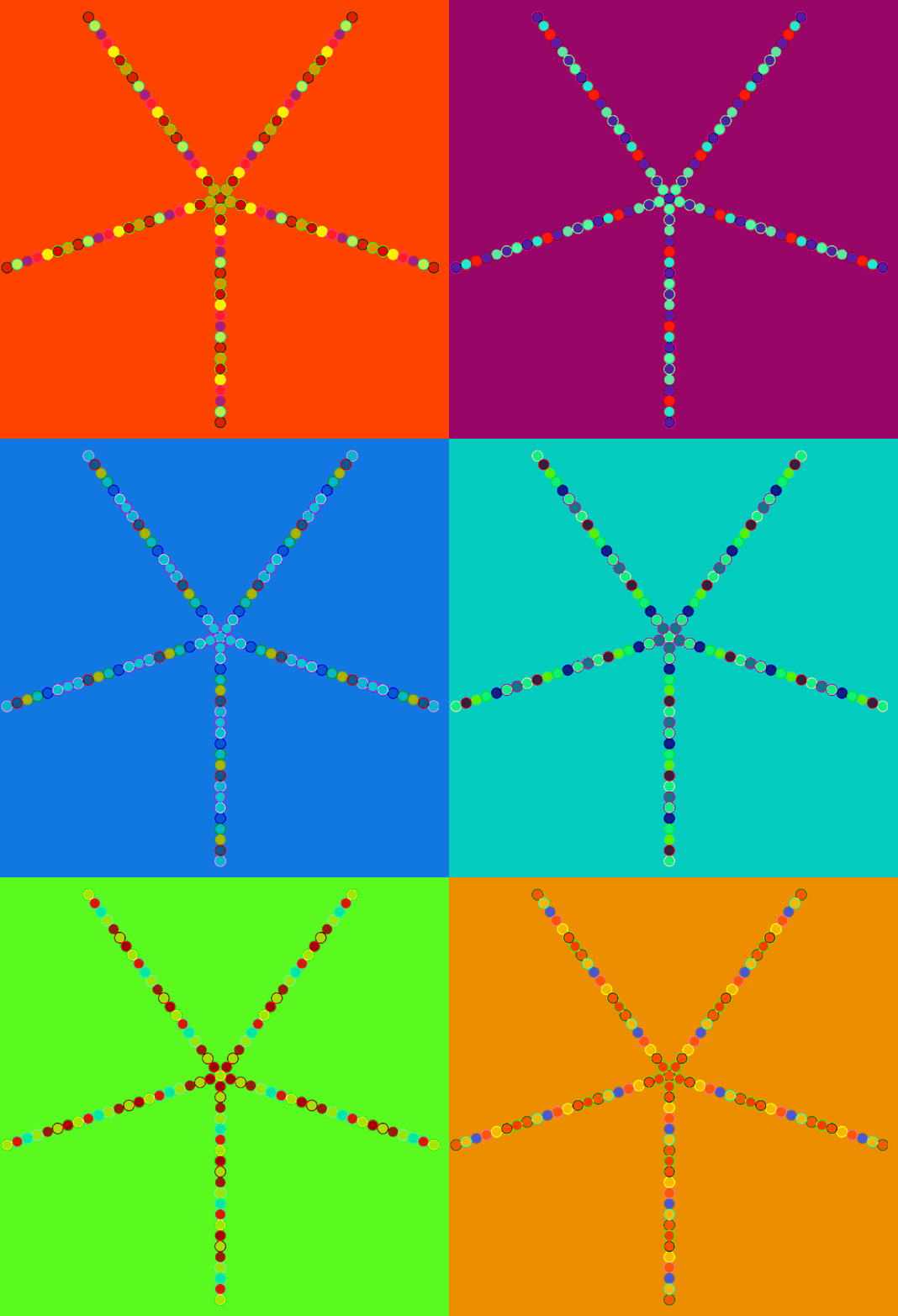
I love numbers, so today I learned that 106 is a centred pentagonal number! If you draw a star made of five equal branches, each branch made of zero or more blocks, and one block at the centre, then the number of blocks will be such a number.
I searched through my Flickr albums for ‘border’ and found this picture of a boat, taken in Oban a few years ago. I wondered at the time what this was – it seemed a strange thing to find in a Scottish tourist resort. However, a Google AI summary tells me today that:
The UK Border Force operates Coastal Patrol Vessels (CPVs) along the west coast of Scotland to secure shallow waters, marinas, and beaches around the Sound of Kerrera and the Isle of Mull. These vessels deploy directly out of major hubs or regional bases when required.
The UK Border Force patrols Oban because its complex coastline serves as a major gateway to the Highlands and Islands, making it vulnerable to maritime crime. While the town is famous for tourism and Caledonian MacBrayne ferries, the vast, rugged geography of Argyll and Bute presents specific security challenges that require a targeted border presence.
So there you have it – this boat protects Scotland from illicit smuggling, and other nefarious practices. Gee, thanks!