The future classroom is a conversation and it can be a conversation: Learning now unfolds in dialogue: between teachers and students, people and systems, questions, and responses. The challenge is not control but balance and allowing technology to contribute without letting it speak for us.
This is one of the statements in the Manifesto for Generative AI in Higher Education which has just launched it’s book project. In the book, a range of international authors have responded to each of the manifesto statements, with their own reflections, experiences, views and provocations. The brainchild of Hazel Farrell and Ken McCarthy, the manifesto and now the book have been deliberately designed as a “living reflection” in the every evolving context of GenAI in higher education (and beyond).
I am delighted to be one of the authors included in the book. Along with my “writing buddies” Bill Johnston and Keith we have addressed statement 30 of the manifesto “the future classroom is a conversation, and it can be extraordinary” which sits within Theme 3 of the book – Imagination, Humanity, and the Future.
In the chapter we take the stance that manifestos are in themselves a call to challenge the status quo. We use Freire’s definition of education praxis – “reflection and action directed at the structures to be transformed? “ (Freire, 1970) to discuss how classroom conversations could be structured to challenge the structures surrounding GenAI. We believe that these types of conversations could be extraordinary and as well as necessary. We propose that these conversations would “require the development of a collective understanding, between learners and educators, of how GenAI systems encode, produce, or reinforce bias, and must include measures to redress imbalances relating to under-represented voices.”
You can access the full chapter directly here, and the whole book is openly licensed , and it is well worth exploring and seeing what conversations and reflections it can stimulate for you, your colleagues and students.
Apologies Dear Reader, it has been far too long since I last posted here. In fact, I wouldn’t blame you if you have given up completely on ever reading something new here. But I during the #edtech26 conference in Dublin this week I have been reminded of the joy of blogging by 2 stalwarts of the craft – Maren Deepwell and Jim Groom.
As I wait for my (annoyingly delayed) flight home, I see Maren has already published a post about the conference. As I sit and watch fellow travelers queue around me for their flights, I am slowly processing the past 2 days.
Of course the best part of any conference is always the people who are there. It was so lovely to catch up with so many colleagues and friends and meet new colleagues from the ILTA community.
It was refreshing to be at a conference and to speak with colleagues who aren’t all facing restructuring, endless rounds of VS and/or compulsory redundancies. The UK HE sector is a challenging place right now. The contrast between the Irish HE sector and the UK sector is quite stark. However we do all still have a common set of challenges around enhancing learning and teaching, integrating and using technology effectively and enhancing the student experience.
All the sessions I attended were really insightful and I could see many parallels with work I am involved in with UK universities. I was also delighted to be able to present an overview of the Jisc Beyond Blended Programme in a session that was chaired by Fiona Concannon who leads one of our pilot projects at the University of Galway.
The 3 keynotes (Abeba Birhane, Ben Williamson, Felicitas Mcgilchrist) were excellent – and can be viewed here For me they all had a common theme around how future and current narratives of edtech are being shaped and co-opted into all of our lives. They all highlighted key challenges not just facing the edtech and wider education domain, but wider society.
Abeba and Ben focused more on the “big tech” consumerist, market driven, AI centred narratives that are driving the seemingly inevitable narrative around the future of an enhanced AI driven and dominated education sector. One that is based on, well not that much evidence really but a whole lot of hype and a whole lot of money. Education’s market potential is huge – the investment companies are moving in. Their stakeholders don’t really care about quality and human impact as long as the shares are riding high on the stock market.
Felicitas looked at another side of the technology narrative -focusing on some of the narratives around use of technology and levels of anxiety and mental health, particularly in children and teenagers. She reminded us that some of the popular narratives around anxiety are gaining traction and leading to some oversimplified potential solutions such as banning smart phones in schools. The issues are far more complex. She reminded us of alternative, critical, scholarly research around notions of fragility, and the need to remember that fragility is part of being human. We all are all fragile, have moments of doubt about our abilities, are worried about failing. Education based on care – not made up of productivity and efficiency metrics (my words not Felicitas) is what we really need.
The conference was full of stories, ones we tell to each other as well as the “bigger” stories each of the keynotes explored. The whole “big tech” era were are currently living is terrifying. Perhaps I, like the rest of the conference delegates. are all too aware of the dystopian nightmare we seem to be hurtling towards. But there must be some hope . . . and I do think there is.
The debate motion:
Big EdTech is getting worse (exactly as planned)
This motion argues that educational technology has, for the last 25 years, been getting slowly worse. While we often talk about the tools and technologies of EdTech, the reality is that we are almost always speaking of commercial products. As products, they are not designed to be sustainable or equitable, but disposable and expensive.
As time has gone by, EdTech has moved relentlessly towards hosted metered services and away from installable, sustainable software. EdTech has become a tap that drip feeds us its services in billable minutes, words and tokens. Its products’ hype cycles rise as fast as its sustainability declines. We can never have equity with products that are designed to function as desirable educational status symbols rather than tools for human transformation and flourishing.
Along with Gavin Hendrick I was in conference co-chair Kate Malloy’s team opposing the motion. My contribution to the debate was that we needed to be better at creating our narratives around edtech and what our communitie do (“the way in which we think about who we are depends on the stories we tell about who we are” Sharon Blackie, Wise Women, 2024) and getting them adopted by our senior management. We need to be articulating in a more compelling way than the ‘big tech bros” what a university is for (We need to be able to articulate an understanding of what universities are for that is adquate for our time if we are to be able to decide what to do” Stefan Collini. 2017 Speaking of universities. I did feel quite a lot of pressure during my 4 minute section. So I will try and write another post about the it I know I did rush that perhaps one narrative to develop was to expand on the notions of sanctuary universities. To see if part of our university spaces could supported digital and data sanctuary for our students and staff. Spaces where we could provide equitable alternatives, systems that weren’t tracked, spaces where tech would only be allowed if it were completely transparent and for example shared all its algorithms, allowed them to be critiqued. However despite the far more articulate efforts of my team mates, we narrowly lost the motion.
It was a really enjoyable, thought provoking and fun conference. So huge thank you to all at ILTA for the organisation, to Kate and Rob for co-chairing so well and including me as one of the invited speakers.
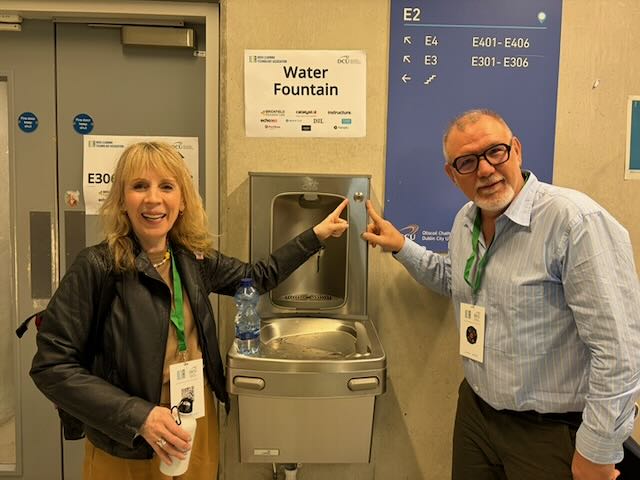
However, I am saving the best moment for last. It was so lovely to catch up with Jim Groom in person. Only Jim would hire a table top pac-mac console for their company “stand”. This retro fabulousness was positioned beside a wall mounted water fountain which I really couldn’t figure out how to work properly – so I was just using the lower (mouth jet) to fill my bottle, until a lovely new colleague wandered, placed his bottle in the “bottle space”, pressed what I had assumed was a button that needed a key or key fob and hey presto the water came out. It was a bit of a “mind blown” moment that had Jim and I in stitched laughing, particularly as our new friend said he had done the same as us until someone showed him “the way”. The joy in helping others for the next few minutes was, well at one point almost a business plan, but certainly had the potential for a new conference ice breaker.
Water cooler moments, they are still the best . . .
Over the past week I have been in London at a magical event celebrating the work of choreographer, dancer and movement theorist Rudolph Laban. The celebration was organised by my friend Darren Royston, who choreographed and directed me in various productions during our undergraduate days and who was a source of inspiration and energy across the 5 days of the gathering.
This time last week I was full of anticipation and anxiety about attending…. I was worried about meeting new people, not being able to keep up physically and not having anything to contribute. But as Erica Jong said, “If you don’t risk anything, you risk even more”.
So I invited my anxious parts to step back and took the risk.
I am so glad I did. I met the most incredible, committed, creative people, all of whom share a passion for connecting and moving with others in a way that can move us towards new and hopeful possibilities.
If you want to know more about Laban’s important work, check out the informative website that Dr Dick Mccraw has just launched: https://www.labanresources.info
Every single moment of the 5 days of workshops and lectures was a learning opportunity but two of the sessions resonated with me in particular. The first was a workshop on Dance Theatre with Annaliese Monica Koch from Austria, whose immense knowledge, experience and desire to inspire, rather than show, spoke to my inner dancer.
The second was a practical session on Embodied Shaping as a Pedagogical Tool with Marylee Hardenbergh from the USA, a dancer and dance therapist whose graceful, gentle and pure energy brought out the poetry in us all.
Within the session we used our movements to inspire poetry.
I rise in order to grow.
I sink I order to cry.
I advance in order to progress.
I retreat in order to be.
I open in order to love.
I close in order to rest.
Thank you to everyone who shared so willingly of themselves at the event and gave me such rich food for thought and action.
As we draw to the end of 2025, I guess it’s time to reflect on what’s happened this year, maybe even make some predictions for next . . . I don’t think I’ll bother with the latter. Those with genuine insights (and some of those with not so genuine insights) have either done or in the process of doing that. In the “betwismas”, I’d rather take a bit of time to reflect on 2025 and share some, well actually my only one, hope for the coming year. And my hope – it’s actully a perennial hope of mine – is for everyone to give themselves a bit more time. Time to think, time to experiment, time to reflect, time to share, time to laugh, and time to just be. Not be obsessed with being more efficient and/or productive. Just be – be with ourselves, with each other, with our students.
Our notions of time, particularly in education are so regimented -the dominant hourly segmentation, nominal study hours, terms/semesters, exam “periods”. Always marching forward, Those neat segments are just ripe to be made more “efficient” and “productive”. So we are told anyway by those AI sales pitches and increasingly dominant narratives about how much more efficient we all need to be.
A lot of my time this year has been spent supporting the Jisc Beyond Blended Pilot Programme. One of the key aspects of the success of the programme, has been the protected time it gave the pilot projects. Being part of the programme gave those involved permission to take time to reflect and engage with the issues they identified in their proposals that were important to them and their institutions. This really struck me during all the support calls we had with the pilots. In one way or another they all reflected on the importance of having some protected time. They were able to carve out a bit of time, to have slightly different conversations, based and supported by the Beyond Blended resources with a range of colleagues and students about things that mattered to them. The resources themselves saved time for those involved in the programme as they didn’t have to create “more stuff.” They could just take the (trusted) resources and use them. An added bonus was the fact that they are openly licenced, so people could confidently adapt them for their context. All this and more is in the Beyond Blended in Action report which summarises the experiences of the phase 1 pilot programme.
When Helen Beetham and I started talking and working with Sarah Knight at Jisc, we were interested in finding out what, if any, difference the pandemic experience had on approaches to learning and curriculum design, and the overall student experience. We spent, and continue to, a lot of time talking about time. Flexibility and time are inextricably linked, the way we blend time, resources, support , flexibility have changed.
During the pandemic I wrote a little post about time called The straight lines or the asterix: some thoughts on time, space and place. It was inspired by a radio play during lockdown and a conversation between a Roman soldier and a Pictish wise woman, and their very different notions of time. My very regimented notions of time were totally subverted by lockdown – and I know I wasn’t alone. We had to connect in different ways, be more flexible about time. But it seems so many of us have forgotten that experience. Or maybe, it’s more that we are not given the time to properly remember and reflect on that experience and to be able use those different notions of time in a more useful way – which in my head is more important than efficiency or productivity. And don’t get me started on how you actually measure efficiency and productivity in an educational context. I was struck by a conversation during one of the onsite visits we had for the programme when a colleague said “remember during lock down we used to talk about learning and teaching, we don’t seem to do that anymore . . .” What other useful things don’t we do anymore?
So, my wish for 2026 – let’s make more time for conversations with each other, with our students, about where, why, when and how we can all engage with learning in ways and times that work for all of us, that acknowledges that sometimes we have to go backwards and remember and reflect on why we do or do not, do things in certain ways, and accept that time is really “a big ball of wibbly, wobbly, timey, wimey stuff.”
About this time last year I wrote a little round up of activity, and I sort of chastised myself for not blogging enough of the year. I think I might have made, well not a resolution cos they always fail, but a little “note to self” to try and get back into the blogging habit. Seems those “note to self” things are about as useful as new year resolutions. Anyway, this week I have been getting a number of automagic, AI fuelled, end of year summaries, which has prompted me to get my fingers out and onto the keyboard.
Linkedin was first. A “smooth, business like, with as dash colour” (note” that’s my description) video giving me “my numbers”. Actually, what it really illustrated was that my colleague Simon Birkett is really good at sharing useful information that often directly relates to me and my work, and I am a pretty good passive “liker” and “share this post” user. But hey, according to LinkedIn my influence “just keeps growing”.
This morning, I got my “wrapstadon”. I actually love the corniness of the title (well it is almost Christmas!). I’m not particularly active on Mastadon but I do check it most days as I feel connected to lots of “good people” there. I got this nice little infographic. Which is probably an accurate summary of when I have used it most – conferences, particularly OER25. Apparently, I am “the oracle” as I “create more new posts than replies”. Or am I really more of a self-publicist? Posting more about “me” than sharing, replying and being part of a community? Not sure how oracle like that really is.
All of this does take me back to the heady days of twitter (when it was a genuine community), and social media analytics. I was genuinely fascinated by how we (well when I say we I actually mean Martin Hawksey and his amazing Tags Explorer google doc) allowed us to explore online communities and visualize often hidden, or at least not obvious connections. Now, I know people (myself included) are disconnecting and connecting in different, more strategic ways. AI engines are gobbling “up all the data”, and I’m not so sure they are actually giving us any really valuable information back. But do I really need a little video to know what I am doing on Linkedin for example? I do know I’m using it more, posting, replying and sharing there seems easier, seems to have a greater value to me, my work, to connecting with my network than other channels (for the moment).
Anyway I will try and write something more reflective about what I’ve actually done this year, but I right now I am basking in the glow of getting my yellow badge in Padlet. Just trying to figure out what this achievement will mean for 2026 . . .
I can’t quite believe it’s almost been a week since the #altc25 conference. Lots of people have beaten me to it in sharing their reflections (thanks Phil and Joe) . There has been quite a lot of sharing and chatter on Linkedin too. Linkedin really does seem be the the platform du jour at the moment.
I wasn’t quite sure what the conference would be like this year. I know that ALT’s “other” conference, OER had quite an atmosphere. As I wrote earlier in the year, it did really feel like it was a necessary, safe space this the summer. ALT-C is quite a different conference to OER. It’s bigger, more diverse so I was curious to see if it felt just as necessary as OER. Turns out it was, but in a different way.
At the start of the week I found out about a couple of people losing their positions with HE. To say I was “a bit cross” about the news for each of the individuals involved is quite the understatement. Good people who have been instrumental in transforming practice in their universities, who have supported staff and students to navigate the ever complex world we are living in, have been seen as not fit suitable for the new visions of their universities. So I was worried about how many more loses I was going to hear about during the conference. It does seem like in HE at the moment there is an ever growing sense of “the disappeared”. That’s worrying in itself, but does mean that those who are left are being once again asked to do more with less.
However, during the 2 days I did get a sense of “well, yeah, it’s all a bit sh*t but I’m here, some of my team are here, and we are just about managing.” Not great, but actually a lot better than I expected #signofthetimes.
Of course AI was “all over the place” . . . but I was heartened by the number of sessions I went to that were either free from AI, or were addressing key issues including ethics and the actual benefits of using AI.
The keynotes also provided a bit of yin and yang in this respect. Charles Knight got the conference off to a good start with his keynote “Being a leader not an algorithm: humanc skills for an AI shaped future“. Charles has a very personable, informal presenting style which was perfect for the first session of the conference. He put forward a view that we “can’t outrun technology with policy” and what is needed is a way to allow space to build ethical cultures of trust and curiosity in learning so we can build and shape “adaptive human systems” that work in context. .
I couldn’t help thinking “hmm” at that point. I understand where he is coming from, but right now the context of HE is being decided in contexts far removed from day to day practice. (Un)ethical choices are being foisted upon the sector by the tech bros who have convinced governments that AI is the answer, without actually knowing what the question is.
Charles also emphasised that everyone in the room could bring some “magic” that makes a difference. The magical metaphor really resonated with everyone. me included. It also led to me asking a slightly rambling question around whose magic gets to be performed to those in power and the patriarchal persecution of witches. The dominant narrative of the witch as an evil woman, as opposed to an wise elder of the community, has been perpetuated throughout history by insecure men.
What I was trying to say was that to me, it seems that the narrative around AI seems to have a bit of “magic” around it for key decision makers. Just leave it to big tech to pull the increased retention/engagement/productivity bunny out of the hat. But what is actually happening is more akin to slight of hand – not magic, just misdirection. Distracting decision makers from humanity that is at the core of education. They seem to be able to just say . .. look into my dashboard, directly into my shiny dashboard, lose yourself in meaning less dials, charts, numbers. Forget about the people who work with students just now – they are sooo expensive, you don’t really need them, give us lots of money now, we’re soo much more worth it than them. They are witches . . . . with their focus on ethics and their need for time and people to support student learning, keep looking directly into my eyes . . .
To be fair to Charles he really got what I was trying to say and we had a great chat about it over dinner.
Gabbi Witthaus’s day 2 keynote, “Engaging learning: rethinking inclusion with insights from the margins” was imho, full of real magic. Sharing her experiences of her research on working with students at the margins of society, particularly refugees. Gabbi ‘s talk focused on inclusive learning design that provides not just safe spaces, but accountable spaces that support the context and needs of students.
How I wish that her framework for student engagement, and more importantly some of the reasons for student disengagement was understood by more ed tech companies. As she reminded us, students want to matter, they want to be seen, they want (nay need) us to understand their context and provide support for their learning that recognises their realities and challenges.
So once again #ALT-C has provided a necessary space for discussions, connections and a this year a bit of a ceilidh too. Congratulations to the Co-Chairs, ALT Staff, Trustees, speakers, delegates and sponsors for making it all happen. And there’s an opportunity to sort of do it all again early next year with the online ALT-C25 revisited conference. Maybe see you there, that is, if I haven’t been burnt at the stake by then . . .