Make a comic strip for that time Puff the Magic Dragon went to Machu Piccu [sic] only to discover to get home they had to enjoy a picnic of cheese and crackers.
I cheated – it’s a busy day at work and I don’t have time to draw all that or find some comic strip software, so here’s an image from NightCafe
Want to see some of his real stuff? Check Artnet for Inspiration. We used a lovely abstract art generator for our masterpiece here, but feel free to use other media and get messy with real paint!
I took a close up picture of part of an oil painting we have on our walls and played around with filters. Here’s the original:
Hello! And welcome back to a series of posts on these updates that focus on action research. You can find parts 1 and 2 here and here.
This is the third and final part, and having discussed how action research can go wrong, this part will have a more positive focus, considering its benefits and providing some suggested guidelines.
The story so far
By action research, I mean research that reflects on and attempts to inform one’s own practice. It is carried out by the practitioner on their own students or context, and might include projects such as:
Exploring a new pedagogical strategy;
Investigating a change in classroom organisation or student support.
At first glance, it sounds like a great way to get realistic studies relevant to our own students and curricula. As I’ve mentioned, however, there are some real pitfalls!
One is ethical – without experience and ethics guidance, there are problems with carrying out research on students.
Another is methodological, with a key issue being that findings are hard to interpret without methodology and statistics expertise, and, especially with small groups of participants, can be ambiguous. As someone with a stake in the outcome, it can be hard for practitioners to analyse findings without bias creeping in.
There is also a risk that teachers focus only on what seems fun or fashionable, ignoring the most impactful areas where there is already a body of theory and evidence.
To cap all of that, organisations often encourage practitioners to share the findings of their action research, potentially amplifying errors and biases!
Data analysis and a learning curve? Image Pixabay here.
Recovering the promise of action research
Having sounded those notes of caution, I want to return to the idea that action research is potentially promising and valuable. There are cases where it can lead to uniquely useful research findings. For example:
The classroom practitioner knows their students, meaning that students are more likely to act in a normal way. With an external investigator their behaviour may not reflect the norm;
The practitioner knows the curriculum, and is therefore in a good position to identify specific areas of content that lend themselves to the application of an evidence-based technique. For example, in research on classroom quizzes, it would be preferable for a teacher to write the quiz than to use a generic one designed by a researcher;
The teacher can easily follow a class over days and weeks, gathering data at several points. It’s much harder for a researcher to achieve this (which is why longitudinal research is rare in education).
The process of getting involved in research is an amazing form of professional learning. Even if no useful findings arise, the engagement with theory, evidence and methodology can all help educators.
Some guidance points
Taking all of this into account, and assuming that many people do see the positives (or, in some cases, doing action research may simply be a requirement of their role!), what tips or guidance can we offer?
Here are my thoughts and ideas in a nutshell:
It’s best to start by becoming well acquainted with the research evidence. Rather than having a fun idea and trying to backfill this with evidence, a practitioner should focus on engaging with and applying research ideas in their classroom first. Doing so will greatly increase their awareness of issues and debates, and they will start to spot important gaps in what is known.
If the practitioner does not already have a relevant background relating to methodology and research ethics, it would be a good idea for them to engage with support in these areas, for example via a course or mentoring by a relevant colleague.
Ethical choices are best not left up to the individual practitioner-researcher. Organisations that do not already have ethics boards for oversight should establish these, drawing on support from partner organisations where needed.
At least to start with, the most important learning that occurs from practitioner research involves the increased awareness on the part of the practitioner, rather than ‘research findings’ that can be shared. As such, institutions should support practitioner autonomy, allowing staff time and support to explore areas of interest.
Having noted the importance of autonomy (see 4), it’s also worth pushing for practitioner research to focus on important, impactful issues where possible. To achieve this, organisations can share sets of priorities, but allow practitioners scope to opt out. Organisations should also highlight learning myths and fads, to discourage projects based on those ideas.
Initial sharing can take place internally within the organisation, and should place an emphasis on critique of methodology and questioning how to improve the findings, rather than assuming that everything a practitioner-researcher concludes must be true.
As a practitioner-researcher becomes more experienced, it may be valuable for findings to be shared more widely, e.g. via conferences and journal articles. However, this is very hard to do without institutional support. Organisations should think about how to put support in place rather than leaving busy teaching staff to figure this out for themselves.
To conclude
The above points reflect my own journey – as I said in a previous post, I started out as a practitioner researcher myself.
If you disagree with my take, I’d love to hear from you and consider your perspective.
Overall, it’s worth remembering that we all have to start somewhere when it comes to research, and a lack of experience in methodology is nothing to be ashamed of. All the same, I don’t think we can just assume that every teacher or educator can do research – not if we want the findings to be worthwhile. It’s a complex business, and if it’s to be done well, the practitioner-researcher deserves support.
Please consider sharing this post with relevant colleagues! Thank you!
I hope you are enjoying Memory and Metacognition Updates. Subscribe for free to receive new posts and support my work – and consider sharing it with colleagues!! Thank you!
Please note that my slides and similar materials are shared under a CC BY-NC 4.0 license. This means you can use or adapt them with attribution for non-commercial purposes. If you wish to use my materials for other purposes, feel free to get in touch.
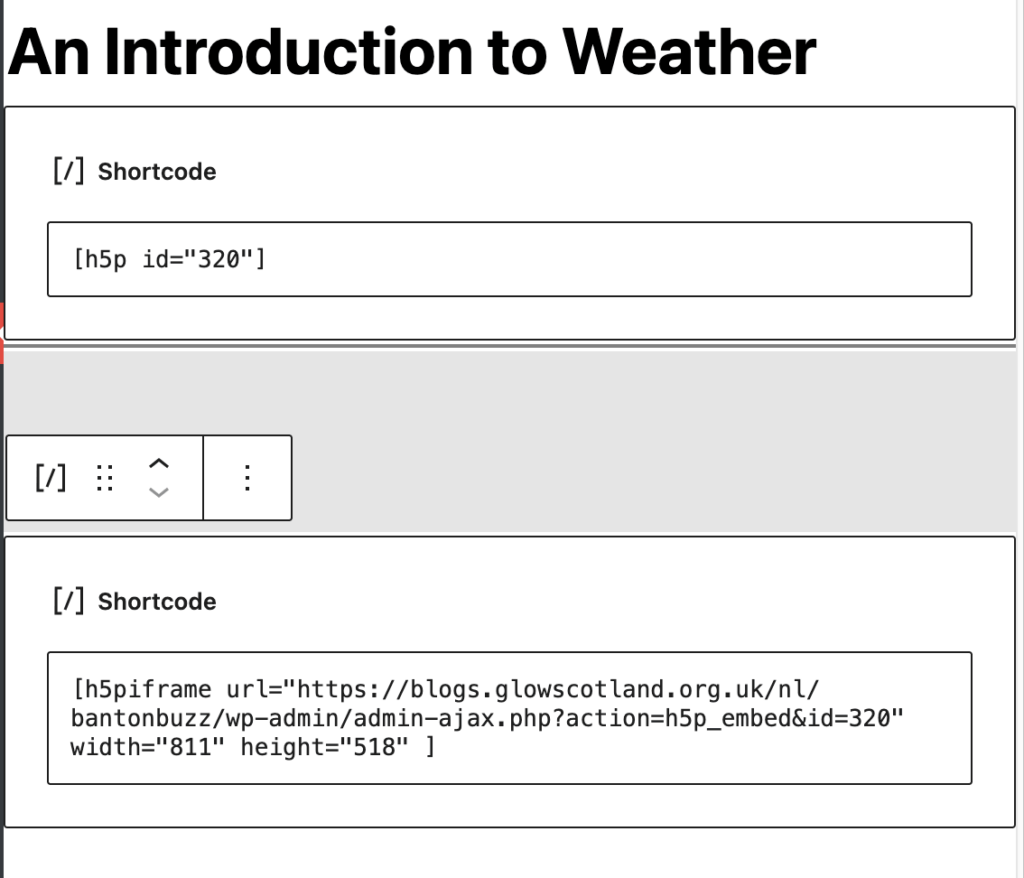
Even after applying the fix about there may be a problem with any YouTube Videos in the Safari browser. There is currently not a fix for this. But there is a workaround.
Create and embed your content or edit the content. Make sure all the Display Options are ticked.
View a page with the content on it.
Click Embed and copy the code. This embed code will work when added to a post. You can replace the original code.
This will fix problems with any YouTube videos in Safari. It may be worth doing if you are providing H5P video content to learners using macs or iPads.
This screenshot show the original embed code and the one copied from the content. Do not use both in the same post.
If you are seeing this problem and have trouble fixing it, please get in touch, fill in the form.
13th September is Roald Dahl Day. Make some art to celebrate this day – maybe a gif from one of his films, or a poster made from a quote from one of his books.
I chose a quote from the MinPins
“Those who don’t believe in magic will never find it.”
― Roald Dahl
and found a gif I did a few years ago of a horse turning into a unicorn.
Show us the old school office supplies you regularly use for school or the office. (Digital devices need not apply.) Yuo don’t get much more old school than a fountain pen, and I use mine for all my writing. You can see some of them at the top of this post.
Think of a local store in your neighborhood. You’ve been hired to come up with a hand-drawn “We’re Open” sign for them to hang on the front door. Your design should speak to the spirit of the store, and entice passersby to take a peek inside.Tell us about the store. Show us your ‘We’re open’ sign.
I asked NightCafe to make me:
A hand written sign for a daily create shop. it says:
We are open for:
ideas
challenges
remixes
What it gave me is at the top of this page, with ‘e’ added by me.