Where is Alphistia?⤴

from

Today’s TDC says:

Alphistia is a geofictional country, you can read about it on its web pages. Tell us where you think it would be, if it had a location. Who lives there? What do they do?

I cheated and asked ChatGPT:

I think Alphistia would be somewhere in northern Europe – perhaps tucked away between Scotland and Scandinavia, in a place that exists in the geographical equivalent of a gap in the map. It would have a temperate climate, plenty of rain, long summer evenings and a landscape of rolling hills, woodland, small farms and lakes. In other words, somewhere that is green rather more often than it is sunny.

It would be a small country, with no enormous cities. Instead, there would be lots of small towns and villages, each with their own character, surrounded by farmland and wilderness. I imagine the capital being more like a particularly ambitious market town than a conventional capital: a university, a library, a railway station, a few museums, lots of cafés, and a parliament which is just about large enough to be taken seriously.

Who lives there? I imagine Alphistians as people who are rather fond of making things – languages, art, music, stories, gardens, maps, bicycles, community projects and unnecessarily elaborate local traditions. They would probably be farmers, teachers, craftspeople, engineers, programmers, artists, researchers and shopkeepers, with a healthy number of people whose occupations are difficult to explain to foreigners.

I suspect Alphistians would have a slightly obsessive interest in their own history and geography. Every village would have a local museum, every hill would have a name, and everyone would have an opinion about the correct pronunciation of the name of the neighbouring village.

Perhaps most importantly, I think Alphistia would be a country where making things up is taken seriously. Not in the sense of being dishonest, but in the sense that imagination is regarded as a perfectly legitimate way of understanding the world. It would be a country for people who like maps of places that don’t exist, languages that nobody else speaks, and the possibility that somewhere, just over the horizon, there might be another country waiting to be invented.
Adventures in an old train⤴

from

Today’s  TDC says

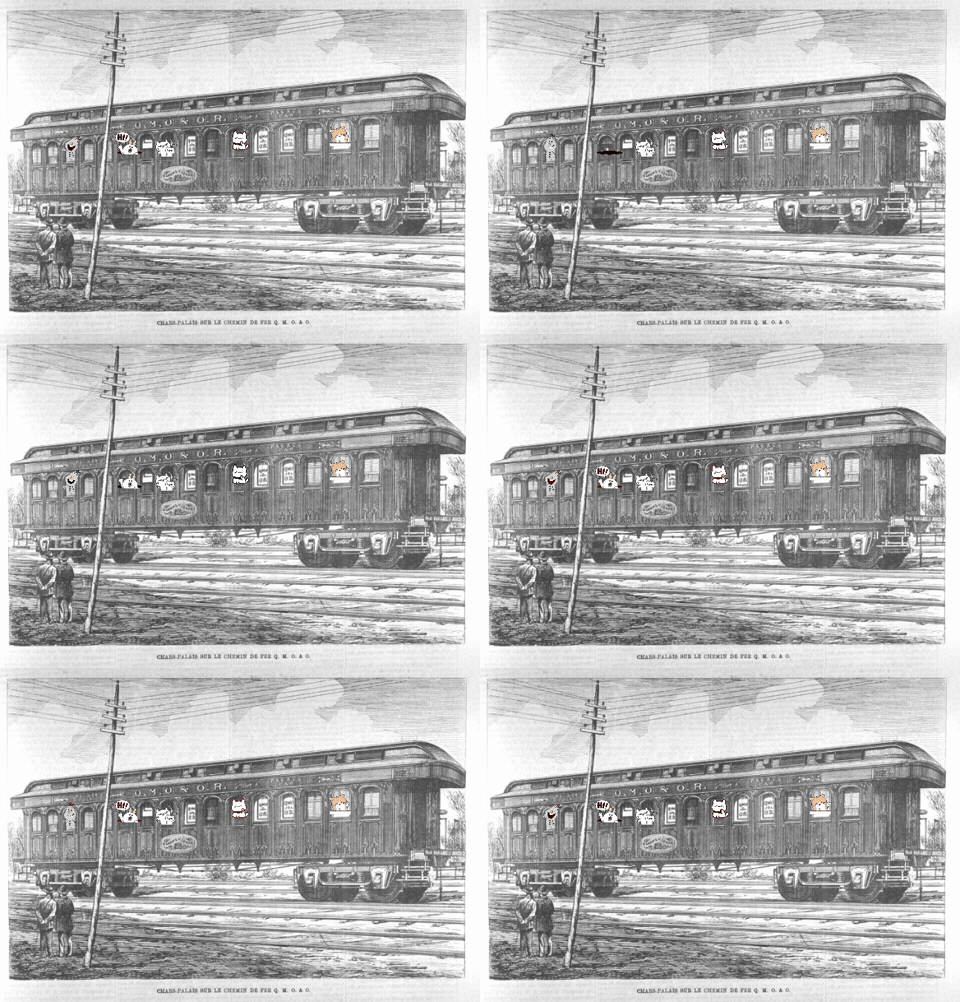
Go back in time and get on the old QMO&OR railway.

The Canadian province of Quebec formed the Quebec, Montreal, Ottawa and Occidental Railway (QMO&OR) in 1874 to link those cities since private companies, without the usual subsidies from the Federal Government of Canada, could not get financing, mainly because the Grand Trunk Railway was lobbying against it

Show us your adventures on that train. Do some research and write a story or modify the image to give is a sense of what you experienced.

I hopped over to Giphy and added some animals waving at the windows.

Jazz Keys⤴

from

Today’s TDC says

Words are music, right? Or is it, music is words? JazzKeys brings words and music together in an interesting way. As you type, it makes music. Then you can share your words/music.

Write a message to the DS106 Community with JazzKeys and share the link with us. Together, we can create a collaborative performance.

Try JazzKeys

I chose a quote from Brian Eno:

people do much better when they don’t think they’re being artists … if you don’t call it art, you’re likely to get a better result. Brian Eno

And uploaded the result to YouTube:

Put a bird on a statue⤴

from

Today’s TDC says:

Birds love to perch on statues. but how about adding an unlikely bird to a statue? Use your digital skilz today to add a bird to a statue, or show us a photo you have taken.

https://social.ds106.us/@johnjohnston/11718405530249199

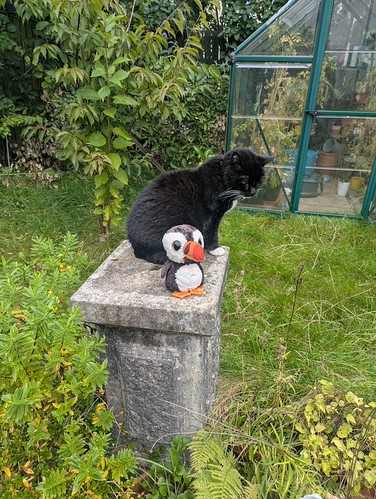
I wandered outside with a couple of toy puffins and took some photos

Fair Flora with Puffin
Fair Flora with Puffin flickr photo by NomadWarMachine shared under a Creative Commons (CC BY-NC-SA 4.0) license

Flora the Puffin and Lacey the Statue Cat
Flora the Puffin and Lacey the Statue Cat flickr photo by NomadWarMachine shared under a Creative Commons (CC BY-NC-SA 4.0) license

Memory in Education – A Seminar⤴

from @ Memory and Metacognition Updates

Hi! I know that in many countries, lecturers, teachers and other educators are starting the term/semester soon. If that’s you, I hope it goes well.

I will be taking time out from our own Welcome and Development Week (a.k.a. freshers’ week) here at the University of Strathclyde to host a seminar on Sept 18th on the topic of memory and education, as I briefly mentioned in an update before the summer.

Memory and education

As discussed in my post on semantic and episodic memory recently, the role of memory goes far beyond the retention of facts, and is therefore relevant to everything we do in education and across life in general.


A person in jeans writing in a journal or notebook that rests on their lap, grassy background
Writing a diary or journal reflects how memories interact with our thoughts and identity. Image: Pixabay

All the same, memory has something of a bad name in education. Many people see ‘memorisation’ as something to be avoided. And in part, rightly so – a lot of strategies used in both teaching and independent study emphasise shallow, inflexible retention of facts, and lead to rapid forgetting. True learning involves long-term retention and the ability to transfer what has been retained to new situations (Soderstrom & Bjork, 2015).

I therefore feel it’s worth exploring memory’s role in education today – not just the evidence but the philosophical basis of how we view and engage with it. The blurb for the seminar is as follows:


“Life is not what one lived, but what one remembers and how one remembers it in order to recount it.” – Gabriel García Márquez

Memory is a central but controversial topic within Education. In many educational systems, memorisation is both required and seen as undesirable. Many institutions and curricula explicitly focus on skills rather than knowledge, but skilled thinking is bound up with what a learner knows and can recall, for example when they engage in hypothesis testing or evaluation of a creative idea.

In addition, memory is not simply an individual cognitive process; it is also social, cultural and political. Educational sectors are shaped by collective memories, traditions, and inherited practices. There are major challenges in the selection of and therefore prioritisation among different cultural artefacts and perspectives.

At this seminar, we will hear perspectives on these issues informed by research from Education Studies and related fields, giving attendees a chance to consider and discuss memory’s role in education (both concepts broadly conceived).


Example issues which may feature in the talks and discussion include:

  • What role should memory play in courses and curricula?

  • What do teachers and lecturers need to know about memory processes?

  • What educational challenges relate to cultural and collective memory?

  • Historically, how have educational approaches reflected popular assumptions about memory?

More details

The seminar runs on 18 Sept 2026 and is organised by two of our research subthemes at Strathclyde: Advanced Pedagogical Theory and Higher Education Research & Pedagogy, and is supported by the Philosophy of Education Society of Great Britain (PESGB).

You can see the talks that are happening on the day and sign up to come along if there is still space (it’s free, but places are limited!) here:


That’s all for today … back soon with the final part of my practitioner research series of posts. All the best,

Jonathan


Last time: Promise and Pitfalls of Practitioner ‘Action’ Research, Part 2

I hope you are enjoying Memory and Metacognition Updates. Subscribe for free to receive new posts and support my work – and consider sharing it with colleagues!! Thank you!

Please note that my slides and similar materials are shared under a CC BY-NC 4.0 license. This means you can use or adapt them with attribution for non-commercial purposes. If you wish to use my materials for other purposes, feel free to get in touch.

It Starts in an A.I. Generated British Place⤴

from

Howelyple
Howelyple flickr photo by NomadWarMachine shared under a Creative Commons (CC BY-NC-SA 4.0) license

Today’s TDC says:

Dan Hon wrote a clever script (and recipe) to train an A.I. to generate British placenames. There just could be places such as “Chorkwheal”, “Storton of Brook”, and “Kinindworthorpe Marmile”, right?

I chose Howelyple, and headed over to NightCafe. I asked for:

In a village called Howelyple, A lone cow stands in a field in front of a cow barn. There is a village church with a steeple and a scarecrow

The image it gave me is at the top of this post

RIP Wendell Berry⤴

from

Berry Heron poem
Berry Heron poem flickr photo by NomadWarMachine shared under a Creative Commons (CC BY-NC-SA 4.0) license

Today’s TDC says:

Poet and environmentalist Wendell Berry has died at age 92 Make some art in his memory – maybe illustrate one of his poems or write one inspired by his words.

I love The Peace of Wild Things, so I looked through my Flickr albums and found a photo of a heron, taken last year – probably at Mugdock.

When despair for the world grows in me
and I wake in the night at the least sound
in fear of what my life and my children’s lives may be,
I go and lie down where the wood drake
rests in his beauty on the water, and the great heron feeds.
I come into the peace of wild things
who do not tax their lives with forethought
of grief. I come into the presence of still water.
And I feel above me the day-blind stars
waiting with their light. For a time
I rest in the grace of the world, and am free.

Imagination Library⤴

from

Today’s TDC  says:

Dolly Parton’s Imagination Library is a wonderful initiative. As Dolly said:

“The seeds of these dreams are often found in books and the seeds you help plant in your community can grow across the world.”

Imagine DS106 was setting up an imagination library. What would you donate to it, and why?

So many books I could suggest to inspire the imagination, but I chose one that helped me to understand my remix

Navas Remix Theory
Navas Remix Theory flickr photo by NomadWarMachine shared under a Creative Commons (CC BY-NC-SA 4.0) license

Once for Scotland Catch Up⤴

from @ Experimental Blog


I enjoy catching sessions from Once for Scotland on the first Thursday of each month.  It is great to hear about all of the joined-up digital initiatives in the national pipeline.  I do think many of these initiatives need more public awareness. There are a lot of potentially really good things happening. If you work across the public sector in Scotland you really should sign up for Once for Scotland. 

The initiative does not have a brand or logo, so I got AI to make one up. 

This month we got updates on 

Scottish Government Digital Mailbox 

The Scottish Government Digital Mailbox is a national digital communication platform designed to provide the people of Scotland with a single, secure location for receiving correspondence from public sector organisations. Following a successful CivTech challenge, and based on the Danish Digital Post system used population wide, the Scottish Government invested in the core infrastructure through Netcompany's AMI platform, integrating it with ScotAccount for trusted identity verification and the Scottish Government Cloud Platform to establish a scalable national service. The platform is now operational and forms part of key strategic programmes including the Digital Front Door (MyCare), providing a foundation for secure digital communications across health and wider public services in Scotland. The focus has now shifted from building the platform to driving adoption, onboarding public bodies, and realising the benefits of a shared national service. This supports the ambitions of the Sustainable Digital Public Services Delivery Plan, which aims to move 25% of public sector correspondence to digital channels by 2030 and deliver potential savings of more than £100 million per year through reduced printing, postage and administration costs.

I can see this as a great tool if adopted by organisations like Qualifications Scotland. 

ScotPayments – 

ScotPayments the payment service designed by and built for government, including background information, progress to date, what the programme is working towards and opportunities to become involved.

 Local Government Architecture Model 

The Local Government Architecture Model (LGAM) is an evolving shared framework for describing the technology councils need to deliver local public services. Creating a common language across local government to support collaboration, technology planning and the adoption of reusable solutions across the sector. 

ScotAccount v MyGovscot Accounts

Many citizens will be trying to understand the difference between their ScotAccount and their Mygovscot account, if they have set one or both up.  Here is a quick table guide. 


FeatureScotAccountmygovscot myaccount
Who runs itScottish GovernmentLocal councils / Improvement Service
PurposeNational digital identityLocal council service login
Identity verificationYes (photo ID or security questions)No
Typical usePVG, disclosures, MyCare.scot, Redress, DASCouncil tax, bins, schools, benefits
2FAYesSometimes
Reuse across servicesYes (national)Yes (local authority only)
InteroperabilitySeparate from myaccountSeparate from ScotAccount