Tag Archives: learning

Reclaiming Lurking⤴

from

Stalker

Lurking is a potential problem for theories of social constructivism and principles of active learning. It’s also a problem for data analytics – if the student is not VISIBLE, how do we KNOW that they are learning? The invisible are easy to ignore, easy to problemetise, easy to marginalise, easy to other, easy to shame. It is tempting to chivvy them into participation, but participation without intrinsic engagement and motivation is futile, is facile, is inauthentic. A pedagogic approach that emphasises the visible over all else ignores autonomy, dismisses reasons, denies that another story might exist. This type of approach can force us all to join in the jolly learning games FOR OUR OWN GOOD.

All of this makes me shudder with memories of the forced jollity of childhood – the insistence upon JOINING IN – no sitting in the corner READING quietly while the rest of the (good) children are PLAYING NICELY together. (If you know Joyce Grenfell you will hear her voice here.) I felt odd. I am not shy, yet for most of my life I had no way of describing my need to sometimes pause and reflect before speaking. Now I know that I am not alone – that others (sometimes) feel as I do. But I digress.

When we other the silent participants we risk confusing what is countable, what is trackable, what is noticeable,  for what is important – we risk confusing meaningful learning with what is easy to assess. But learning is not a counting noun – Dave Cormier taught us that. And, if we are not careful, we send students the message that spending time in quiet reflection is somehow wrong, that spending time learning conventions is wrong, that watching is cheating, that this behaviour is FREELOADING and that is JUST NOT CRICKET.

Yet learning often takes time. Thoughts need to percolate. Fine wine is not made overnight. this blog post, for example, began with a discussion on Twitter, and has been knocking around in my head ever since.

So I am stating, here and now, that I am reclaiming lurking. I am reclaiming the behaviour, and I am reclaiming the word. Lurking is allowed. Lurking. Is. Allowed. There, I said it aloud (lol).

I’ve written about this with others before. I’ve used Lave and Wenger’s idea of legitimate peripheral participation to suggest that lurking can be a legitimate strategy for those new to a community and its norms. I’ve talked about how our Facebook groups can help shyer students, and those without English as a native language, to take their time to respond in their own way. I’ve run a Twitter chat to talk in more detail about this. I’m not saying anything new. But the current emphasis on student engagement and active learning makes me want to emphasise this more. Lurking is a legitimate behaviour. It is something we all do from time to time. I lurk, you lurk, we all lurk. (Note, by the way, that I am talking about a behaviour here, and not a type of person – lurking is relational, is situational, is context dependent.)

We learn a lot by doing, I know. We should encourage our students to participate. We should ensure that the digitally shy can be helped to find their voice, that students build their digital capabilities as well as their academic ones. All of these will help them both within academia and beyond it. But any insistence on one size fitting all, of active learning being the only ‘proper’ way of learning, needs to stop.

So the question becomes, I think: how do we, as compassionate educators, allow students opportunities to learn what, when and how they want to learn?

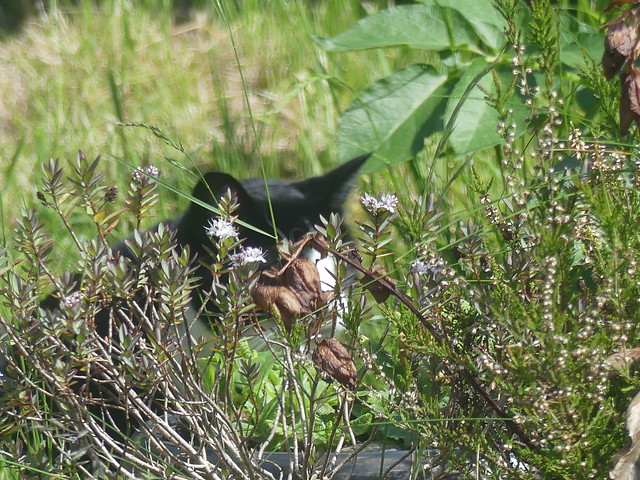
Image of Cagney, lurking in our garden
Twitter chat personas⤴

from

Say cheese

I’ve been thinking a lot about the different ways of interacting, or not, on Twitter this week, and I’ve come up with a rough list of types of engagement in Twitter conversations:

  • Academic:  adds relevant academic references
  • Networker: links to others/brings other tweeps into the conversation
  • Self-publicist: always twists the conversation to talk about their work; provides links to their work over and over again
  • Cheerleader: RTs with added positive comments about the original post
  • Enthusiast: replies to say how great everybody and their ideas are
  • Lurker: likes posts, might RT without added comment, but does not post
  • Critic: disagrees, adds alternative points of view, but does so in a positive way*
  • Troll: no need to define these*

What do you think? Do you recognise yourself or others in this categorisation? Ha:ve I missed out any personas you’d include?

* Thanks to Len for these two

It depends how you look at it⤴

from

Blind men and elephant3

There’s a story that’s often told about a bunch of blind men and an elephant. Each man only encounters a part of the elephant and, based on their partial understanding, disagree with the others about the *real* nature of the animal. I wrote about this years ago on another site, now lost, and I can’t remember exactly what I said, butI said something related during rhizo15.

I’m not a fan of pretending that educational researchers can be objective. However, I don’t think that an implication of this is that all educational research is a matter of subjective opinion – there’s an alternative candidate that’s worth consideration.

Perspectivism is the view that every point of view is a matter of perspective.* Everybody has their own perspective, and it’s important to recognise that this might not be the whole story. This doesn’t mean that truth is subjective, or relative – perspectives can be better or worse than others, and some perspectives can be aggregated to make a bigger story, as the blind men can do in order to get a fuller picture of the elephant – if they take the time to listen to each other.

Rhizomes are like this. Each of us finds our own way of navigating then, each of us have our own perspective. We can often understand others’, and we can agree or disagree with them. Rhizomes are heterogeneous multiplicities, to use some of D&G’s words.

Perspectivism grounds my methodology and my ethical approach for my PhD. I am looking at CLMOOC and putting my interpretation on what I see there, then making my interpretation open to others to agree, or disagree. I’m not pretending to have all of the answers, but I am suggesting a point of view that I think is plausible. I think that’s how educational research should be viewed.

* There’s a lot more to this, of course. I’m not suggesting that there is no such thing as objective truth, it’s more complicated than that. But this will suffice for here.

Stealing learning⤴

from

He came like a thief in the night. Stealthily, furtively, he crept in. With nobody watching he grabbed it, clutched at it with all his might, cradled it close to his chest and shuffled away.

This picture of learners who do not actively post, but passively consume, is one that I think is prevalent with some folk. I’m not minded to give in to it – I think that this is an opportunity to reclaim the term. That’s an idea that is at the edge of my mind a lot at the moment. Lurking there, some might say. I’ll say more soon, but in the meantime here’s a couple of my sketches.

Be More Kind⤴

from

A timely earworm for me this week as I am marking philosophy exam scripts. The lyrics are actually about our broken society, but the title of the song speaks to me as I try to decipher scrawly handwriting and make the best sense I can of the jumbled thoughts written under pressure. Education could, and should, be more kind, in my opinion.

This semester has been particularly hard, with the strike action and weather leading to lost teaching time – and the need to be lenient yet fair while marking seems all the more important. This way of assessing students doesn’t seem at all kind to me.

Don’t kill the messenger⤴

from

It’s no surprise to find that Jeremy Hunt is talking rubbish again this week. In a Guardian article we hear that he is proposing a universal social media limit for every child. Sound good? Maybe – except that there’s no evidence to suggest that this policy is necessary.

Politicians – pfff. Not worth wasting typing time on. But there’s an undercurrent here (of course) about controlling the masses, and I suspect Hunt and his cronies are trying to attempt to control our non-state-controlled means of communication. Of course social media can be misused, but the frequent dissing of social media, and the emphasis on studies purporting to show how social media is bad for us, in one way or another, just annoy me. Social media is so important to me – it’s how I communicate, participate, and learn. I was reminded of this earlier when Verena asked the following question:

Like anything else, it depends how it’s used. But don’t kill the messenger if you find others using it badly. For some of us, it is our community, our affinity space, our home.

Memories of a Hillhead infant⤴

from @ blethers


It was this picture that started it. I've been rummaging among my old teaching materials and came upon a small buff book, with cartridge-paper pages that are half blank, half ruled in light and heavier red. This pre-dates all the other stuff I found, as it comes from my childhood. From 1952, I would say, when I was in Infants 2 in Hillhead Primary School in Glasgow. A chance remark on the Facebook conversation that followed its publication there brought memories flooding back - far too many for that medium. And it struck me that this is social history as well as my history, and I find it fascinating. That's what brings me back to Blethers after so many months. I want to write it down before I forget, or before no-one who was there is around to remember with me.

Let's begin with Christine Findlay, pigtailed in Primary 2. By this time she will be almost 7, because her birthday is in September. This meant that she started school in January, already 5 years and 3 months old and able to read. She is no longer playing with Plasticene and lacing cards (the latter, for some reason, a great thrill; something never seen at home).
Presumably for reasons connected with accommodation - and perhaps staffing - her class was called 1e and the school day began at 1pm and ended at 4pm. She travelled by tram from her top-flat home in Hyndland along Great Western Road to the foot of Cecil Street, where she crossed the main road with the help of a traffic warden. (He was once knocked down while she waited beside the road - perhaps this story will reappear). The lunchtime journey cost a ha'penny - the "Ha'penny Special" for school children; the return a whole penny. A yellow ticket at lunchtime, a blue to go home. Six months later her class became 1a and attended school in the morning. I cannot recall - see: it's going already - if the beloved Miss Buchanan survived the transition to morning class or if it was then that Mrs Reilly appeared, a red-haired, vivacious woman confusingly addressed by older pupils as Miss Forrester.

It is her class that provides this book, and some of my clearest memories. I can actually remember writing some of the legends in it, drawing the pictures to go with the writing exercise. In the course of it, we moved on to joined-up writing, copperplate. But before I go there, a vivid, stressful moment...
We were writing the letter l, lower-case, on the same kind of ruled paper as is above. And I couldn't work out how long the letter l (lower case) should go on. How many lines? Two thick and two thin? It looked far too long and wavering. I was distraught. We were forbidden erasers. Even when I saw a friend - was she a friend? - doing what looked a more correct version, there was no way I could hide my shame. I was a fool, and I blushed. That perky child in the picture - wearing, I notice, the regulation school winter jersey with the collar (striped in school colours) through which one threaded the school tie under the gym-slip - was feeling anything but perky.

But I progressed. My writing became fairly spectacularly neat copperplate - an example occurring in the day we learned about Diogenes. There is a wonderful picture of someone else's vision of how he might live here, but this is what I drew.

On other days we drew such things as the Glasgow coat of arms (so hard, these fish!) and a cuckoo which still looks quite convincing. All with this amazing writing underneath. Of other learning I remember less; I was bored much of the time during reading lessons because I was already a fluent reader and became cross at people who read aloud each individual word. Clearly, I was not destined to be a patient person.

I think there were forty children in my class, boys and girls equally distributed. The "a" designation referred to our birth dates, and all of us had our birthdays between September and December. We were the oldest class in the year group, we had had two terms of education more than the rest of the year. We felt superior, and no doubt we acted that way. We had embarked on our Hillhead journey. And the next time it's raining and I have little more to do, I'll regale the waiting world with a few memories of the next stage of that journey ...

The Story of Me – increasing vocabulary recognition.⤴

from

I am a primary school class teacher, based in Scotland. I teach Primary 2 (age 6 -7 years). I designed the Story of Me project to promote recall of vocabulary. […]

Closing the mindset gap!⤴

from

HOW DO WE INCREASE THE ATTAINMENT AND CONFIDENCE OF OUR LEARNERS ACROSS SCOTLAND? While there is no overall magic bullet, I believe that by creating a growth mindset culture within our schools; we can do much to improve children’s attainment and mental health. Let’s focus on the issue of closing the attainment gap. The link […]

Scottish Parent Teacher Council 2016-08-08 15:51:00⤴

from @ Scottish Parent Teacher Council

Some of you may be familiar with Upstart, to others it may sound like something you do to your car to get it going again. Thankfully this blog isn’t about to do a U-turn and become about motoring.

So – to be clear - Upstart is the title of the campaign to introduce a kindergarten stage for children aged three to seven in Scotland.

What do we mean by kindergarten stage? Basically instead of the formal schooling that we are all familiar with from age five, children aged three to seven will have more opportunities to learn through play (especially outdoors); to develop their spoken language and social skills; and to build sound foundations for academic achievement.

Evidence from around the world shows that children under the age of seven benefit from an approach to education that is about experiences, that supports their all-round physical, emotional, social and cognitive development, rather than pushing them towards early academic achievement. 

You may remember an article we shared on Twitter and Facebook a few weeks ago about schools in Finland: http://bit.ly/29hebN2

In fact, in the most recent review by the Organisation for Economic Co-Operation and Development (OECD), the three most successful nations in terms of academic results were Finland, Estonia and Switzerland. One thing all three have in common? They all have a play-based kindergarten stage for three to seven year-old children.

Such a radical change in how children are educated may seem intimidating, especially if at first glance it seems to postpone academic development. In actuality, the evidence seems to indicate that there is no educational advantage to an early start. Many studies have shown that children who are taught literacy skills from the age of five don’t do any better in the long run than those who start at seven – performance evens out by the time they reach age ten.
Additionally, some research studies have actually linked an early start in formal education and early pressure for academic achievement to social, emotional and mental health problems as children develop into their teens and adulthood.

People often think of play and work or school as being completely different things, but they are really one and the same. Play combines physical and active learning and if it is properly guided, it can help children develop all the skills they will need to be lifelong learners. Music, art, drama, stories, songs and rhymes develop young children’s listening, language, memory and thinking skills, all needed for good literacy.  


Active, creative play develops the problem-solving skills and understanding of concepts and 
ideas needed for maths and science.

Our next Parent’s Voice survey is going to be about Upstart – we want to know what our members know about Upstart and how they feel about its ideas. In the meantime while the survey is being developed, here is some more in depth information about Upstart and the arguments around it: