Tag Archives: Early Years

Community readers – The most magnificent thing⤴

from @ Glowing Posts

This blog was active until 2022. It is a great example of a project blog:

This blog records the fantastic reading work which takes place at Kirkhill Primary School and Dechmont Infant School. We love to read and encourage all our families to read and share books for enjoyment as much as possible. While our access to books and ability to share books has been limited over the last eighteen months we have found new ways to celebrate reading.

Community readers – The most magnificent thing | Kirkhill Reads/ Dechmont reads

The blog consists of posts containing videos of different people from the school community reading different books. What a great idea.

The UKs first Intergenerational care home and nursery⤴

from

I’ve written about ‘doing things differently before’ particularly when it comes to education and the building of schools. A couple of years ago a stumbled across an intergenerational care home and nursery (pre-school) that had been set up in Seattle, USA.

I was delighted to read that similar provision has opened in Nightingale House in Wandsworth and there was a nice write up on the innovation on The Independent newspaper website yesterday.

“The children trot in and they love it. They dance and they prance. And we love it too,” beams Anna Platman, 93, who has been a resident of the care home for nearly a year. “Being old has its moments. But for the hour or so you forget that you’re away from your own family.”

Innovations like this make so much sense particularly in areas of Scotland (and other parts of the world) where there is a rapidly aging population and where at the same time the Government has made bold commitment to increase the amount of free childcare to 1,140 hours per year (30 hours per week) by 2020.

As well as the social benefits of intergenerational working there will be obvious academic benefits as well. For example we know that Back-and-forth exchanges boost children's brain response to language which in turn develops literacy rates – but for these back-and-forth exchanges to occur you need more people to talk to the young children (a ratio of 1:10 just won’t cut it). There will be other subtle benefits as well, such as young people learning about mobility, disability (eg: hearing impairment) and loss.

Family visitor centre opened at HMP Low Moss⤴

from

Yesterday, I opened the new family visitor centre in HMP Low Moss in Bishopbriggs.

It is the fourth new centre to have opened at a prison in Scotland this year and will allow the children and families of those in custody an opportunity to relax and play before visiting their loved ones, as well as providing support, information and impartial advice relating to housing, finance and travel issues, children and health matters.

The Scottish Government is supporting these new centres, and seven existing ones, with £1.8 million in grant funding over three years as we recognise the very real benefit they offer to families.

Being a parent is the most amazing experience, but it can also be one of the most  challenging. These challenges are much greater for families living in difficult or adverse circumstances, not least those affected by imprisonment.

At a time when a child really needs additional support from non-imprisoned family members, those family members may themselves be physically, emotionally and mentally unable to offer extra support.

The children of imprisoned parents are often described as the forgotten victims of parental incarceration. Loss of income, loss of housing, shame, stigmatism, relationship breakdowns, victimisation and an array of negative impacts on children are all prevalent side effects.

Evidence tells us that by the age of 5, children from less advantaged circumstances are between 11 and 18 months behind in their vocabulary skills and between 6 and 16 months behind in their problem solving abilities than children from more advantaged circumstances. The impact of this disadvantage can be seen throughout a child’s life into adulthood. 

Our vision for our children and young people is a simple but ambitious one – we want Scotland to be the best place in the world for children and young people to grow up. Ensuring that all of our children get the best possible start in life is key to us achieving that ambition. 

I am encouraged and excited about how, on a national level, we are making the links between children and families, health and justice – by working collaboratively and delivering programmes like this one in Low Moss and across other prisons in Scotland.


The post Family visitor centre opened at HMP Low Moss appeared first on Engage for Education.

Sing alang tae the langest sang!⤴

from @ Glowing Posts

This is a lovely idea, classes are invited to join in with writing verses for classic Scots children’s song, The World Must Be Coming To An End.

Classes can send in their verses via email or teachgers can get an account and post to the blog themselves. Organised by Mr M (@athole) on Twitter

Sing alang tae the langest sang!


DYW Interesting Practice – Ferguslie – Pre5 Centre: Skills Development in Early Years⤴

from

pwp_2896Fergulsie Pre 5 Centre, this year’s Scottish Education Award winner in the category ‘Employability across Learning’,  provides a skills based learning approach for children from 3 – 5 years, actively seeking to connect learning to the world of work whenever possible.  Through a variety of play contexts and in connection with professionals and local businesses they engage in projects that inspire enterprising attitudes and creativity.  At the same time it introduces children to a range of jobs people hold within the wider community.

pwp_3132Children are at the heart of this approach, influencing the direction of projects by leading the learning.   Some examples include the creation of a ‘dog house’, their business venture, the ‘Rainbow Café’ for the local community and creating a nursery newspaper.

The Tackling Poverty agenda has further motivated staff to support children in developing the necessary skills and confidence to succeed. The opportunities and experiences put ipwp_3552n place in partnership with parents supports the develop of skills for everyone involved ensuring that no matter their stage of development they are equipped to lead their own learning and celebrate their achievements.

Judith Thomas, head of the centre says:  “At Ferguslie Pre-five Centre our children have a natural curiosity about the world around them and we, as a staff, have put an increased emphasis on the development of children’s skills through play.  They engage in projects that develops a depth of learning and to scaffold this, we connect to and work with businesses and professions.  Local schools and colleges also  support the projects children engage in and they understand who can help them achieve.”   Partners and parents make valuable contributions to the curriculum and opportunities to involve the local community in children’s learning are maximised. ”

The holistic approach taken by the centre to developing skills and engaging children in play around the world of work providpwp_2676es inspiration and creative engagement opportunities that fosters positive attitudes for learning, life and work, important stepping stones for career education from 3 – 18.

Hear more about the nursery’s approach to developing skills for learning, life and work employability by accessing the following interview with Judith:


Additional resource:

2016 Scottish Learning Festival presentation:  career-education-at-ferguslie-pre-five-centre

Scottish Parent Teacher Council 2016-08-08 15:51:00⤴

from @ Scottish Parent Teacher Council

Some of you may be familiar with Upstart, to others it may sound like something you do to your car to get it going again. Thankfully this blog isn’t about to do a U-turn and become about motoring.

So – to be clear - Upstart is the title of the campaign to introduce a kindergarten stage for children aged three to seven in Scotland.

What do we mean by kindergarten stage? Basically instead of the formal schooling that we are all familiar with from age five, children aged three to seven will have more opportunities to learn through play (especially outdoors); to develop their spoken language and social skills; and to build sound foundations for academic achievement.

Evidence from around the world shows that children under the age of seven benefit from an approach to education that is about experiences, that supports their all-round physical, emotional, social and cognitive development, rather than pushing them towards early academic achievement. 

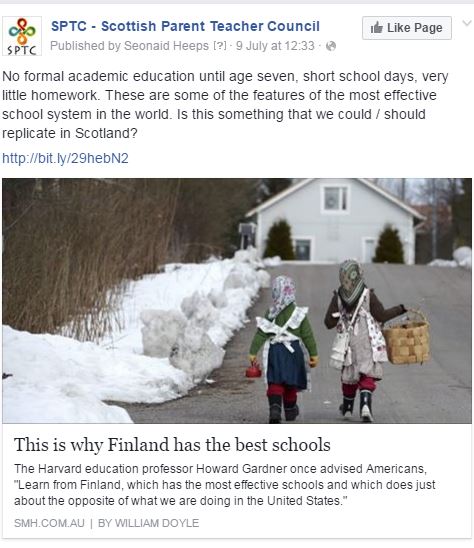
You may remember an article we shared on Twitter and Facebook a few weeks ago about schools in Finland: http://bit.ly/29hebN2

In fact, in the most recent review by the Organisation for Economic Co-Operation and Development (OECD), the three most successful nations in terms of academic results were Finland, Estonia and Switzerland. One thing all three have in common? They all have a play-based kindergarten stage for three to seven year-old children.

Such a radical change in how children are educated may seem intimidating, especially if at first glance it seems to postpone academic development. In actuality, the evidence seems to indicate that there is no educational advantage to an early start. Many studies have shown that children who are taught literacy skills from the age of five don’t do any better in the long run than those who start at seven – performance evens out by the time they reach age ten.
Additionally, some research studies have actually linked an early start in formal education and early pressure for academic achievement to social, emotional and mental health problems as children develop into their teens and adulthood.

People often think of play and work or school as being completely different things, but they are really one and the same. Play combines physical and active learning and if it is properly guided, it can help children develop all the skills they will need to be lifelong learners. Music, art, drama, stories, songs and rhymes develop young children’s listening, language, memory and thinking skills, all needed for good literacy.  


Active, creative play develops the problem-solving skills and understanding of concepts and 
ideas needed for maths and science.

Our next Parent’s Voice survey is going to be about Upstart – we want to know what our members know about Upstart and how they feel about its ideas. In the meantime while the survey is being developed, here is some more in depth information about Upstart and the arguments around it:


How Good Is Our Early Learning and Childcare? – Draft QIs Consultation⤴

from

IMG_20150129_140554

Effective self-evaluation is the cornerstone of how we effect improvement in learning. There is a great deal of experience in the Early Learning and Childcare (ELCC) sector in using the Quality Indicators (QIs) in Child at the Centre to bring about those improvements. However, since its publication in 2007, there have been a number of significant developments in Scottish education. It is important therefore, that tools to support self-evaluation and self-improvement in ELCC reflect the most up-to-date thinking about how young children best develop and learn.

So, the suite of QIs for the Early Learning and Childcare sector is under review.

The new suite of indictors to be called, How Good Is Our Early Learning and Childcare? (HGIOELCC) will be published in May/June 2016; and, will mirror the framework of the recently published How Good Is Our School? (4th edition).

Over the past few months, the Children and Families team at Education Scotland has been working with stakeholders to produce a first draft of QIs.

So what happens now?

We’ve created a special section on our website for you to view a set of draft QIs and to make comment via Survey Monkey.

The first round of drafts includes:
1.2 Leadership of Learning
2.2 Curriculum
3.2 Securing Children’s Progress

The set of QIs can also be viewed inside Glow Early Learn. We are keen to hear your views via Glow using #hgioelcc.

Of course, Child at the Centre (2007), still has relevance, providing support to early learning and childcare (ELCC) settings and primary schools to look inwards, to scrutinise their work and evaluate what is working well for learners and to decide what could be better.

Make sure you don’t miss out on this opportunity to have your say about how well the new suite of QIs is shaping-up.

Bookbug – it’s time for you to have your say!⤴

from

Scottish Book Trust would like to know what professionals think about the Bookbug programme. To do this, our friends at Scottish Book Trust have designed an online survey for you to complete.

BookBugBedtimeCMYK

The Bookbug programme is currently being evaluated by researchers from the Centre for Research on Families and Relationships, based at the University of Edinburgh. The evaluation is investigating what difference Bookbug makes to parents, children and early years professionals. As part of this evaluation Scottish Boko Trust has developed an online survey for professionals whose work supports the delivery of Bookbug bags or Bookbug sessions.

Bookbug Session

The survey will provide for Scottish Book Trust an overview of professionals’ views and experiences of the Bookbug Programme. In addition, findings from the survey will be used to help identify areas for further exploration in four case study areas for evaluation in 2016.

The survey will take between 20-25 minutes to complete, depending on the level of detail that you provide. Scottish Book Trust is really keen to hear your views, so just give as much detail and information as you can in the time you have available.

To thank you for your participation, Scottish Book Trust is giving one lucky participant chosen at random a bundle of books worth £100 .

Bookbug professionals 2

It is really important that we all do our bit to ensure that programmes such as Bookbug are developed to meet the needs of the children, families and staff across Scotland. Please take some time to complete the survey and make sure you send the this link on to colleagues in your organisation and/or locality who have contact with Bookbug.

https://edinburgh.onlinesurveys.ac.uk/bookbug-evaluation

The closing date for the survey is Friday 27th November 2015.

Don’t miss out!