Tag Archives: open

Hitting the wall and maybe working out how to get back up again⤴

from @ education

I’ve collapsed. Mentally a bit, but more so physically. After many months of work stress, family grief, and poor health I’ve hit a wall. Thanks to a wicked combination of oestrogen and anemia I’ve piled on weight and am currently swollen up like a balloon … Continue reading Hitting the wall and maybe working out how to get back up again

Digital transformation and why it can’t be done without learning technologists⤴

from @ education

A tweet by Brian Lamb today reminded me of a blog post that's been gestating for a while and that I really ought to try get out of my head, if only for my own sanity. Trigger Warning: It might be about digital transformation, which … Continue reading Digital transformation and why it can’t be done without learning technologists

A Culture of Sharing: Strategic Support for OER at the University of Edinburgh⤴

from

Many thanks to P-8 Digital Skills Project “Strengthening Digital Skills in Teaching”, ETH Zürich and ZHAW for inviting me to speak at their OER Conference 21. Slides and transcript of my talk, which highlights the work of Wikimedian in Residence, Ewan McAndrew, GeoScience Outreach students and Open Content Curation Interns, are available here.

Before we get started I just want to quickly recap what we mean when we talk about open education and OER.

The principles of open education were outlined in the 2008 Cape Town Declaration, one of the first initiatives to lay the foundations of the “emerging open education movement”. The Declaration advocates that everyone should have the freedom to use, customize, and redistribute educational resources without constraint, in order to nourish the kind of participatory culture of learning, sharing and cooperation that rapidly changing knowledge societies need.  The Cape Town Declaration is still an influential document that was updated on its 10th anniversary as Capetown +10, and I can highly recommend having a look at this if you want a broad overview of the principles of open education.

There are numerous definitions and interpretations of Open Education, some of which you can explore here.

One description of the open education movement that I particularly like is from the not for profit organization  OER Commons…

“The worldwide OER movement is rooted in the human right to access high-quality education. The Open Education Movement is not just about cost savings and easy access to openly licensed content; it’s about participation and co-creation.”

Though Open Education can encompass many different things, open educational resources, or OER, are central to any understanding of this domain.

UNESCO define open educational resources as

“teaching, learning and research materials in any medium, digital or otherwise, that reside in the public domain or have been released under an open license that permits no-cost access, use, adaptation and redistribution by others with no or limited restrictions.”

And you’ll see that this definition encompasses a very wide class of resources, pretty much anything that can be used in the context of teaching and learning, as long as it is in the public domain or has been released under an open licence.

This definition is taken from the UNESCO Recommendation on OER, which aims to facilitate international cooperation to support the creation, use and adaptation of inclusive and quality OER.  The Recommendation states that

“in building inclusive Knowledge Societies, Open Educational Resources (OER) can support quality education that is equitable, inclusive, open and participatory as well as enhancing academic freedom and professional autonomy of teachers by widening the scope of materials available for teaching and learning.”

Central to the Recommendation, is the acknowledgement of the role that OER can play in achieving the 2030 Agenda for Sustainable Development and particularly Sustainable Development Goal 4: to ensure inclusive and equitable quality education and promote lifelong learning opportunities for all. 

OER at the University of Edinburgh

Here at the University of Edinburgh, we believe that open education and the creation of open knowledge and open educational resources, are fully in keeping with our institutional vision, purpose and values, to discover knowledge and make the world a better place, while ensuring that our teaching and research is diverse, inclusive, accessible to all and relevant to society.  The University’s vision for OER is very much the brain child of Dr Melissa Highton, Assistant Principal Online Learning and Director of Learning and Teaching Web Services. Our student union were also instrumental in encouraging the University to support OER, and we continue to see student engagement and co-creation as being fundamental aspects of open education. This commitment to OER is more important now than ever, at a time of crisis and social change, when we are emerging from a global pandemic that has disrupted education for millions, and we’re embracing new models and approaches to teaching and learning.  

OER Policy

In order to support open education and the creation and use of OER, the University has an Open Educational Resources Policy, which was first approved by our Education Committee in 2016 and reviewed and updated earlier this year.  Our new policy has adopted the UNESCO definition of OER, and the update also brings the policy in line with our Lecture Recording and Virtual Classroom Policies. The policy itself has been shared under open licence and is available to download along with several of our other teaching and learning policies.

As one of the few universities in the UK with a formal OER policy, this new policy strengthens Edinburgh’s position as a leader in open education and reiterates our commitment to openness and achieving the aims of the United Nations Sustainable Development Goals, which the University is committed to through the SDG Accord. 

It’s important to be aware that our OER Policy is informative and permissive. It doesn’t tell colleagues what they must do, instead its aim is to encourage staff and students to engage with open education and to make informed decisions about using, creating and publishing OERs to enhance the quality of the student experience, expand provision of learning opportunities, and enrich our shared knowledge commons. Investing in OER and open licensing also helps to improve the sustainability and longevity of our educational resources, while encouraging colleagues to reuse and repurpose existing open materials expands the pool of teaching and learning resources and helps to diversify the curriculum. 

OER Service

In order to support our OER Policy we have a central OER Service, based in Information Services Group, that provides staff and students with advice and guidance on creating and using OER and engaging with open education. The service runs a programme of digital skills workshops and events focused on copyright literacy, open licencing, OER and playful engagement.  We offer support directly to Schools and Colleges, work closely with the University’s Wikimedian in Residence, and employ student interns in a range of different roles, including Open Content Curation interns.  The OER Service also places openness at the centre of the university’s strategic learning technology initiatives including lecture recording, academic blogging, VLE foundations, MOOCs and distance learning at scale, in order to build sustainability and minimise the risk of copyright debt.

And we also manage Open.Ed a one stop shop that provides access to open educational resources produced by staff and students across the university. We don’t have is a single central OER Repository as we know from experience that they are often unsustainable, and it can be difficult to encourage engagement.  Instead, our policy recommends that OERs are shared in an appropriate repository or public-access website in order to maximise their discovery and use by others. The OER Service provides access to many channels for this purpose on both University and commercial services, and we aggregate a show case of Edinburgh’s OERs on the Open.Ed website.

We don’t have is a formal peer review system for open educational resources.  The review process that different materials will undergo will depend on the nature of the resources themselves. So for example we trust our academic staff to maintain the quality of their own teaching materials. Resources created for MOOCs in collaboration with our Online Course Production Service, will be reviewed by teams of academic experts. OERs created by students in the course of curriculum assignments will be formally assessed by their tutors and peers.  And if these resources are shared in public repositories such as our GeoScience Outreach OERs, which I’ll come on to say more about later, they may also undergo a second review process by our Open Content Curation Interns to ensure all third-party content is copyright cleared and no rights are being breached.  While open content shared on Wikipedia is open to review by hundreds Wiki admins, thousands of fellow editors, and millions of Wikipedia users.

OER in the Curriculum

As a result of this strategic commitment to OER, we have a wide range of open education practices going on across the University, but what I want to focus on today are some examples of integrating open education into the curriculum, through co-creation and OER assignments.

 Engaging with OER creation through curriculum assignments can help to develop a wide range of core disciplinary competencies and transferable attributes including digital and information literacy skills, writing as public outreach, collaborative working, information synthesis, copyright literacy, critical thinking, source evaluation and data science.

Wikimedia in the Curriculum

One way that colleagues and students have been engaging with open education is by contributing to Wikipedia, the world’s biggest open educational resource and the gateway through which millions of people seek access to knowledge.  The information on Wikipedia reaches far beyond the encyclopaedia itself, by populating other media and influencing Google search returns. Information that is right or wrong or missing on Wikipedia affects the whole internet and the information we consume. Sharing knowledge openly, globally and transparently has never been more important in building understanding, whether about the Covid pandemic, the Black Lives Matter movement, or other critical issues. And the need for a neutral platform where you can gain access to knowledge online for free has never been more vital in this era of hybrid teaching, remote working, and home schooling.

Working together with the University’s Wikimedian in Residence, Ewan McAndrew, a number of colleagues from schools and colleges across the University have integrated Wikipedia and Wikidata editing assignments into their courses.  Editing Wikipedia provides valuable opportunities for students to develop their digital research and communication skills, and enables them to contribute to the creation and dissemination of open knowledge. Writing articles that will be publicly accessible and live on after the end of their assignment has proved to be highly motivating for students, and provides an incentive for them to think more deeply about their research. It encourages them to ensure they are synthesising all the reliable information available, and to think about how they can communicate their scholarship to a general audience. Students can see that their contribution will benefit the huge audience that consults Wikipedia, plugging gaps in coverage, and bringing to light hidden histories, significant figures, and important concepts and ideas. This makes for a valuable and inspiring teaching and learning experience, that enhances the digital literacy, research and communication skills of both staff and students.

Here’s Dr Glaire Andersen, from Edinburgh College of Art, talking about a Wikipedia assignment that focused on improving articles on Islamic art, science and the occult.

“In a year that brought pervasive systemic injustices into stark relief, our experiment in applying our knowledge outside the classroom gave us a sense that we were creating something positive, something that mattered.

As one student commented, “Really love the Wikipedia project. It feels like my knowledge is actually making a difference in the wider world, if in a small way.”  

Other examples include Global Health Challenges Postgraduate students who collaborate to evaluate short stub Wikipedia articles related to natural or manmade disasters, such as the 2020 Assam floods, and research the topic to improve each article’s coverage.

History students came together to re-examine the legacy of Scotland’s involvement in the TransAtlantic Slave Trade and look at the sources being used in evaluating the contributions of key figures like Henry Dundas but also balancing this against and presenting a more positive view of Black History by creating new pages such as Jesse Ewing Glasgow.

And Reproductive Biology Honours students work in groups to publish new articles on reproductive biomedical terms. Being able to write with a lay audience in mind has been shown to be incredibly useful in science communication and other subjects like the study of law.

And I want to pause for a moment here to let one of our former Reproductive Biology students to speak for herself. This is Senior Honours student Aine Kavanagh talking to our Wikimedian Ewan about her experience of writing a Wikipeda article as part of a classroom assignment in Reproductive Biology in 2016.

And the article that Aine wrote on high-grade serous carcinoma, one of the most common and deadly forms of ovarian cancer, which includes 60 references, and diagrams created by Aine herself, has now been viewed over 130,000 times. It’s hard to imagine another piece of undergraduate coursework having this kind of global impact.

Last year, in collaboration with Wikimedia UK, the UK chapter of the Wikimedia Foundation, our Wikimedian co-authored the first ever booklet dedicated to UK case studies of Wikimedia in Education which you can download under open licence here.   Also many of the resources Ewan has created during his residency, including editing guides and inspiring student testimonies, are freely and openly available and you can explore them here.

Open Education and Co-creation – GeoScience Outreach

Another important benefit of open education is that it helps to facilitate the co-creation of knowledge and understanding.  Co-creation can be described as student led collaborative initiatives, often developed in partnership with teachers or other bodies outwith the institution, that lead to the development of shared outputs.  A key feature of co-creation is that is must be based on equal partnerships between teachers and students and “relationships that foster respect, reciprocity, and shared responsibility.”

One successful example of open education and co-creation in the curriculum is the Geosciences Outreach Course.  This optional project-based course for final year Honours and taught Masters students, has been running for a number of years and attracts students from a range of degree programmes including Geology, Ecological and Environmental Sciences, Geophysics, Geography, Archaeology and Physics.   Over the course of two semesters, students design and undertake an outreach project that communicates some element of their field.  Students have an opportunity to work with a wide range of clients including schools, museums, outdoor centres, science centres, and community groups, to design and deliver resources for STEM engagement. These resources can include classroom teaching materials, websites, community events, presentations, and materials for museums and visitor centres. Students may work on project ideas suggested by the client, but they are also encouraged to develop their own ideas. Project work is led independently by the student and supervised and mentored by the course team and the client.

 This approach delivers significant benefits not just to students and staff, but also to the clients and the University.  Students have the opportunity to work in new and challenging environments, acquiring a range of transferable skills that enhance their employability.  Staff and postgraduate tutors benefit from disseminating and communicating their work to wider audiences, adding value to their teaching and funded research programmes, supporting knowledge exchange and wider dissemination of scientific research.  The client gains a product that can be reused and redeveloped, and knowledge and understanding of a wide range of scientific topics is disseminated to learners, schools and the general public. The University benefits by embedding community engagement in the curriculum, promoting collaboration and interdisciplinarity, and forging relationships with clients.

The Geosciences Outreach course has proved to be hugely popular with both students and clients.  The course has received widespread recognition and a significant number of schools and other universities are exploring how they might adopt the model.

A key element of the Course is to develop resources with a legacy that can be reused by other communities and organisations. Open Content Curation student Interns employed by the University’s OER Service repurpose these materials to create open educational resources which are then shared online through Open.Ed and TES where they can be found and reused by other school teachers and learners.  These OERs, co-created by our students, have been downloaded over 69,000 times.

Here’s Physics graduate and one of this year’s Open Content Curation Interns, Amy Cook, talking about her experience of creating open education resources as part of the Geoscience Outreach course.


We’re hugely proud of the high-quality open education resources created and shared by our GeoScience students and Open Content Curation Interns, so we were delighted when this collection won the Open Curation Award as part of this year’s OEGlobal Awards for Excellence.

Conclusion

These are just some examples of the way that open education and OER have been integrated into the curriculum here at the University of Edinburgh, and I hope they demonstrate how valuable co-creating open knowledge and open educational resources through curriculum assignments can be to develop essential digital skills, core competencies and transferable attributes.  There are many more examples I could share including academic blogging assignments, open resource lists, student created open journals, open textbooks, and playful approaches to developing information and copyright literacy skills.  Hopefully this will provide you with some inspiration to start thinking about how you can integrate engagement with OER in your own courses, curricula and professional practice. 

Not retreating⤴

from @ education

Last week we held our first Office of the Deputy Provost all day retreat. My office contains the Office of the Registrar, Learner Support Services, and the Centre for Learning Accreditation (at the moment, it will expand, more on that another time). We had games, … Continue reading Not retreating

OERxDomains21 – All Change⤴

from

OER21 BadgeThe OER Conference is always one of the highlights of the year for me. I’ve been privileged to attend every single one since conference launched in 2010 and it’s been interesting to see how the event has changed as open education has evolved over the last 11 years. My keynote at the 2018 conference focused on this evolution and explored how themes and trends around open education had developed, and the OER conferences had responded by become more diverse, inclusive, and international. This year the OER conference entered a new phase of its evolution with a new partnership and a new technology platform. OER21 was run in conjunction with the Domains Conference as OERxDomains21 and, instead of Blackboard Collaborate, the event used Streamyard, YouTube and Discord. The event was brilliantly co-chaired by Joe Wilson, Louise Drumm, Lou Mycroft, Jim Goom and Lauren Hanks.
I have to confess I didn’t know quite what to expect as the conference approached, for the first time in years, I wasn’t able to join the conference committee owing to other work commitments. Streamyard was completely new to me, and although I’m very familiar with Discord I was a bit conflicted about using it for work purposes, as it’s one of my main non-work channels; basically, it’s where I hang out with my friends on group chat.  In the event, the technology worked brilliantly, with unflappable support from ALT and the Reclaim Hosting team.   Proving the adage that a change is as good as a rest, the new platform encouraged all kinds of opportunities for discussion and interaction and lots of participants commented that the event had much more of a social feel than other online conferences. Discord really did have the feel of a physical conference space, where everyone came together to chat, share and hang out, and the live Youtube comment facility that accompanied the presentations and keynotes really helped to encourage discussion.  My only small regret is that with so much of the engagement happening across multiple conference platforms, there was less activity on the hashtags on twitter, which makes it a little harder to look back over all the discussions that took place.

It’s not the technology that makes the OER Conference such a special experience though, it’s the community, and this year was no exception.  I was really delighted to be attending with three student interns, Ana Reina Garcia, Ifeanyichukwu Ezinmadu and Kari Ding, to present a paper on our Open Textbooks for Access to Music Education project.  Our presentation got a really positive response and it was great to see how enthusiastically everyone responded to the students’ involvement in both the project and the conference.  You can find a transcript and slides, as well as more information about the project, on our blog here The Scale of Open: Re-purposing open resources for music education.

I also helped to facilitate an Open Space session with Jane Secker, Chris Morrison, Greg Walters and Sarah Barkala exploring the relationship between open practices, copyright literacy and the shift to online teaching. The Open Space sessions ran in dedicated Discord channels, and although the platform is ideal for group chat, participants were a little shy about taking the mic, and without an in-channel chat facility, it meant that there was less discussion than we’d hoped.  However we did collate some useful resources on a padlet around four key questions related to copyright law, literacy and open practice.

I had to dip in and out of the conference owing to a bit of a crazy workload and a lot of meetings, sadly that’s not something that even the best conference organisation can solve, however the new platform did make it very easy for me to catch up with sessions that I’d missed, which I really appreciated.  I made a point of catching as many of the keynotes as possible, and came away truly inspired. Three themes that emerged strongly across the conference were playfulness and creativity, equity and care, and acknowledging the labour of openness.

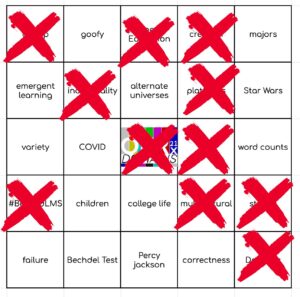
OER21 bingo cardCreativity and playfulness was very much to the fore in Laura Gibbs keynote #BeyondLMS: Open Creativity, Randomized which focused on the transformative power of encouraging creative writing on the open web.  Not only did Laura randomise her keynote slides she also let participants create randomised bingo cards so we could play along during her keynote.  Believe it or not, I was the first to get bingo! Though of course it’s the taking part that counts, not the winning 😉

Another of the creative highlights of the conference was Eamon Costello and Prajakta Grime’s mind expanding University V is alive! Now open to the closed, the cruel and the dead.  More of an incantation than a presentation, this incredible multimedia experience left participants challenged and bewildered. I missed the live performance but there was such a buzz about it on Discord that I dropped everything to jump over to youtube to watch the recording. 

A powerful ethic of care has been nurtured by the OER conferences year on year and it’s been humbling and inspiring to see seeds planted at previous conferences take root and grow.  Jasmine Robert’s keynote asked Open for Whom?: Revisiting the Global Commitments of Open Education and posed three key questions:

Jasmine reminded us that open is not always culturally appropriate in different cultural contexts and questioned the ease with which we assign authority to white men, while urging us to acknowledge and protect vulnerable scholars and people of colour who are doing the hard work of open scholarship. She closed her keynote by quoting bell hooks

“All the great social movements for freedom & justice in our society have promoted a love ethic. The testimony of love is the practice of freedom.”

And asking for “open education that is focused on a love ethic to move towards a path of global healing.”

In the Q&A session afterwards I asked Jasmine how we can work to ensure that the labour of care and social justice labour is fully acknowledged and more equally distributed?  She replied that we must begin by acknowledging how much we *all* benefit from social justice labour and care.

In the closing keynote, Rajiv Jhangiani also focused on the Curious Contradictions and Open-ended Questions of what it means to be open, who gets to decide what is open enough, and whether openness is always a good thing.  Rajiv cited an example highlighted by tara robertson of an instance where openness raised troubling ethical issues.  When the lesbian porn magazine On Our Backs was digitised and released under CC BY licence, women who had modelled for the magazine felt that work they had created for their own community had been appropriated for uses they had never intended and did not consent to. 

As someone who is passionate about knowledge activism and the representation of queer history in open culture, this really gave me pause for thought, particularly as I recently created a Wikipedia entry for another lesbian porn magazine Quim, which was co-created by a former On Our Backs photo editor.

Rajiv reminded us that:

“Openness can be leveraged for justice, but it can also do harm. Closed practices can also do harm, but there are times when closed is the empowered choice. Choice is key. We must serve justice, rather than merely being open.”

Another point Rajiv made that raised interesting questions for me was that “the OER Community is one where people are more comfortable to be vulnerable.”  This is certainly true, and I speak from experience, though of course we all have different relationships with that community and I wonder if we don’t always appreciate just how deeply uncomfortable vulnerability can make us feel, even within such a supportive community.  This had struck me during an earlier conference session where participants were asked so share, as part of a series of small groups discussions, stories of instances where care or equity had been lacking, and record them on slides to be shared with the larger group.  While sharing stories of this nature in a small group can be cathartic and empowering, it can be difficult and potentially risky for some to share examples from personal practice in public.  The exercise raised some interesting issues of power and inequity, points that the presenters acknowledged.  

For me, as is so often the case, it was Catherine Cronin who really captured the ethic of care that resonated at the heart of the conference by reminding us that

“Care without equity exacerbates inequality”.

To close I want to say a huge thank you to the teams at ALT and Reclaim hosting, the conference co-chairs and committee, and all the participants who made OER21 such a fun, engaging, thought provoking and empowering event.  And special thanks, as always, to Maren Deepwell who really embodies ALT’s commitment to community, care, equity and openness ♡

The Biodiversity Heritage Library & Bird Bingo⤴

from @ wwwd – John's World Wide Wall Display

Somewhere or other1 I Saw a link to v.2 (1799) – The Naturalist’s Pocket Magazine or compleat cabinet of the curiosities and beauties of nature. Intriguing enough which lead me to discover the Biodiversity Heritage Library:

The Biodiversity Heritage Library (BHL) is the world’s largest open access digital library for biodiversity literature and archives. BHL is revolutionizing global research by providing free, worldwide access to knowledge about life on Earth.

About BHL – Information about the Biodiversity Heritage Library

There seems to be a vast collection of biological books that are free to read and download. There is also a twitter account, @BioDivLibrar and an amazing Flickr account: Biodiversity Heritage Library where there are over a quarter of a million images, many public domain. They have also contributed

over 2 million BHL images have been uploaded to the IA Book Images Flickr stream as part of the Art of Life project. These images are identified and uploaded in bulk using an algorithm. They offer a great opportunity for serendipitous discovery via browsing.

from: About Biodiversity Heritage Library | Flickr.

The Library are asking for people to help tag their flickr images and this might be a good activity for secondary pupils?

Bird Bingo


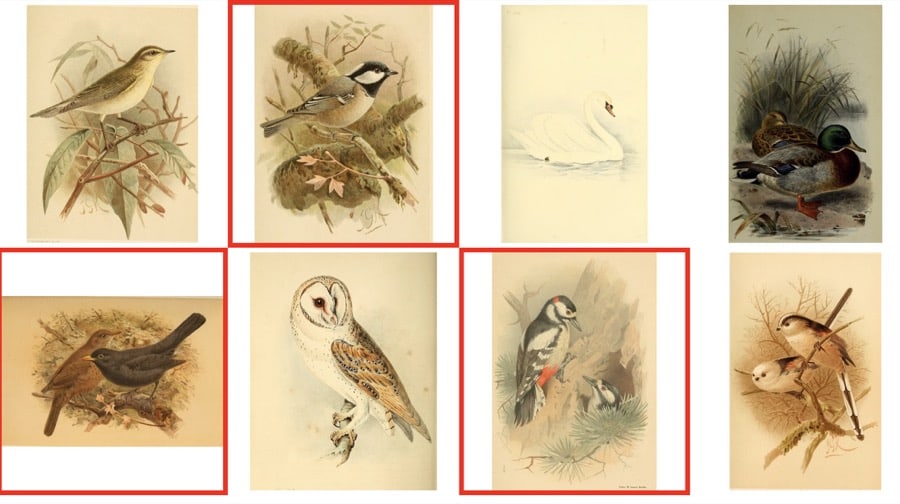
As a primary teacher, once I’d stopped just raking through some beautiful images I knocked up a quick Bird Bingo game for my class to help with bird identification. It has random cards and a caller.

There is page after page of beautiful pictures in the photo stream I defy anyone to leave it quickly. Example page 2094!

Featured Image: n456_w1150 | Natural history of the animal kingdom for the u… | Flickr public domain.

1. I don’t like not being able to attribute where I found this amazing resource.↩

Care is a sustainability practice⤴

from @ education

I haven't written a lot about my new role and just what exactly I've been getting up to over the last year, mostly because it has seemed so trivial compared to all of us trying to get through this bloody pandemic. However, it's been over … Continue reading Care is a sustainability practice

Open Practice in Practice⤴

from

Last week I had the pleasure of running a workshop on open practice with Catherine Cronin as part of City University of London’s online MSc in Digital Literacies and Open Practice, run by the fabulous Jane Secker.  Both Catherine and I have run guest webinars for this course for the last two years, so this year we decided collaborate and run a session together.  Catherine has had a huge influence on shaping my own open practice so it was really great to have an opportunity to work together.  We decided from the outset that we wanted to practice what we preach so we designed a session that would give participants plenty of opportunity to interact with us and with each other, and to choose the topics the workshop focused on. 

We began with a couple of definitions open practice, emphasising that there is no one hard and fast definition and that open practice is highly contextual and continually negotiated and we then asked participants to suggest what open practice meant to them by writing on a shared slide.  We went on to highlight some examples of open responses to the COVID-19 pandemic, including the UNESCO Call for Joint Action to support learning and knowledge sharing through open educational resources, Creative Commons Open COVID Pledge, Helen Beetham and ALT’s Open COVID Pledge for Education and the University of Edinburgh’s COVID-19 Critical Care MOOC. 

We then gave participants an opportunity to choose what they wanted us to focus on from a list of four topics: 

  1. OEP to Build Community – which included the examples of Femedtech and Equity Unbound.
  2. Open Pedagogy –  including All Aboard Digital Skills in HE, the National Forum Open Licensing Toolkit, Open Pedagogy Notebook, and University of Windsor Tool Parade. 
  3. Open Practice for Authentic Assessment – covering Wikimedia in Education and Open Assessment Practices.
  4. Open Practice and Policy – with examples of open policies for learning and teaching from the University of Edinburgh. 

For the last quarter of the workshop we divided participants into small groups and invited them to discuss

  • What OEP are you developing and learning most about right now?
  • What OEP would you like to develop further?

Before coming back together to feedback and share their discussions. 

Finally, to draw the workshop to a close, Catherine ended with a quote from Rebecca Solnit, which means a lot to both of us, and which was particularly significant for the day we ran the workshop, 3rd November, the day of the US elections.

Rebecca Solnit quote

Slides from the workshop are available under open licence for anyone to reuse and a recording of our session is also available:  Watch recording | View slides.

Open Policy for Learning and Teaching⤴

from

This post also appears on the Open.Ed blog. 

Earlier in September, my colleague Neil McCormick, Education Technology Policy Officer at LTW, and I took part in Jane Secker and Chris Morrison’s regular ALT webinar Copyright, Fair Dealing and Online Teaching at a Time of Crisis on the topic of lecture recording and virtual classroom policies.  This is an area of policy that is particularly pressing for many institutions right now as they manage the transition to hybrid and online teaching.  It’s also a live issue for staff who are faced with the prospect of recording not only their lectures but also their seminars and small group teaching sessions as well, in order to ensure that different cohorts of students on campus and online, have equitable access to their classes. 

At the University of Edinburgh we already have a Lecture Recording Policy that was approved in 2018 following extensive consultation with academic colleagues, legal services and the unions.  Much of this policy has been replicated in a new Virtual Classroom Policy that was approved earlier in September.  Neil is the policy officer responsible for drafting both policies, a responsibility he has undertaken with notable patience and diligence.  The OER Service’s contribution has been to provide some input around copyright and open licensing, and this was one of the topics under discussion during the webinar.

Neil explained that the approach taken by both the Lecture Recording and Virtual Classroom policy is that everyone involved in the recording retains their rights, while the recording is licensed for specific purposes that are clearly defined by the policies.  In the case of lecture recordings and virtual classroom recordings, the recording is shared with “students and staff on the instance of the course to which the lecture relates”. Students may use the recording only for personal study and schools may “use recordings in exceptional situations to provide continuity as specified within business continuity plans relevant to the School”.

The University also has an Open Educational Resources Policy, approved in early 2016, which encourages staff and students to use, create, and publish OERs to enhance the quality of the student experience, enhance the provision of learning opportunities for all, and improve teaching practices.   In supporting this policy, the OER Service encourages colleagues and students to share all kinds of teaching and learning resources under open licence.  You can see a showcase of some of these resources here on the Open.Ed website.  We also  have over 3,500 Creative Commons licensed videos on Media Hopper Create and a large number of open licensed blogs on Blogs.Ed.

During the webinar, Chris raised a question that has come up a number of times before, about the tension that exists between lecture and classroom recording policies and openness:

“particularly in the case of teachers who are expected to record what they do in what is typically a closed private space and the idea of openness and sharing, and things going wherever they go on the internet without being able to control them.”

In terms of the Edinburgh policies it’s important to note that none of the three policies mandate the use of open licences.  The OER Policy is informative and permissive, it encourages the use of open licences, it does not mandate them.  The Lecture Recording and Virtual Classroom Policies are normative policies, which do permit lecturers to share their recordings under open licence but only if they have the appropriate permissions from all parties to do so.

“A lecturer may publish a recording of their lecture as an open educational resource, with appropriate modifications and safeguards, including an appropriate attribution, licence and having obtained any permissions required from other participants or third parties whose intellectual property resides within the recording. Guidance on this is contained within the Open Educational Resources Policy and Website Accessibility Policy.”

The important point here is that colleagues always have a choice as to whether they share their content under open licence, and if they do choose to share that content then they are required to respect the rights of all relevant parties, whether that is other colleagues, students or third party copyright holders, and to provide appropriate attribution as necessary.  Choice and attribution are both fundamental aspects of open education and open educational resource creation.

In order to ensure that colleagues are in a position to understand the rights of all parties involved in recorded content the OER Service provides a range of resources and workshops focused on copyright literacy and understanding licences.  When lecture recording was rolled out across the University, one of the first workshops launched as part of a comprehensive digital skills programme was Lecture Recording – Licensing, Media Use and OER. Resources from these training sessions are available to reuse under open licence.

With rights come responsibilities and the University has also recently launched a comprehensive set of Digital Safety and Citizenship resources curated by Digital Safety Support Officer Dr Vicki Madden.  These resources include a Digital Citizenship Guide which is designed to be read alongside the University’s Virtual Classroom Policy.  In addition, Neil has developed a set of slides covering etiquette, identity and recording, designed for use in virtual classroom sessions.

In keeping with the University’s commitment to OER and open knowledge, all three policies, together with the Digital Citizenship Guide and slides, are available under open licence for other institutions to adapt and reuse: Open Policy for Learning and Teaching.

I’d like to thank Jane and Chris for inviting us to take part in their webinar, a recording which is available here: Copyright, Fair Dealing and Online Teaching at a Time of Crisis: Lecture recording and virtual classroom policies.

I do not like this new normal (please be nice to others)⤴

from @ education

I've seen a number of news articles over the last few weeks about the start of term in various Universities. Many of them share a common theme - IT services suffering under load on the first day of teaching. They also share the same sorts … Continue reading I do not like this new normal (please be nice to others)