Tag Archives: oer

Transcending the digital and physical at #altc22 – the #femedtechquilt⤴

from

It’s always tricky to try and summarize a conference experience in one post, so this post like so many other of my past conference posts is not going to try to do that. Instead I want to take a few minutes to share what was for me the most important part of #altc22 – the #femedtechquilt.

The #alt22 conference was my first “proper” f2f conference since lock down. I was simultaneously excited and a bit anxious about it. All the preparation, traveling and packing which seemed so mundane in the “before times” took much longer. However being back in person with some of my favourite people was well worth it.

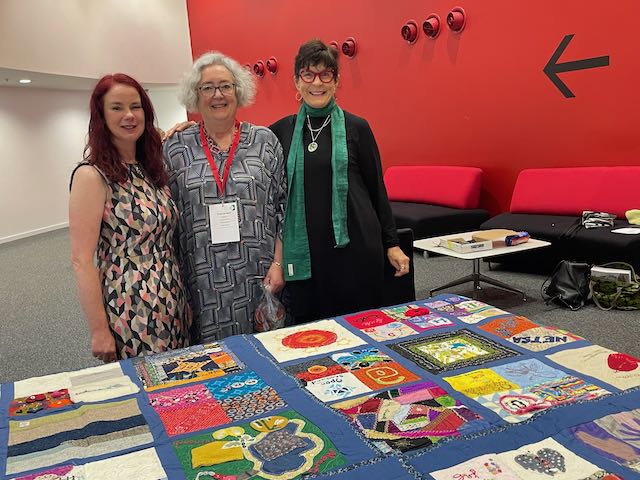
What added to the #joy and sense of place and community was undoubtedly the first public outing and joining of the #femedtechquilt. You can find our more about the origins for the quilt here, it did seem to me (and others) that the more that 2 year wait to see it IRL brought even more resonance and power to the underlying principles of the quilt and its physical presence.

The quilt represents so many people, so many issues. Of course the quilt is a community created object, but its driving force has been Frances Bell, who has spent so much time planning, co-ordinating, stitching, quilting and writing about the quilt.

Frances situated the quilt outside the main lecture theatre used in the conference. It was at once a grounding and centering force. Arousing curiosity, attracting attention, allowing participation, creating conversations and ideas for the future. In quite a magical way, the presence of the quilt provided a way to bind many of us together by providing a safe, open, space to have long overdue catch ups, to share experiences and allow time for reflection and just “being”.

It was wonderful to see Frances explain the history of the quilt to those who didn’t know about it, to help those who had contributed to it find their square, and support and encourage people to make a contribution to squares to be added to the quilt. One priceless moment for me was when Marion Manton (who had organised a quilting circle to contribute squares to the quilt as well as supply lots of fabric for quilting) saw the quilt for the first time. A wave of unrequited joy washed over everyone nearby.

I felt hugely privileged to be able to help drape the completed quilt for delegates to see. I didn’t contribute to the quilt. I had planned to, but at that point in 2019 I had a creative crisis and wasn’t able to do anything remotely creative. However I have promoted and shared what I can about it. And now, I have also sewn a button onto a square!

On the final day of the conference I really missed the physical presence of the quilt. However, I know this first outing of the quilt won’t be its last. So I just wanted to thank everyone who contributed to the quilt, it really is a symbol of hope, of justice and the power of openness.

And of course congratulations to the ALT team, the Trustees, the conference committee and all the presenters and delegates for bringing #ALTC so successfully back to its physical space as well as supporting its digital spaces.

Photo  3 people beside part of the quilt on a table
Lorna Campbell, Frances Bell and Catherine Cronin with the quilt

My Liminal Podcast: Open for good!⤴

from

Earlier in the summer, way back at the end of June, I had the very great pleasure of joining Puiyin Wong on her fabulous My Liminal Podcast. We had a really engaging and wide ranging discussion covering open education, OER, digital labour, knowledge equity, Wikimedia in the classroom, and perhaps most importantly, cats!  You can listen to Puiyin’s My Liminal Podcast on anchor.fm and Spotify, and follow on twitter at @MyLiminalPod.

Procurement aka the crack in everything that lets the bullshit in⤴

from @ education

I've been thinking and writing and talking a lot about edtech procurement recently. In fact I've been thinking and writing and talking about it for years but it feels like in this moment it might just be getting a little more traction. It might of … Continue reading Procurement aka the crack in everything that lets the bullshit in

Adventures in Hybrid Conferencing⤴

from

I’ve been to three hybrid conferences over the course of the last few months so I thought it might be interesting to write a bit of a reflection on my experience of being both a delegate and a speaker at these events, what worked, what didn’t, and what I learned in the process. 

OER22 Conference

The first event was the OER22 Conference run by ALT at the end of April. This conference marked a return to in-person events for ALT for the first time since the pandemic started, and I know that there was some understandable anxiety about bringing people together for a face-to-face event. The conference ran for three days; kicking off with a day of in-person talks and parallel sessions in London, followed by a day of recorded online talks, and finally a day of live online parallel sessions. About 80 people attended the in-person day of the conference, with around twice that number taking part online.  ALT have a wealth of experience when it comes to running both in-person and online conferences and, despite having a very small staff team, their events invariably run like clockwork.  As expected, ALT handled the logistics of bringing people back together with real sensitivity and empathy, with plenty of space at the venue so that people never felt crowded, and plenty of time in the programme for people to network and socialise.

For the online component of the conference ALT used the same suite of technologies that they’ve used for several previous online events, which includes Streamyard, YouTube and  Discord, all of which worked well. The programme was easily accessible and simple to navigate, and it was possible to move between sessions if you wanted to catch presentations that were taking place in parallel. I did have a bit of trouble getting into my own online presentation session, due to some technical weirdness, but ALT dealt with the hitch smoothly, and it didn’t detract from my experience as a presenter.  A Discord server provided a social space where delegates could share slides and resources, and meet and chat informally throughout the conference.  There was also a dedicated channel for help and support. I confess I was not enthusiastic when ALT first started using Discord as part of their online conference platform, primarily because it’s a channel I use a lot outside work, however I have to admit that it works really well and it really adds to the online conference experience.  I’ve written a longer reflection on the OER22 here: OER22 In Person & Online.

University of Edinburgh Learning & Teaching Conference

Like OER22, the University of Edinburgh’s internal Learning & Teaching Conference ran as a hybrid event after having run online for two years during the pandemic.  The first day of the event took place in the magnificent McEwan Hall and surrounding buildings, and consisted of an exhibition space, posters, keynotes and parallel sessions. The second and third days took place online and consisted of parallel tracks of online talks.  I don’t know how many people attended the conference but I’d guess maybe 60 – 80 people were present for the in-person day of the event.  The content of the conference was excellent, all the sessions I attended online and in person were really thoughtful and thought provoking.  The exhibition space in particular provided a great opportunity for colleagues to network and socialise after so long apart, and I appreciated that the breaks were long enough not to feel rushed.  

The conference platform was based on Eventscase and Zoom and this is where some problems crept in.  The platform could be accessed via the web, but we were also asked to download an app and a QR code to join the conference.  Normally I avoid loading work apps onto my personal devices, so I wasn’t mad keen on having to do this, however as it turned out, I didn’t need to use either the app or the QR code after downloading them. Navigating the programme on Eventscase was tricky; the schedule was available as a web page and in a calendar view, which also allowed delegates to book on to specific sessions.  However because the calendar view only showed sessions that had to be booked, you had to go back to the webpage to find information about keynotes and plenaries, so there was a bit of confusion about what was happening where and when during the first day.  Also while I appreciate the reasons for encouraging delegates to book onto online sessions, it didn’t seem to be possible to change sessions, to listen to different presentations running in parallel, even when there were still places available, which was more than a little frustrating.  Presenters had to book on to their own sessions in order to be able to present, but getting into the sessions wasn’t always straightforward, and in some cases session chairs had to e-mail speakers Zoom links instead.   The session chairs were unfailingly helpful though, as were all the conference helpers who directed delegates around the campus on the first day of the event. Although I really enjoyed the conference the Eventscase platform did feel unnecessarily complicated and at times seemed to be more of a hindrance than a help. 

ALT Scotland Annual Conference

The ALT Scotland Annual Conference was a much smaller event, which provided a really interesting opportunity to experiment with a different kind of hybrid conference; one where some participants attended online and some attended in-person simultaneously.  The event, which ran for one day, was hosted by City of Glasgow College, and brought together learning technologists and policy makers from across all sectors of Scottish education.  Again, I’m not sure exactly how many people attended, but I’d estimate there were c.20 people attending in person and perhaps the same number again online. The conference took place on the day of a national rail strike which meant that quite a lot of folk who had planned to attend in person, had to join online instead. The event was facilitated using Thinglink, Zoom, and a double screen and camera set up that had been donated to the college by a vendor whose name I didn’t catch. We had one person chairing the event in the room and another coordinating Zoom online.  The screens at the front of the room showed Zoom but unfortunately it was difficult to see the online discussion from where I was sitting.  Several of the attendees in the room also joined Zoom from their laptops so they could participate in the online chat with colleagues who were attending remotely.  Unfortunately I couldn’t get on to Eduroam so I wasn’t able to join the online interaction, and it did rather feel like I was missing out.  Several of the presenters joined remotely via Zoom which worked well for participants both online and in person.  I gave a short talk in-person, which was a bit of an odd experience.  Standing at the front of the room facing the camera meant that the screens were behind me, so I couldn’t help feeling like I’d turned my back on the online participants.  This also meant that I couldn’t see the Zoom chat which meant that some of the remote participants felt as though their questions were being ignored.  When I finished speaking, the camera stayed locked on to me and followed me all the way back to my seat, which was a little disconcerting! 

As a group of learning technologists, the conference gave us an excellent opportunity to experiment with the kind of technologies that might be used to facilitate hybrid teaching and learning, and we had a really interesting discussion at the end of the day about the pros, cons and practicalities of running hybrid events like this.  I think we all agreed that it’s not easy, and we need a lot more practice to figure out what works and what doesn’t. Joe Wilson, who chaired the event in-person commented that it would have been impossible to coordinate everything, online and in-person, without the help of Louise Jones who was managing Zoom.  Sheila MacNeill has written an interesting blog post about the ALT Scotland Conference, which includes some reflection on a questionable “attention tracking” feature of the conferencing system, which I hasten to add we didn’t experiment with during the event.

Reflection

In terms of my takeaways from these three quite different hybrid events I’d say that running conferences that have in-person and online components on different days is a good way to ensure that an event is accessible to as many people as possible.  I did really appreciate being able to get together with colleagues in person, and I wouldn’t want to lose that again, however there are many advantages to having an online component too.  Online events are generally more accessible, convenient, they reduce the necessity to travel and as a result they’re better for the environment.

In terms of the technology, simple is better. It’s often more convenient to have the conference programme available on a simple web page rather than in an interactive calendar that takes multiple clicks to navigate. Also requiring delegates to download apps onto their personal devices is not a good idea for numerous reasons. 

When it comes to running events online and in-person simultaneously, we still have a lot to learn. As is so often the case, it’s not necessarily the technology that trips us up, it’s the human interactions that really make a difference, and clearly we still need a lot of practice to ensure that simultaneous events provide an equitable experience for everyone involved. 

Edtech is killing us: Random notes on a Neil Selwyn talk about edtech and climate crisis⤴

from @ education

Thanks to a blog post yesterday by George Veletsianos I was alerted to a recent talk Neil Selwyn gave to my friends at the Centre for Research in Digital Education at Edinburgh, titled "Studying digital education in a times of climate crisis: what can we … Continue reading Edtech is killing us: Random notes on a Neil Selwyn talk about edtech and climate crisis

Open for Good – New brochures from the OER and Online Course Production Services⤴

from

I’m very excited that the OER Service has a new brochure to celebrate 5 years of support for open education at the University of Edinburgh. Writing the text and gathering the images for this brochure has taken up a lot of my time over the last couple of months and I’m really pleased with the way at turned out, thanks to the fabulous design skills of Nicky Greenhorn from Information Services Group’s Graphic Design Service.

Open for Good: OER at the University of Edinburgh tells the story of five years of support for OER and open knowledge at the University of Edinburgh.  The brochure includes information about our award-winning open policies, our outreach activities, and our commitment to the United Nations Sustainable Development Goals.  It also features case studies of student engagement and OER in the curriculum from across the University, along with a timeline of significant open education developments and events.

We worked alongside our Online Course Production Service, who also produced their own brochure: 

Short Online Courses unpacks our open course development process from a learning design perspective, covering our commitment to accessibility, continuing professional development, and learner-centred approaches to online learning. The brochure highlights our partnerships with Coursera, EdX and Futurelearn, and provides access to a wealth of online courses, and free resources, including open course production templates and Creative Commons licensed media.

Both brochures showcase open licensed images from the University’s unique archives and collections, and feature forewords by Dr Melissa Highton, Assistant Principal and Director of Learning, Teaching and Web Services, along with testimonials from our staff and students. 

We’re planning to make online versions of both brochures available to browse and download shortly.  If you would like printed copies in the meantime, please e-mail open.ed@ed.ac.uk or course-production-team@ed.ac.uk.

Hitting the wall and maybe working out how to get back up again⤴

from @ education

I’ve collapsed. Mentally a bit, but more so physically. After many months of work stress, family grief, and poor health I’ve hit a wall. Thanks to a wicked combination of oestrogen and anemia I’ve piled on weight and am currently swollen up like a balloon … Continue reading Hitting the wall and maybe working out how to get back up again

Digital transformation and why it can’t be done without learning technologists⤴

from @ education

A tweet by Brian Lamb today reminded me of a blog post that's been gestating for a while and that I really ought to try get out of my head, if only for my own sanity. Trigger Warning: It might be about digital transformation, which … Continue reading Digital transformation and why it can’t be done without learning technologists

OER22 In Person & Online⤴

from

Last week I was at the OER22 Conference, and I was actually at the conference because for the first time in two years the OER Conference was in person and online.  OER22 was a hybrid conference in every sense of the word; the first day took place in London, the second day featured recorded online presentations, and the final day was live sessions online.  The event was organised seamlessly by ALT and chaired by the GO-GN Network.  The opening day of the conference in London was the first opportunity many of the OER community had to get together in person since the OER19 Conference in Galway, so it was understandably an emotional experience and a little overwhelming.  ALT handled the logistics of bringing people back together with real sensitivity and empathy, with plenty of space at the venue so that people never felt crowded, and plenty of time in the programme for people to network and socialise. 

Sketch of a cartoon penguin in blue pen against a white and blue backgroundBryan Mathers opened the conference with a thoughtful and humorous illustrated talk that gave us all a much needed opportunity to ease our way back into in-person conferencing.  It culminated with everyone drawing their own version of the GO-GN penguin and sharing them in the fabulous Visual Thinkery ReMixer.  Bryan set the tone for the conference perfectly and I think the little drawing exercise helped everyone overcome any residual anxiety they may have had about participating in an in person event.  Everyone said my penguin looked scary, but honestly he’s just a bit shy. 

The themes of the conference were; Pedagogy in a time of crisis – what does an ‘open’ response look like? Open textbooks: making the most of their potential; Open in Action: open teaching, educational practices and resources; and Open research around any aspect of open education. 

I took part in two panels, the first with Jane Secker, Catherine Cronin, Leo Havemann and Julie Voce focused on the approaches adopted by our various institutions and projects to support and develop open educational practices. These include teaching a module on open practices as part of a Masters in Academic Practice, creating open education and copyright literacy policies that signify institutional commitment to open practices, modelling open approaches in sharing our own teaching and learning resources, and advocacy work with organisations at a local, national and international level, to promote better understanding of open practice and copyright literacy.  I spoke about how the University of Edinburgh’s OER Policy, supported by the OER Service, enabled and encouraged open practice across the institution, and the importance of supporting digital skills development around copyright literacy.  Slides from the panel are available here: Open in Action. 

Image by Jane Secker on Twitter.

I was also invited to take part in a plenary panel discussion on open textbooks along with Gary Elliot-Cirigottis (Open University), Dhara Snowden (UCL Press), and Jane Secker (City University London), chaired by Beck Pitt (Open University) who was previously involved in the UK Open Textbooks project. Our institutions all had very different experiences of supporting and engaging with the use and creation of open textbooks so it made for an interesting and wide ranging discussion, covering how open resources enabled institutions to respond to the COVID-19 pandemic, the impact of the pandemic on the cost of resources, the role of open textbooks and our vision for OER in UK HEIs.  A recording of the plenary panel will be available shortly.

Image by Josie Fraser on Twitter.

I also attended a couple of other interesting sessions on open textbooks including Catrina Hey talking about the University of Sussex’s Open Press which is based on Pressbooks and informed by NUI Galway’s Open Press and the Jisc’s New University Press Toolkit.  I also really enjoyed hearing about the Open Pedagogy Project Roadmap: A Resource for Planning and Sustaining Open Educational Practices at Penn State University from Bryan McGeary and Christina Riehman-Murphy.  Their examples of student co-created open textbooks (e.g. Open Anthology of Earlier American Literature.) were really inspiring and gave me some ideas for initiatives we could explore at the University of Edinburgh.  

Other highlights for me included Javiera Atenas talking about the importance of professional conversation as a fundamental aspect of open practice during her presentation about creative project design for open education practitioners.  Slides from this session are available here: Creative Project Design.   There was also some really lively and thought provoking discussion around what open technology platforms do with your data during Javiera and Leo’s session on Co-creating a framework for platform governance in open education – policy, data ethics and data protection.  Leo and Javiera made the point that it isn’t enough for platforms, technologies and textbooks to be free, they must also resist surveillance and other forms of intrusion. Josie Fraser raised a pertinent counter point that this has to be balanced against benefit, noting that some school children had no contact with their teachers at all during the pandemic as some schools adopted an overly cautious approach to online conferencing platforms due to fears over how they store and use data.  

On the last day of the conference, I gave an online presentation on our Open eTextbooks for Access to Music Education project.  Along with our student interns, we gave a talk about the early stages of this project last year at OER21, so this year I was back to reflect on the project outputs and what we learned along the way.  Unusually, we had all kinds of technical gremlins during the session, which Maren dealt with in her own calm and professional manner.  We got there in the end and I was really touched with the positive comments on this student co-creation project. Slides and transcript of this talk are available on our project blog. 

Sadly I had to miss a lot of day 2 and 3 of the conference due to juggling meetings and other work commitments, but I did enjoy catching up with discussions and resources on the conference Discord, and I’m looking forward to dipping in to the recorded sessions.

One final reflection more generally…Given that one of themes of OER22 was open textbooks, it was perhaps understandable that over the course of the conference the term OER was often used to refer specifically to open textbooks. I still had to do a bit of mental adjustment as I tend to think of OER as being a much wider class of thing, with open textbooks being just one form of open educational resources among many.  While I’m really exited about the possibility of open textbooks taking off in the UK, particularly if they are co-created and founded on open practice, I am a little concerned that we might lose sight of the broader understanding of OER.  Over the last few months I’ve seen a few think pieces and comments about the crisis in etextbook costs, which suggest that there has been little adoption of OER in the UK.  While it’s true that there has been less adoption of open textbooks by academic libraries in the UK than in the US, (though this is changing rapidly), there has of course been considerable engagement with open education resources and practices supported by learning technologists across the sector.  With more and more institutions launching open presses and libraries exploring the affordances of open textbooks, I hope they’ll work together with learning technologists, open education practitioners, and academic colleagues who have a wealth of experience of supporting and engaging with open education resources and practices of all kinds. Otherwise we may run the risk of recreating OER repositories the wheel. 

Being among the OER community again, among good friends and colleagues, was a much needed breath of fresh air.  It really made me appreciate the hope that co-chairs Catherine Cronin and Laura Czerniewicz left us with at the end of OER19 in Galway, and how much it sustained us through the last two years. 

Open Education and OER in the Curriculum⤴

from

Principles of Open Education and OER 

This blog post was originally posted on the University of Edinburgh’s Curriculum Transformation Hub.

The principles of open education were initially outlined in the 2008 Cape Town Declaration [1], which advocates that everyone should have the freedom to use, customize, and redistribute educational resources without constraint, to nourish the kind of participatory culture of learning, sharing and cooperation that rapidly changing knowledge societies need. 

Broadly speaking, open education encompasses teaching techniques and academic practices that draw on open technologies, pedagogical approaches and open educational resources (OER) to facilitate collaborative and flexible learning. This may involve both teachers and learners engaging in the co-creation of learning experiences, participating in online peer communities, using, creating and sharing open educational resources (OER) and open knowledge, sharing experiences and professional practice, and engaging with interdisciplinarity and open scholarship. 

Although open education can encompass many different approaches, open educational resources, or OER, are central to this domain. The UNESCO Recommendation on OER [2] defines open educational resources as 

 “teaching, learning and research materials in any medium, digital or otherwise, that reside in the public domain or have been released under an open license that permits no-cost access, use, adaptation and redistribution by others with no or limited restrictions.” 

Open Education and OER at the University of Edinburgh 

At the University of Edinburgh, we believe that open education and OER, are fully in keeping with our institutional vision, purpose and values, to discover knowledge and make the world a better place, while ensuring that our teaching and research is diverse, inclusive, accessible to all and relevant to society.   In line with the UNESCO Recommendation on OER, we also believe that OER and open knowledge are critical to achieving the aims of the United Nations Sustainable Development Goals [3].   

To support open education and the creation and use of OER, the University has an Open Educational Resources Policy [4], approved by our Learning and Teaching Committee, which encourages staff and students to use, create and publish OERs to enhance the quality of the student experience, expand provision of learning opportunities, and enrich our shared knowledge commons.  We also have a central OER Service [5], based in Information Services Group, that provides staff and students with advice and guidance on creating and using OER, engaging with open education and developing digital and copyright literacy skills.  Understanding authorship, copyright, and licensing is increasingly important at a time when both staff and students are actively engaged in co-creating digital resources and open knowledge.    

Benefits and Risks of Openness  

Open education approaches, such as collaborative flexible learning and co-creation of learning experiences, can be beneficial in many different contexts, but they are particularly well suited to hybrid teaching and learning, where no separation is made between digital and on campus student cohorts, and students are brought together by the way teaching is designed, enabling them to move between digital and classroom-based learning activities. 

Engaging with open education, OER and open knowledge through curriculum assignments can help to develop a wide range of core disciplinary competencies and transferable attributes including: 

  • Digital, data and copyright literacy skills, 
  • Understanding how knowledge and information is created shared and contested online, 
  • Collaborative working and collective knowledge creation, 
  • Information synthesis, 
  • Critical thinking and source evaluation, 
  • Writing as public outreach.  

However, it’s also important to consider the risks of openness, as any understanding of openness is highly personal, contextualised and continually negotiated. We all experience openness from different perspectives, depending on different intersecting factors of power, privilege, inclusion and exclusion.  

In his 5Rs for Open Pedagogy [6] Rajiv Jhangiani identifies Risk as being one of his values for Open Pedagogy. 

“Open pedagogy involves vulnerabilities and risks that are not distributed evenly and that should not be ignored or glossed over. These risks are substantially higher for women, students and scholars of colour, precarious faculty, and many other groups and voices that are marginalized by the academy.” 

Many systemic barriers and structural inequalities exist in open spaces and communities; open does not necessarily mean accessible to all.  When engaging with open education, we need to be aware of our own privilege and be sensitive to those who may experience openness differently, and we need to address the systemic barriers and structural inequalities that may prevent others from engaging with open education and to enable everyone to participate equitably, and on their own terms. 

The University has an invaluable Digital Safety and Citizenship Web Hub [7], that offers comprehensive information and resources on a range of digital safety and citizenship-related issues, including training and events, and advice on being an informed digital citizen.   

If we’re sensitive to these risks and inequities and work to mitigate them, integrating open education and OER into the curriculum can bring significant benefits, including building networks, relationships and communities, fostering agency and empowerment, developing strong societal values and an appreciation of equity, intersectionality and social justice. 

Open Education in the Curriculum 

Wikimedia in the Curriculum 

One way to engage with open education and the creation of open knowledge is by contributing to Wikipedia, the world’s biggest open educational resource and the gateway through which millions of people seek access to knowledge.  Working together with the University’s Wikimedian in Residence, Ewan McAndrew, colleagues from a number of schools and colleges have integrated Wikipedia and Wikidata editing assignments into their courses.  Editing Wikipedia provides valuable opportunities for students to develop their digital research and communication skills, and enables them to contribute to the creation and dissemination of open knowledge. Writing articles that will be publicly accessible and live on after the end of their assignment has proved to be highly motivating for students, and provides an incentive for them to think more deeply about their research. It encourages them to ensure they are synthesising all the reliable information available, and to think about how they can communicate their scholarship to a general audience. Students can see that their contribution will benefit the huge audience that consults Wikipedia, plugging gaps in coverage, and bringing to light hidden histories, significant figures, and important concepts and ideas. This makes for a valuable and inspiring teaching and learning experience, that enhances the digital literacy, research and communication skills of both staff and students. 

Talking about a Wikipedia assignment that focused on improving articles on Islamic art, science and the occult, Dr Glaire Andersen, from Edinburgh College of Art commented 

“In a year that brought pervasive systemic injustices into stark relief, our experiment in applying our knowledge outside the classroom gave us a sense that we were creating something positive, something that mattered. As one student commented, “Really love the Wikipedia project. It feels like my knowledge is actually making a difference in the wider world, if in a small way.”   

Other examples include Global Health Challenges postgraduates collaborating to improve Wikipedia articles on natural or manmade disasters. History students re-examining the legacy of Scotland’s involvement in the transatlantic slave trade and presenting a more positive view of black British history. Digital Education Masters students collaborating to publish a new entry on Information Literacies. And Reproductive Biology Honours students work in groups to publish new articles on reproductive biomedical terms. 

Wikimedia in the Classroom assignment, Aine Kavanagh, Reproductive Biology, by Ewan McAndrew, Wikimedian in Residence, University of Edinburgh, CC BY SA.

Our Wikimedian in Residence provides a free central service to all staff and students across the University, further information including testimonies from staff and students who have taken part in Wikimedia in the Curriculum assignments is available here: Wikimedian in Residence. 

Open Education and Co-creation – GeoScience Outreach 

Another important benefit of open education is that it helps to facilitate the co-creation of knowledge and understanding.  Co-creation can be described as student led collaborative initiatives, often developed in partnership with teachers or other bodies outwith the institution, that lead to the development of shared outputs.  A key feature of co-creation is that is must be based on equal partnerships between teachers and students and “relationships that foster respect, reciprocity, and shared responsibility”[8]. 

One successful example of open education and co-creation in the curriculum is the Geosciences Outreach Course, which provides students with an opportunity to work with a wide range of clients including schools, museums, outdoor centres, and community groups, to design and deliver resources for STEM engagement. Students may work on project ideas suggested by the client, but they are also encouraged to develop their own ideas.  This provides students with the opportunity to work in new and challenging environments, acquiring a range of transferable skills that enhance their employability. They gain experience of science outreach, public engagement, teaching and learning, and knowledge transfer while at the same time developing communication, project and time management skills.  

A key element of the course is to develop resources with a legacy that can be reused by other communities and organisations. Open Content Curation student Interns employed by the University’s OER Service repurpose these materials to create open educational resources aligned to the Scottish Curriculum for Excellence, which are shared online through Open.Ed and TES Resources [9] where they can be found and reused by school teachers and learners.  These OERs, co-created by our students, have been downloaded over 58,000 times and the collection was recently awarded Open Education Global’s Open Curation Award [10].  

Open Education Awards for Excellence: Open Curation / Repository – University of Edinburgh by Stephanie (Charlie) Farley, CC BY SA. 

OER Assignments – Digital Futures for Learning 

OER creation assignments are also incorporated into the Digital Futures for Learning module, part of the MSc in Digital Education, where students create open resource that critically evaluate the implications of educational trends, such as the future of writing, complexity in education, and radical digital literacy.  Creating genuinely open resources that are usable and reusable requires careful attention to issues such as accessibility, structure, audience, and licensing. The students need to critically consider and apply their learning, and in doing so are able to create practical re-usable resources, while demonstrating a range of transferable skills and competencies.  

Commenting on this OER creation assignment, course leader Dr Jen Ross said 

“Experiencing first-hand what it means to engage in open educational practice gives student an appetite to learn and think more.  The creation of OERs provides a platform for students to share their learning. In this way, these assignments can have ongoing, tangible value for students and for the people who encounter their work.” [11] 

Reusing and Repurposing OER 

Reusing and customising existing open educational resources can help to diversify and expand the pool of teaching and learning resources available to staff and students. 

LGBT+ Resources for Medical Education 

In 2016 undergraduate medical students developed a suite of resources covering lesbian, gay, bisexual and transsexual health. Although knowledge of LGBT+ health and of the sensitivities needed to treat LGBT patients are valuable skills for qualifying doctors, these issues are not well-covered in the medical curricula. This project remixed and repurposed resources originally created by Case Western Reserve University, and then contributed them back to the commons as OER. New open resources including digital stories recorded from patient interviews and resources for Secondary School children, were also created and released as OER. In a recent blog post on Teaching Matters [12], Dr. Jeni Harden, Senior Lecturer in Social Science and Health, reflected on how these resources have contributed to the medicine curriculum over the past five years. 

Fundamentals of Music Theory 

Fundamentals of Music Theory [13] is an open textbook co-created by staff and students from the Reid School of Music with support from the University’s OER Service.  This Student Experience Grant funded collaborative project [14] repurposed existing open licensed MOOC content and blended-learning course materials to co-create a proof-of-concept open textbook. The project enabled our student partners to develop digital and copyright literacy skills, an understanding of OER and open textbooks, familiarity with ebook applications, and experience of working with educational media and content. Their input enhanced the original teaching materials and brought about further teaching and learning enhancement. Open textbooks have the potential to benefit universities in the post-pandemic world by reducing textbook costs, benefit staff by providing access to easily customisable open textbooks, and benefit students by providing free, high quality digital learning materials. Furthermore, open textbooks and OER have the potential to facilitate the democratic reshaping of teaching materials through student engagement and co-creation. 

Further Information  

These are just some examples of ways that open education and OER have already been integrated into the curriculum here at the University of Edinburgh.  They demonstrate how valuable co-creating open knowledge and open educational resources through curriculum assignments can be to help students develop essential digital skills, core competencies and transferable attributes, and enable our learners to become fully engaged digital citizens. 

For further information about open education and OER please visit the University’s OER Service at Open.Ed or e-mail us at open.ed@ed.ac.uk.  

References 

  1. Capetown Open Education Declaration https://www.capetowndeclaration.org/read/
  2. UNESCO, (2019), Recommendation on Open Educational Resources, http://portal.unesco.org/en/ev.php-URL_ID=49556&URL_DO=DO_TOPIC&URL_SECTION=201.html
  3. United Nations Sustainable Development Goals https://sdgs.un.org/goals
  4. University of Edinburgh Open Educational Resources Policy, https://www.ed.ac.uk/files/atoms/files/openeducationalresourcespolicy.pdf
  5. OER Service, https://open.ed.ac.uk/
  6. Jhangiani, R, (2019), 5Rs for Open Pedagogy, Rajiv Jhangiani, Ph.D. Blog, https://thatpsychprof.com/5rs-for-open-pedagogy/
  7. Digital Safety and Citizenship Web Hub, https://www.ed.ac.uk/information-services/help-consultancy/is-skills/digital-safety-and-citizenship
  8. Lubicz-Nawrocka, T., (2019), An introduction to student and staff co-creation of the curriculum, Teaching Matters Blog, https://www.teaching-matters-blog.ed.ac.uk/an-introduction-to-student-and-staff-co-creation-of-the-curriculum/
  9. University of Edinburgh Open.Ed Hub, TES Resources, https://www.tes.com/teaching-resources/shop/OpenEd
  10. OE Awards for Excellence https://awards.oeglobal.org/awards/2021/open-curation/open-ed-collection-of-geoscience-outreach-oers-and-more-on-tes/
  11. Ross, J., (2019), Digital Futures for Learning: An OER assignment, Open.Ed Blog, https://open.ed.ac.uk/digital-futures-for-learning-an-oer-assignment/
  12. Farley, S. and Harden, J., (2021), Five years on: The LGBT+ Healthcare 101 OER, Teaching Matters Blog, https://www.teaching-matters-blog.ed.ac.uk/five-years-on-the-lgbt-healthcare-101-oer/
  13. Edwards, M., Kitchen, J., Moran, N., Moir, Z., and Worth, R., (2021), Fundamentals of Music Theory, Edinburgh Diamond, DOI: https://doi.org/10.2218/ED.9781912669226
  14. Open eTextbooks for Access to Music Education Project, https://blogs.ed.ac.uk/opentextbooks/