Tag Archives: Remix

Reflection on an ongoing collaboration⤴

from

OEGlobal Postcard

“Postcards on Pedagogy” flickr photo by NomadWarMachine shared under a Creative Commons (BY-NC-SA) license

It’s a couple of weeks into the UW/UofG collaboration, and I thought I’d take a few minutes to reflect on my experiences so far.

It started out very low-key for me. Mum died on 10th October 2024 (I still can’t type that without having to pause to wipe my eyes). So when the collaboration ‘officially’ began at the beginning of November, I knew that my participation would be interrupted by my need to travel 470 miles south to attend her funeral in early November, and all of the emotional upheaval that would entail. But I thoroughly enjoyed meeting my group (Debs, Alka and Mary) over Zoom and coming up with an asynchronous activity for us all to add to before meeting again on the 18th. On my return from England, after pushing through the mountain of work that had accumulated in my absence, I enjoyed a brief hiatus that I allowed myself in which write. Sending a quick email to Debs, Alka and Mary on Tuesday evening (my time) resulted in three lovely replies in my inbox on Wed morning – that really gave me a boost, and I have found a little more time to plan my next contribution to the collaboration.

I also found time to catch up with a project initiated by Carole, who is sending out prompts asking people to respond with a digital postcard. Carole had sent a card around to the group with a picture of her typical classroom. I have had neither classrooms nor students for years now, so I responded with a postcard remix from the amazing Bryan Mather’s remixer. However, this did get me thinking about my own learning environment, and an idea for my next remix.

Both of these activities have helped me to reflect on what I was hoping to gain from this collaboration, and what I was enjoying. I think that one thing that I have realised from my online communities is to enter experiences like this without rigid expectations, but with high hopes. I hoped to meet good people, to have interesting conversations, to participate in ways that I had not anticipated, and without rigid rules (no facilitators telling me that I am doing it wrong).  And I always hope for the opportunity to play with remix.

Well, so far I’ve not been disappointed, and I’m looking forward to the rest of the month.
N+ Sonnet⤴

from

Today’s Daily Create asks us to share a poem in celebration of National Poetry Day, with this year’s theme being counting. I chose a Shakespeare Sonnet:

Shall I compare thee to a summer’s day?
Thou art more lovely and more temperate:
Rough winds do shake the darling buds of May,
And summer’s lease hath all too short a date;
Sometime too hot the eye of heaven shines,
And often is his gold complexion dimm’d;
And every fair from fair sometime declines,
By chance or nature’s changing course untrimm’d;
But thy eternal summer shall not fade,
Nor lose possession of that fair thou ow’st;
Nor shall death brag thou wander’st in his shade,
When in eternal lines to time thou grow’st:
   So long as men can breathe or eyes can see,
   So long lives this, and this gives life to thee.

And used a N+ generator to remix it. Here’s the N+8 version:

Shall I competition thee to a summer’s deadline?
Thou artist more lovely and more temperate:
Routine windpipes do shampoo the date buffers of May,
And summer’s lectureship hath all too short a daze;
Sometime too hot the eyepiece of heed shines,
And often is his goner composition dimm’d;
And every falcon from falcon sometime deductions,
By chant or nature’s changing courtyard untrimm’d;
But thy eternal sunbeam shall not fade,
Nor lose postcode of that falcon thou ow’st;
Nor shall debt branch thou wander’st in his shallot,
When in eternal linguists to tin thou grow’st:
So long as mandolins can breathe or eyepieces can see,
So long lives this, and this gives lift to thee.

Stir Up Sunday⤴

from

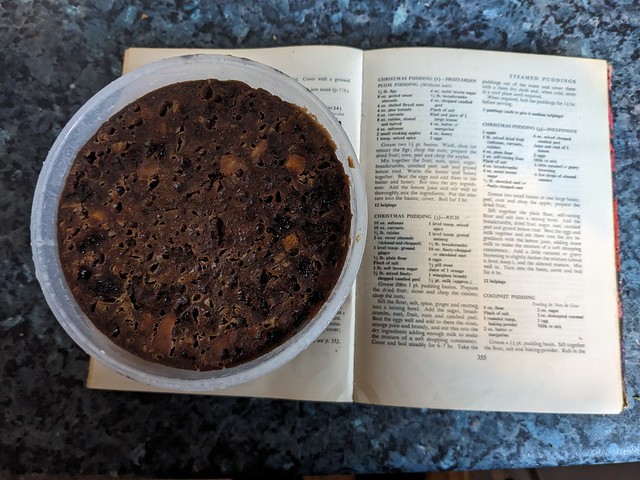
Today is Stir-up Sunday, the day when families gather around stir their homemade Christmas pudding on the last Sunday before advent begins. I made mine yesterday, as it takes seven hours to steam and we take lunch over to my MiL on Sundays. It’s a Mrs Beeton recipe, and fingers crossed it tastes as good as it smells.

Xmas Pudding

“Xmas Pudding” flickr photo by NomadWarMachine shared under a Creative Commons (BY-NC-SA) license

Thinking about charms to put into this for a DS106 pudding. Here’s what I’m adding.

  • A coin for creativity
  • A wishbone for inspiration
  • A thimble for remix
  • A ring for connectivity
  • An anchor for community

Remixometer⤴

from

Today’s Daily Create challenges participants to make a FitBit type device to measure something that would not usually be measured. My suggestion is a remixometer – a way of measuring the amount of originality, ingenuity … whatever property or quality we think we might measure when we look at the various remixes that we see. This is the one that I submitted – the scale left open for the reader to decide (my scale is from ‘copy’ at the red side to ‘remix’ on the green side).

DS106 Remixometer
“DS106 Remixometer” flickr photo by NomadWarMachine shared under a Creative Commons (BY-NC-SA) license

This remixometer is inspired by Austin Kleon’s Steal like an Artist, and when I flicked through that book again to write this post I realised that I was probably basing my remix on something like this

Table from Kleon about good and bad theft
Steal Like an Artist, p39

Which is why an earlier version of my remixometer had these values

Remixometer
“Remixometer” flickr photo by NomadWarMachine shared under a Creative Commons (BY-NC-SA) license

Still a work in progress.

McLuhan’s Tetrad⤴

from

I’m keeping half an eye on #ETMooc2 at the moment, and one of this week’s suggested activities caught my interest.

Activity #1 – Marshall McLuhan Tetrad of Effects for Generative AI: What are the opportunities and challenges presented by the evolution of technologies in the digital age?
View the following video (3:45) for an example of McLuhan’s Tetrad OR search for other examples.
Brainstorm changes that are already occurring or will occur with the use of generative AI in your context. Add ideas to each of the following four quadrants: enhance, obsolete, retrieve, reverse.

Google Doc

I wondered how this might apply to my favourite non-MOOC activity, the Daily Create.

McLuhan's Tetrad
“McLuhan’s Tetrad” flickr photo by NomadWarMachine shared under a Creative Commons (BY-NC-SA) license

The Daily Create amplifies creativity, by encouraging DS106ers to create something every day. It makes copying obsolete, as the ethos is remix, not plagiarism. It retrieves inspiration, with a new prompt every day. There are no unexpected dissatisfactions, just a warning that #DS106 is #4Life

Daily Create 2023⤴

from

Daily Create Leaderboard 1/1/23

I first did a Daily Create on 19th March 2016, and I’ve been doing it daily for years now. As of this morning I have completed 2465 challenges. Sometimes, when I have a bit of spare time, I look back at ones I missed and fill in the gaps. I had hoped to end 2022 with a final tally of 2500, and I came pretty close.

So what will my challenge be for 2023? To do the TDC every day, of course. My ultimate all time goal is to complete every single daily create, but doing an extra 1541 over the next year might be too much of a challenge. But I will keep chipping away!

Happy 2023 all.

Heideggerian Art⤴

from

Language Noths
“Language Noths” flickr photo by NomadWarMachine shared under a Creative Commons (BY-NC-SA) license

Inspired by a Twitter conversion, I added a couple of phases from Heidegger to an AI art generator and this is the result. These are the phrases:

Why are there beings at all, instead of Nothing?

Language remains the master of man. 

Aletheia⤴

from

Queen Margaret Bridge over the Kelvin
“Queen Margaret Bridge over the Kelvin” flickr photo by NomadWarMachine shared under a Creative Commons (BY-NC-SA) license

Aletheia was a Greek Goddess. The word is often translated into English as truth – and Aletheia’s Roman counterpart is called Veritas. However, as Heidegger and others say, truth is really insufficient as a translation. Truth is a noun in Latin, but in Greek aletheia is an activity.  This is not just an exercise in semantics. Heidegger understood the importance of language: it shapes our understanding of our world and constrains what we can say.

Etymologically aletheia means un-forgetting or un-concealing (a- lethe). In Greek mythology the river Lethe was one of the five rivers in Hades, and all those who drank from it forgot everything they knew.  In “The Origin of the Work of Art” Heidegger tells is that art opens up a clearing to disclose meaning – it helps us to un-forget. And further – art is not just a way that we can find out about ourselves and our world – it also creates meanings for us as a community. I might prefer to conceptualise this slightly differently and talk about art as opening up possibilities for different meanings, interpretations or understandings, but the idea is thought provoking.

Wittgenstein makes a similar point in his Tractatus (5.6) when he says that “the limits of my language are the limits of my world” – if we can’t describe something in words then in a very real sense it does not exist for us (I am aware that Wittgenstein would have gone further with this thought at the time than I am doing now).  And further, in a later work:

“A picture held us captive. And we could not get outside it, for it lay in our language and language seemed to repeat it to us inexorably.” Philosophical Investigations, 115

Art helps us to give us the concepts that we need to understand our world in new ways – it reminds us that there is more than one way of looking at things. Aletheia is stronger than just remembering, it is making a conscious effort to act in a certain way – it is an attitude towards the world. I think that this might well describe the demeanour of a bricoleur. Our ‘what if?’ and ‘yes, and?’ attitudes to life help us to open up the world to ourselves in new ways and discover new ways of being in the world.

Start copying⤴

from

mimesis
“mimesis” flickr photo by NomadWarMachine shared under a Creative Commons (BY-NC-SA) license

I think I’ve always been a bricoleur – it’s a family trait. But it’s not without danger. When I read this page by Austin Kleon, I remembered happy times messing around with my brother. We were big fans of seeing how things worked. Watches, clocks – anything that had moving parts. We’d prise them apart and put them back together again. Yet, somehow, there was always a small pile of springs and screws left on the floor afterwards.

And the watches and clocks ended up on Dad’s workbench …