This is a guest blog by Sanum J Khan who you can follow on Twitter at @Sanumjkhan. Sanum is a an Assistant Headteacher and frequently speaks at events and writes articles for the education press on a range of issues, especially diversity, equity and inclusion. She is speaking at the 13th Festival of Education this summer. … Continue reading Nurturing Inclusive CPD Events
The third and final instalment of this series is about EduFest at Institut Le Rosey in Switzerland, which debuted in 2019 and was back in 2022 after a COVID-enforced hiatus. It’s a start-up which has huge potential, bringing together educators from across Europe every two years. From what I saw, it has a bright future. … Continue reading A Summer of Festivals Part III: EduFest Le Rosey
The second day of the Festival of Education saw equal amounts of sunshine and political debate given that Boris (finally) resigned so there was a real buzz about the place. I managed to fit in sessions on classroom practice, social mobility, coaching and the BAMEed strand, so there was no rest for the wicked… Nicholas … Continue reading A Summer of Festivals Part II: Friday at #EducationFest
After moving online during the pandemic, the Festival of Education at Wellington College was back on site and in person for 2022. It also moved date, coming in early July rather than late June, and that had no adverse impact on attendance or interest. With around 400 speakers and over 5,000 attendees over the two … Continue reading A Summer of Festivals Part I: Thursday at #EducationFest
A tribute to my father-in-law, Dr Ansar Skandary. Unusually, this piece is not about my professional life, but my personal life. It was driven by a desire to put something into words for my own children. Unlike my professional blogs it will not be actively advertised or shared, but will just sit here waiting for … Continue reading On sightseeing, and getting lost.
This is the second blog about a visit to Denmark to learn about education and the provision of sport and physical activity. The first blog is about the school system and provides more context for this piece. For the past two years I’ve been investigating the future of sport and physical education. If we’re going … Continue reading The Danish Way of Life 2: Sport and Physical Activity
I’ve just come back from a visit to Denmark, and my intention was to blog about what I learned about the education system there. In fact, it was such a productive visit that I’ve had to divide it into two parts. Here’s the first instalment, and it focuses on the education system and what we might learn from what is a very different approach to the UK.Part 2 is about sport and wellbeing.
The Danish Education System
The first thing to set out is how schools work in Denmark. Education is compulsory from ages 6-16, with pupils doing a pre-school year (Year 0) and then Years 1-9. This is ‘primary’ and ‘lower secondary’ education and there is an option to carry on in Year 10. After primary school things split into different pathways depending on what works best for each student. There are three options:
High school (gymnasium) – three years of upper secondary at a general gymnasium (stx), a business college (htx, or handelsgymnasium) or a technical school (htx, or teknisk gymnasium), which leads to a leaving examination and provides a pathway into university. This path is by far the most common.
A three year pathway of vocational education leading more directly to specific professions.
A two year vocational education leading directly to skilled or unskilled professions.
School leavers are typically 19 years of age and for those of you who are PISA fans, Denmark came 25th out of 79 countries in science in 2018. However, the socio-economic differences in attainment are below average (10% compared to 12% in reading), and economically disadvantaged students are marginally more academically resilient (by 1%). Those stats might not seem world-beating, but the ethos is completely different. Danes sacrifice attainment for egalitarianism. You won’t find Singaporian mass cramming here, but you won’t find so many human beings consigned to perpetual failure either.
A Different Option – the Folk High School Movement
This is where things get really interesting. There is something called the ‘folk school movement’ which was inspired back in 1844 by Nikolaj Grundtvig, and became fully established in the late 19th century. Folk schools were a reaction to the prevailing conservatism of the 1840s, and they are open to adults of all ages. Exams are forbidden, the curriculum is bespoke (schools design them based on need), and the length of time here can vary. Folk high schools are also typically boarding schools. They offer opportunities for non-formal lifelong learning which can provide highly skilled people with new skills, or a chance for those who have struggled to reset their life. In a post-COVID world, this looks incredibly attractive.
Boarding Schools
A key feature of the Danish system, which is common across Scandinavia, is that many parents opt to send their children to boarding schools for one year in Year 10. This is equivalent to S5 in Scotland or Year 12 in England, and gives pupils a social experience which is rooted in life skills. There are no exams in this year, and about one third of all Danish pupils (around 30,000 per year) take this option. It’s subsidised by the state, but parents know that it is coming and will save up for several years in advance to pay the 10,000 euros (approximately) that it will cost. The main objective is to teach young adults about socialisation and living as a community.
Case Study: the Three Schools at Oure
I spent an afternoon with Michael Sørensen, who has worked at Oure for 20 years and is a former pupil. He’s now on the Senior Leadership team and if you want to speak to someone who is passionate about their school and the values they espouse, he’s your man. Oure consists of three schools and they are very much a community. As Michael says, the purpose is to “lift people up”, often when they lack the resources or skills to do so themself.
Oure is a boarding school that specialises in sports and the performing arts and was founded in 1987. It’s on the outskirts of a village about two hours west of Copenhagen. It has three schools: the upper secondary (the Kostgymnasium) for years 10 and up, so ages 16-19; the continuation school (Efterskole – a Danish word that I’m sure should be be Scottish) which offers a formal secondary school education for pupils aged 15-16 to add life skills, additional maturity, and lifelong friendships to the formal part of the education, effectively like an early gap year; and the Folk High School. In total there are around 1050 students and 250 staff. Each school is boarding, and two thirds of the funding for the Kostgymnasium and Efterskole is provided by the state, with the remaining third being paid in fees by parents or students themselves. The Folk High School is entirely state funded. The cost for all education, activities, food and lodgings is about 250 euros per week, so in line with the 10,000 euros p.a. cost outlined above.
The school specialises in performing arts and sport, so has various dance studios, music practice rooms and studios, a swimming pool, sports halls and many outdoor areas for biking, handball, volleyball and football.
Boarding life is organised around small houses, which are mixed gender. In the upper secondary, eight boys will share with eight girls in four rooms. When Oure was founded there was real opposition to co-educational boarding houses, but this has been normalised now. The bedrooms are separated by gender but the toilet and shower facilities are shared. Each year, students have to work for one week in the main school kitchens to develop a work ethic, a respect for the staff, and learn about food waste. Student work about wellbeing, health and nutrition can be seen posted on the walls of the canteen. In the Efterskole, the same principles apply but students are in two bed rooms rather than four. The furnishings are modest – think of a clean, functional youth hostel and you’ve more of less got the picture.
The Folk School currently has an age range of 20-32, and the average age is 22. There is no upper limit – it is open to adults of all ages. At the younger end you have people who still don’t feel they have found their purpose in life and need more time to develop. At the older end, you have people who want to change career or take a break, so need time to think and to learn new skills. The eldest graduate last year was a man who left the army and didn’t know what he wanted to do. Social life here is vibrant – there is a bar/cafe and plenty to do.
Michael is especially passionate about the folk school. “If it hadn’t been invented over a hundred years ago then no one would want to establish it now, because it’s too ambitious and idealistic. Yet all political parties support it and no one would ever criticise it. That would lead to defeat at the next election for any politician.” It is so well established and respected, but it’s worth reflecting on the fact that such a great idea was possible in the 19th century but probably wouldn’t be feasible to start from scratch now.
The site is incredible and has been developed incrementally over time. There are multiple facilities for sport, arts and leisure. The whole place is powered by a wind turbine that is 32 years old – how’s that for being ahead of the curve? Thought has gone into locations of buildings and there is a natural flow. For example, the music school is next to the indoor skateboarding park, causing a lovely cross-fertilisation of ideas and friendships that come from those two social groups mixing outside. The mountain bike park has a huge hill that is man-made, coming from earth that was dug out of the lake – all done by the folk school students. The lake is due to be extended to allow for watersports to be done on site. There is a shop, which was opened by staff when the local village shop closed down. It’s a co-operative where all the proceeds are divided between the students annually to help cover their expenses.
As I visited during the holidays, the campus was being used for summer schools. Interestingly, when parents enrol their children on these they attend as well. The emphasis is on family learning, so I saw a sports hall packed full of parents and their children doing various games. The staff were mainly former pupils who had come back because they love the school and believe in the Danish tradition of non-formal education and volunteering. That’s a big part of the ethos, not just at Oure but across Denmark.
Families taking part in the summer camp
Reflections
There is a lot we can learn here about ethos and values, and about life-long learning. Danish education isn’t talked about in the same lofty terms as Finland or Estonia, but the metrics are different. Emphasis is on equity and allowing people to learn (or relearn) at their own pace. State support for boarding is based on the intrinsic belief in building shared communities, and this is where Denmark does stand out. After all, it’s frequently cited as being one of the happiest places on earth. That might be down to hygge, but it might also be down to the education system.
In a few days’ time, Scotland will play host to COP26. The eyes of the world will be on Glasgow, and the conference has been discussed in terms of being a last chance opportunity to create the change needed for human life on this planet to be sustainable. What is meant by sustainable development needs to be defined clearly, and the best definition I’ve come across goes back to the UNWCED in 1987. It stated that sustainable development was:
“development that meets the needs of the present generation without compromising the ability of future generations to meet their own needs.”
United Nations World Commission on Environment and Development (WCED) OECD iLibrary
This has the beauty of simplicity, and also broadens the definition beyond purely environmental issues. It is also about the economy, political structures, education, culture and society. Whilst I am no expert on climate science, I am comfortable to talk about the role that education has to play in creating a sustainable future. In fact, I would argue that the single most important intervention we can make in the battle for a sustainable future is actually in education. Here’s why.
The Problem of ‘Peak Human’
Peak human is the moment when population growth plateaus. Population growth globally actually hit a high point in the 1960s and has been slowing ever since, but we have yet to reach peak human. There are two key issues here:
The date at which we reach peak human – for this to be sooner is more desirable.
The level at which we reach peak human – we want this to be lower.
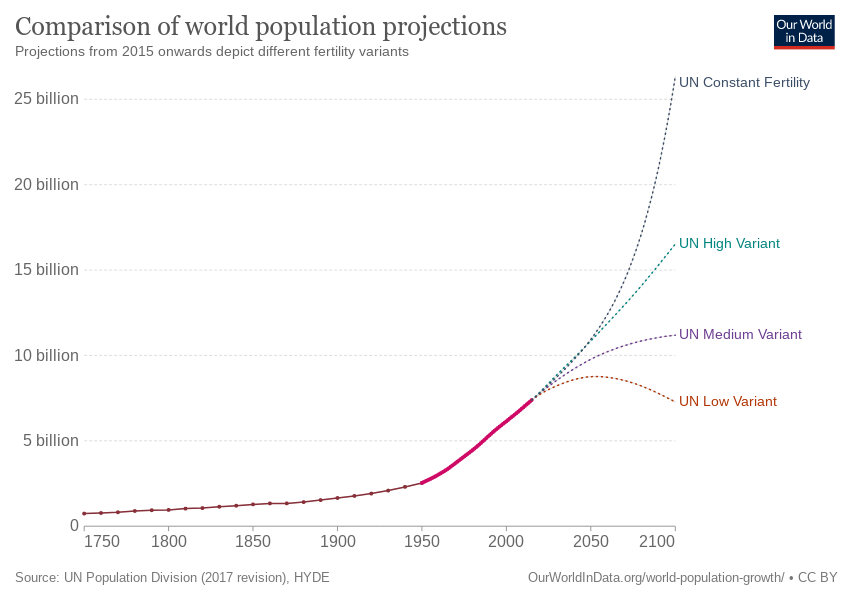
Projections on the date and level vary, as shown by this graph from the UN Population Division.
The high variant shows the global population at over 15 billion people in 2100 and still climbing. The low variant shows peak human coming around the mid-point of the 21st century at around 9 billion and then a gradual decline following. Needless to say, the former projection will exhaust all resources no matter what we do, whereas the latter makes it much more likely that we can find solutions to the problems we currently face. The most recent projection published in the Lancet suggests that the peak will come in 2064 at 9.7bn which is more optimistic than we might previously have thought.
What will make the difference? Educating girls around the world. Where girls have access to secondary (and ideally tertiary) education they are less likely to be forced to marry early and have multiple pregnancies throughout their life. This leads to a natural reduction in population growth and makes the challenge of feeding, housing, and providing energy for the world much more feasible. In this respect, education – and SDG 4 – are of critical importance.
The New York Times Climate Hub – Educate on Climate Programme
I’ve been working with the New York Times, Summerhouse Media and Kite Insight on the Educate on Climate programme at COP26. The NYT has created a Climate Hub which is a brilliant venue (Es Devlin’s ‘Conference of the Trees, the featured image of this post, has to be seen to be believed). We’ve spent the past few months thinking about which issues to tackle. The NYT are looking at various strands so education is just a part of this, but on November 5th we have a programme which tries to explore as many core education issues as possible. Online tickets are still available and are free, with content being recorded and available to view later on.
So what are looking at? Here are the debates that we’ve got lined up:
Forming Partnerships With Schools in the Global South
Creating a Research-Informed Manifesto for Environmental Sustainability in Education
How Schools Can Prepare Their Students for a Changing Climate
The U.N.’s Decade of Education for Sustainable Development: Is It Working?
From Climate Change to Change-Making: Firing Up Youth Activism
Future-Proofing Pupils: Preparing Students for Work in a Changing World
Teaching Critical Thinking in an Age of Misinformation
Reboot the Future: How Do We Move Faster, Together?
Climate Tech Will Be Bigger Than the Internet Revolution
Explore: Urban Nature Teacher CPD
The steer given to all speakers is that the audience should have practical takeaways from their session. The dynamic we are looking to create is a platform where students and educators can really put policy makers and those in power on the ropes.
It’s impossible to be comprehensive when exploring the ways in which education can be the solution, and we were left with so many good ideas that we couldn’t fit into the time we had. We’ll think of how we can use these ideas to carry on the conversation long after the UN has packed up and left Glasgow.
What Do We Want to Achieve at COP26?
In the many meetings and discussions I’ve been involved in over the past year, it’s clear that we’re way past the point of raising awareness. What we need to do now is tackle two key things: attitude and behaviour.
Many young people are left struggling with what to know and think about the crisis we are facing. ‘Climate anxiety’ is a term that has come into public discourse, and I think it’s unhelpful. A recent study led by Bath University found that 56% of young people believe that “humanity is doomed”. The narrative that underpins this makes it less likely that our students will feel motivated to tackle a problem if they are led to believe that it is futile. Self-fulling prophecies are not what we need or want.
Instead, what we need to do is persuade students that a) the problems we face do have solutions and b) that they have agency to make a positive contribution. It is not too late, it is not insurmountable, and it is something that every one of us can influence. That should then lead to a change in behaviour. It is not only about the behaviour of all school age pupils, but the positive impact that their action can have on older generations. Making everyday decisions, even at a very basic level, will affect change.
I’ve written about this before, but Generation Z clearly cares about this issue more than any other. The Greta Effect has led many students to believe it is better to miss school and campaign for change than stay in a class and learn more about the issues. That is either a damning indictment of education on sustainable development (ESD), or evidence that it has energised young people and created a global call to action. The jury is still out on that, but we’ll be discussing it at the Climate Hub.
What we definitely want post-COP is a paradigm shift, with change ranging from macro level policy to micro level behaviour, so that humankind has a future beyond this century. There have been many mass extinction events in earth’s history. Our species will either be the first to be the architect of their own demise, or the first to escape this fate. I hope that COP26 is looked back on as a significant turning point, for the better.
Last week we held our first Office of the Deputy Provost all day retreat. My office contains the Office of the Registrar, Learner Support Services, and the Centre for Learning Accreditation (at the moment, it will expand, more on that another time). We had games, … Continue reading Not retreating
I haven't written a lot about my new role and just what exactly I've been getting up to over the last year, mostly because it has seemed so trivial compared to all of us trying to get through this bloody pandemic. However, it's been over … Continue reading Care is a sustainability practice