Flower Pie Chart Art⤴

from

Flower pie chart
Flower pie chart flickr photo by NomadWarMachine shared under a Creative Commons (CC BY-NC-SA 4.0) license
Today’s TDC says

Pie charts. Bar graphs. Scatter plots. Can the representation of data be art too? Enjoy this scenic pie chart- what kind of data art can you make?

I asked for help from NightCafe.  First I asked it for a bird that looked like a pie chart, but I thought the image it gave me looked too corporate:

Pir chart bird
Pie chart bird flickr photo by NomadWarMachine shared under a Creative Commons (CC BY-NC-SA 4.0) license

Next I asked it for

a circle with segments like a pie chart, all in pinks so it looks like a flower

I downloaded the result and put a circle around the outside. The final image is at the top of this post.

Link: The Right Words in The Right Order⤴

from @ wwwd – John's World Wide Wall Display

Bookmarked The Right Words in the Right Order by William Davies.

As the education scholar Gert Biesta has argued, over the 1980s and ’90s the very idea of “education” was displaced in favor of an ideal of “learning.” Education implies a teacher, a subject, and a purpose; learning is something an individual does. What Biesta termed “learnification” meant that the transmission and application of knowledge became a priority across society and the economy in order to produce more active, independent, and prosperous citizens. Not only was “learning” (unlike “education”) something that could occur anytime and anywhere, but evidence of it would be found in practical applications, that is, the ability of individuals to achieve their goals. Pedagogy became anchored in cognitive science, so as to instrumentalize it in the service of economic ends

and

The threat posed by LLMs is not so much that they remove the difficulty of reading and writing (as the agonistic humanists would have it), as that they remove the playfulness, the uncertainty, and the intriguing mistakes.

What needs reviving is not some classical ideal of “Man,” but, as Weatherby argues, poetry. Textual generation, he writes, “puts poetry on one end of a spectrum bookended on the other by ideology.” Where we feel compelled to use the correct words in the right order, for fear of consequences, we are victims of ideology. LLMs allow us to witness our own ideological constraints, showing us how our culture has been streamlined, disciplined, and constrained into certain forms of expression. Poetry, by contrast, is the exploitation of the improbable, based on the assumed freedom to put words in an order that wasn’t expected and hasn’t been done before. The point is not that only humans can write an improbable sentence; machines can too. It is that a student should be free to try one, and to get it wrong.

I’ve lost the chain of link through which I’ve found it but I’ve come pack to this essay a few times over the last day or two. Brings together the problems of screens, LLMs, literacy, education and the humanities. Poetry seems to be a solution.

This struck a chord with me:

Such an agenda would need to also take aim at the Edtech industry, which has elevated “learnification” to new heights, profiting from the development of feedback systems that close down the space for experimentation, error, and creative nonsense.

I found using technology in the class a powerful way of engendering experimentation, error, and creative nonsense. From blogging poetry to glue-gunning cardboard I found some technologies very useful. Edtech and the tech giants with educational programmes have always seem suspicious. Teachers using or bending technology to fit the classroom has always seemed more interesting.

Unfortunately we do not seem to have avoided being lead by commercial technology despite suspicions being voiced over the years.

A really interesting essay.

Pavement Talk⤴

from

Pavement chalk
Pavement chalk flickr photo by NomadWarMachine shared under a Creative Commons (CC BY-NC-SA 4.0) license

Today’s TDC says

Imagine your sidewalk could talk — what would it say, in the form of a small poem or prose?

I wrote a poem about my pavement. We live on a busy road with a school over the road, so there are a lot of people walking up an down throughout the day.

Who’s that walking overhead?
Who’s that walking on my head?
Pounding, stamping on my head
Oh how I wish that you would stop

I took the photo at the top of this post a couple of months ago as I walked up the road to the bust stop.

Iquitos⤴

from

Iquitos
Iquitos flickr photo by NomadWarMachine shared under a Creative Commons (CC BY-NC-SA 4.0) license

Today’s TDC says:

Research how a specific location has changed over time using historical photos online. One such tool is Google’s Timelapse Google Earth Engine. Write a poem that moves through time, reflecting on environmental changes.

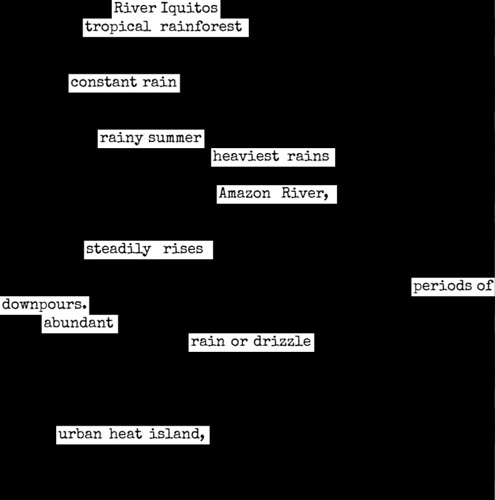
I chose the meandering rivers in Iquitos, Peru. After watching the timelapse I found the Wikipedia page about Iquitos and pasted the climate section into a blackout poetry generator. The poem I made is at the top of this page.

Haikomic⤴

from

Haikomic
Haikomic flickr photo by NomadWarMachine shared under a Creative Commons (CC BY-NC-SA 4.0) license

Today’s TDC says

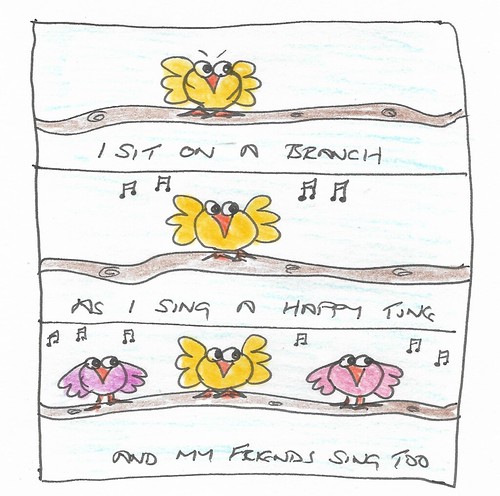
Comic creator Grant Snider has long used comics for expression and he periodically goes through periods where he turns his poetry into comics. He even has a book of Poetry Comics. For Write Out, Snider suggests a haikomic, or a haiku in the form of a three panel nature comic.

Grant has even provided a template, if you need one.

Read more about Grant’s idea at the Write Out site.

Here’s the haiku

I sit on a branch
As I sing a happy tune
And my friends sing too

Blogs Back Online⤴

from @ Glow Blog Help

As a precautionary measure, the Glow Blogs platform was temporarily taken offline.

This decision was made to allow our technical team to apply urgent security updates to protect the platform. These updates address recently discovered vulnerabilities in PHP – the foundational programming language that acts as the “engine” behind the scenes to make our WordPress websites run.

You may have seen news coverage regarding this software issue, as many other service providers globally have taken the exact same preventative steps to secure their systems.

We rolled out the necessary updates and conducted thorough testing.

All services are back online and access is restored.

Thank you for your patience and understanding as we prioritise the security of the platform.

Outside Writing/Inside You⤴

from

Thesis writing
Thesis writing flickr photo by NomadWarMachine shared under a Creative Commons (CC BY-NC-SA 4.0) license

Today’s TDC asks

What ways does writing outside inspire the writer inside of you and/or inside of other writers in your place?

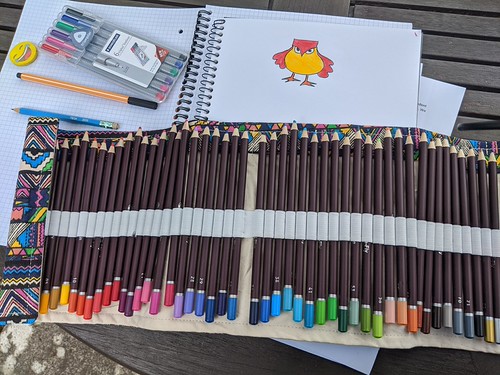
I do a lot of writing in my garden – away from the distractions of the internet. Here’s a couple from when I was writing up my thesis a few years ago. I got really good at doodling as a different type of procrastination. Cat was NOT a help!

Doodling
Doodling flickr photo by NomadWarMachine shared under a Creative Commons (CC BY-NC-SA 4.0) license

Building Advanced H5P Learning Experiences webinar⤴

from @ Glow Blog Help

A recording of a webinar for teachers interested in building more complex learning.

The video explores content containers such as game maps and branching scenarios designed to encourage interactive, gamified education. The First Game map example is aimed at 9 year old pupils and the second for adult learners.

It provides a good workflow for creating content. The video does not show the editor in WordPress but the standalone editor uses has the same interface.

There are some great tips for designing and planning content.

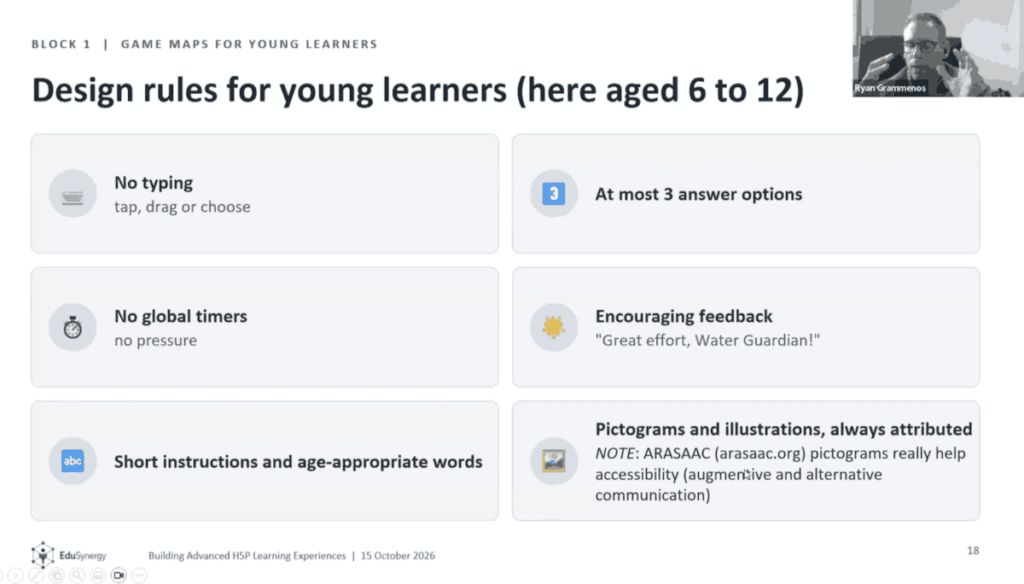
Screenshot of slide. Text:
BLOCK 1 | GAME MAPS FOR YOUNG LEARNERS
Design rules for young learners (here aged 6 to 12)
Ryan Grammenos
No typing
tap, drag or choose
At most 3 answer options
No global timers no pressure
Encouraging feedback
"Great effort, Water Guardian!"
Short instructions and age-appropriate words
Pictograms and illustrations, always attributed NOTE: ARASAAC (arasaac.org) pictograms really help accessibility (augmentive and alternative communication)

The H5P Group provides a whole series of videos on their vimeo channel.

Glow Blogs information and help on the H5P Examples Site.