For today’s TDC. I chose the word ‘puffin’.

Puffins flickr photo by NomadWarMachine shared under a Creative Commons (CC BY-NC-SA 4.0) license
view: full | short | titles only
from NomadWarMachine
For today’s TDC. I chose the word ‘puffin’.
Puffins flickr photo by NomadWarMachine shared under a Creative Commons (CC BY-NC-SA 4.0) license
from John @ news – Glow Blog Help
from NomadWarMachine
For today’s TDC.

AI Monkey Smile flickr photo by NomadWarMachine shared under a Creative Commons (CC BY-NC-SA 4.0) license
from John @ Glowing Posts
from NomadWarMachine
Hello! New term/semester, and I’m back after a bit of a break to discuss research on retrieval practice – in particular, classroom evidence for the technique.
As you probably know, retrieval practice is the process of actively recalling information to mind, for example when a learner self-tests or answers a teacher’s questions (see update #36).
For example, if I had asked you to remember what retrieval practice means rather than summarising it for you, it would have been an example of retrieval practice in action!
Retrieval from memory can happen in many situations. While we often associate it with quizzes, students also retrieve from long-term memory during activities such as discussions.
As you may know, much of the key research on retrieval practice – for example the work of Roediger and Karpicke (2006) – has been done in laboratory settings and on college students. It’s therefore worth asking what this looks like in real classrooms and across different age ranges. Are the same benefits still found?
This was the question asked in a review by Moreira and colleagues (Moreira et al., 2019), which included both children and older students. All of the studies reviewed were in authentic classroom settings.
A nice aspect of the study was that it separated out different ways of implementing retrieval practice.
The main findings were that:
Multiple-choice tests showed strong benefits;
Gap-fill tasks also helped, and more so if feedback was given, though only two studies had used gap fills;
Short-answer tests showed mixed results especially among younger students, with benefits clearer if feedback was provided;
For free recall tasks, the evidence was very limited, despite this being a widely used approach in lab studies.
On balance, the study endorses the use of retrieval practice when teaching children. It did express some concerns about the benefits of short-answer questions, but this largely focused on studies that did not provide feedback on answers, which is unlikely to happen in real classrooms.
I also think that the difficulty level of short-answer questions is hard to calibrate, and we know that in general, desirable difficulties can become undesirable if they are too challenging.

Probably the issue that has given me the most food for thought from this paper is the question of what retrieval practice should be compared to in classroom-based studies, including the presence or absence of feedback.
In lab settings, it’s common not to give feedback (i.e. to tell participants what the correct answer was after an attempt), as this can make it unclear whether it was the process of retrieval or the repetition of the correct information that made a difference.
However, in real classrooms, however, I’d imagine that it’s overwhelmingly common that students do get feedback after a quiz, meaning that failing to provide this makes the setting less authentic.
So, what should be the condition to which retrieval is compared? In lab studies, it’s often silent re-reading. But how likely is it that teachers choose to do this instead of giving students a more active task?
It probably depends on the context, and I’d be interested to hear your thoughts. For me, the key thing is that retrieval is compared to something that a teacher might reasonably choose to do with the same class and the same period of time. Studies that have compared it with concept mapping (discussed in update #23) are a good example of this.
When educators plan and teach, they are constantly choosing between one option and another, and we need to have studies that mimic these choices in an authentic way. This review highlighted a shortage of such studies. However, there have been relevant new publications since the review was done, and I’ll return to those soon!
The reference is below.
Moreira, B. F. T., Pinto, T. S. S., Starling, D. S. V., & Jaeger, A. (2019). Retrieval practice in classroom settings: A review of applied research. Frontiers in Education, 4(5).
All the best for the coming week,
Jonathan
Last time: Applying Cognitive Science to Questioning: Timing
I hope you are enjoying Memory and Metacognition Updates. Subscribe for free to receive new posts and support my work – and consider sharing it with colleagues!! Thank you!

Please note that my slides and similar materials are shared under a CC BY-NC 4.0 license. This means you can use or adapt them with attribution for non-commercial purposes. If you wish to use my materials for other purposes, feel free to get in touch.
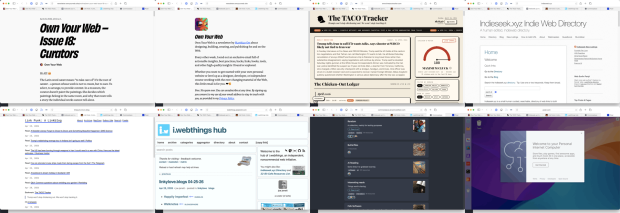
I’ve not posted a set of links for a while, keep saving them, but retired life is busier than I thought it would be. I am prompted by this newletter post:
Own Your Web – Issue 18: Curators
So every time you share a link on your blog, every time you write a few sentences about why someone else’s work matters to you, every time you add a new entry to a blogroll or a links page – you are a curator. You are doing what no algorithm can do. You’re saying: I am a person. I read this. I think you should read it too.
There is a good selection of links to link curators.
I am not sure when I subscribed to Own Your Web
Own Your Web is a newsletter by Matthias Ott about designing, building, creating, and publishing for and on the Web.
But it is great. There is an RSS feed too.
The TACO Tracker: Every Time Trump Chickens Out
Trump won’t stop chickening out. We won’t stop tracking it
One of the more amusing uses of AI
Via brad who has the Indieseek.xyz Indie Web Directory
Indieseek.xyz is a small human curated, searchable, directory of web links to both websites and to individual web pages. We try and list pages that are informative, fun, classic and useful
And
Just a linkblog, mainly for articles and individual blog posts that I find and want to share. I think of this as me being a DJ only playing articles rather than songs.
Brad also post funny political thoughts most days on mastodon.
Another great source of links is Joe Jennet
i.webthings hub
Welcome to the hub of i.webthings, an independent, noncommercial web initiative
Joe credits where he finds his links which can lead to some other interesting directories.
Commonplace is a self-hosted, federated link-collection manager. You can create curated collections of links and share them with followers across both the Fediverse (Mastodon, Pixelfed, etc.) and Bluesky — without creating new accounts on either network
Created by Doug Belshaw. And changing quickly. I am logged on via indieAuth, which is nice. I’ve created a few collections, the largest so far is AI Reading. It is always interesting to try out new pieces of software.
Commonplace allows sharing collections, suggestions and replies.
Commonplace now has a bookmarklet, which is for me essential. It grabs an image and description via open graph (I’d guess) to give a description. You can edit this and add curators notes.
I’ve used a bunch of link collectors over the year, delicious, pinboard, locally in the drafts app, on my site and a few more. I’ve not used pinboard much in the last few years. I feel a bit guilty about not updating my lifetime sub when pinboard changed to annual fees. Life-timers like myself could upgrade to a yearly fee. I didn’t. I mostly use drafts in a fairly disorganised way. At the very least commonplace is giving me the chance to think a bit about my link collection & sharing. It is also interesting to watch the development, as Doug is AI coding the site.
Here is an ‘real’ teaching and learning link. I’ve been doing the odd bit of supply and wonder if I should give this a go.
micro:bit CreateAI is a free, web-based tool that makes it easy for students to explore AI through movement and machine learning (ML).
You can use micro:bit CreateAI to train an ML model and then run it on your BBC micro:bit V2.
- Collect movement data from the micro:bit accelerometer
- Train an ML model to recognise patterns in the data
- Code the micro:bit to run ML models and take your creation anywhere.
And a last weird one.
Code seems like a computer on the web. You get a desktop. Also can create web apps and get access to AI. The UI has me baffled. I might not be the audience.
from NomadWarMachine
Today’s TDC:
April 26th is Marcus Aurelius‘ birthday. Using some of his words as an inspiration, make him a birthday card. Happy 1905th Birthday to you, Marcus.

Marcus Aurelius flickr photo by NomadWarMachine shared under a Creative Commons (CC BY-NC-SA 4.0) license
And happy birthday to me as well.
from NomadWarMachine

Boats at Salen flickr photo by NomadWarMachine shared under a Creative Commons (CC BY-NC-SA 4.0) license

Scotland’s funding system prioritises where you study over what you learn. This has left college students chronically underfunded compared to their university peers, even when they are studying for the exact same level of qualification.
As we approach the Scottish Parliament election on May 7th, the survival of the college sector is no longer a "future" problem; it is a present-day emergency. I have looked beyond the campaign slogans to ask: which policies will finally align our education system with the occupational competencies the modern world actually demands?
A major hurdle to fairness is the lack of transparency. Most people don't realise that while work-based learning, schools and colleges use the Scottish Candidate Number (SCN) to track a learner’s journey from age five, the university system has largely resisted adopting it.
By using their own internal IDs instead of the SCN, universities make it nearly impossible to track a student’s progress through the entire system. This "data silo" hides a multitude of sins, including potential double-funding and an inability to prove if "widening access" programs are actually working. Without a single ID, we are essentially trying to run a national education system where the biggest players speak different languages.
The core of the problem is a fundamental divide in how courses are built. Universities enjoy "Academic Autonomy," meaning they create their own curriculum based on theoretical research. In contrast, colleges deliver a curriculum mapped to National Occupational Standards (NOS).
If a degree claims to be vocational but isn't tied to these competencies, should it be funded at the same rate as a course that is?
| Qualification Type | Primary Driver | Linked to Occupational Competency? |
| College HNC/D | Industry Standards (NOS) | Directly. Required for professional registration. |
| Modern Apprenticeship | Employer Demand and (NOS) | Directly. Based on "doing" the job. |
| Traditional BA/BSc | Academic Research | Rarely. Designed for "critical thinking," not a specific job. |
| Graduate Apprenticeship | Co-designed (Uni + Employer) | Directly. The "Gold Standard"—should embed HN and SVQ levels based on (NOS) |
I believe all the current manifestos fall short of delivering a truly equitable settlement for vocational education, but here is how the "Big Three" are pitching their solutions:
The SNP is betting on the Tertiary Education and Training (TET) Act 2026. Their plan is to merge college and university funding into a "single bucket" to ensure money follows the learner.
The Catch: While they talk about "parity," college funding has dropped by 20% in real terms, leaving campuses in an "emergency" state.
Labour is positioning itself as the party of the workforce, promising multi-year funding settlements. This would allow colleges to stop living hand-to-mouth and actually plan for the long term.
The Catch: They have been vague on whether the current "no-fee" model is sustainable without a massive injection of cash they haven't yet found.
The Tories are focusing on the physical decay of the sector, proposing a Capital Investment Fund for "wind and watertight" repairs.
The Catch: Their wider plans to cut government spending could leave little room for the revenue increases the sector desperately needs.
If we want a fair system, we must "cut our cloth" accordingly. A truly learner-friendly policy wouldn't just promise more cash; it would mandate that any vocational degree must be mapped to National Occupational Competencies and funded at the same rate as a college HND.
Until we close the "Missing Link" and adopt a single tracking number (SCN) for every student, the "parity of esteem" between colleges and universities will remain a myth.
Many of these issues are very long-standing, and no administration has really been prepared to tackle them. The system should be about learners, not institutions. I reflected on a similar theme in 2024.
Transparency Note: To help navigate the dense landscape of 2026 election manifestos, budget reports, and legislation like the Tertiary Education and Training (TET) Act, I used AI as a research collaborator to pull this data together. All policy comparisons and insights were cross-referenced against official party platforms and sector reports from Colleges Scotland and Audit Scotland to ensure accuracy.