
Mugdock flickr photo by NomadWarMachine shared under a Creative Commons (CC BY-NC-SA 4.0) license
Silent Sunday⤴
from NomadWarMachine
view: full | short | titles only
from NomadWarMachine
Mugdock flickr photo by NomadWarMachine shared under a Creative Commons (CC BY-NC-SA 4.0) license
from John @ Glow Blog Help
This upgrade focuses on collaboration, editing improvements, new blocks, accessibility, and performance. Here are the main changes. We have put then in a new accordion block, so click the headings to expand each section and find out more.
A new accordion block lets you create expandable/collapsible sections without plugins. Good for FAQs, long pages, or menus. We have used this block to show you the update information. Read more about The Accordion Block on the Blocks Blog.
A stretchy heading fills the available space. There is a stretchy paragraph block too:
This is stretchy and fills the space.
We would recommend typing a paragraph and then transforming that to stretchy. More information on the Blocks Site.
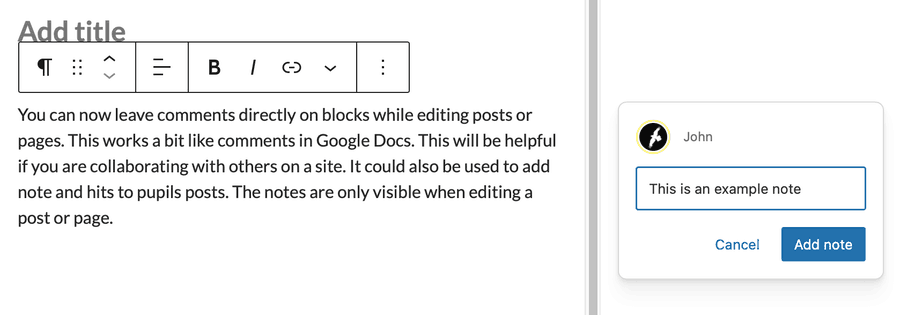
You can now leave comments directly on blocks while editing posts or pages. This works a bit like comments in Google Docs. This will be helpful if you are collaborating with others on a site. It could also be used to add note and hits to pupils posts. The notes are only visible when editing a post or page.
You add a note from the ellipses on a block toolbar.
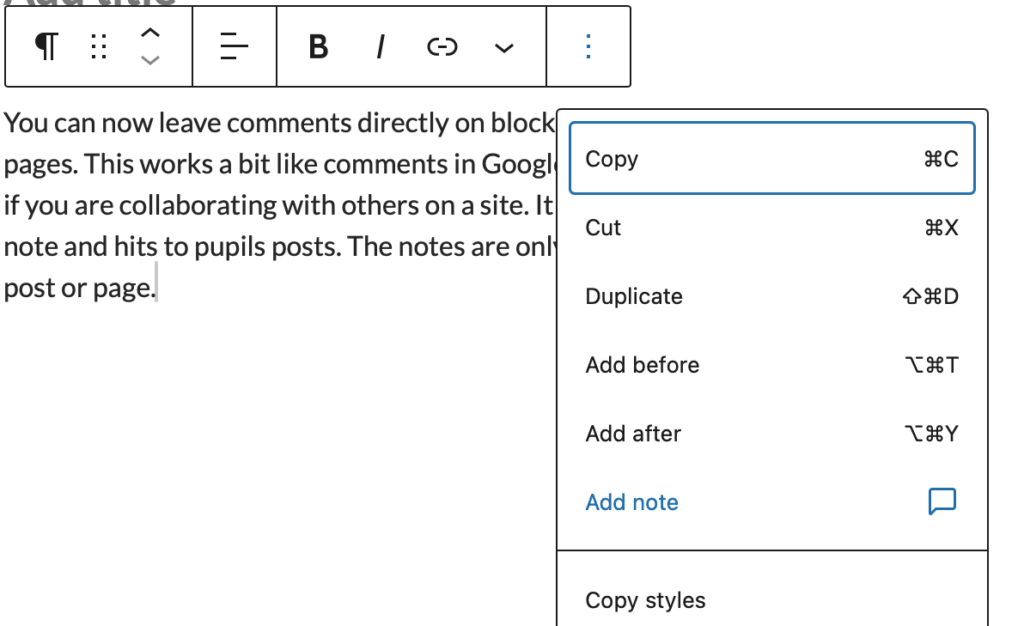
The Block appears in the side bar.
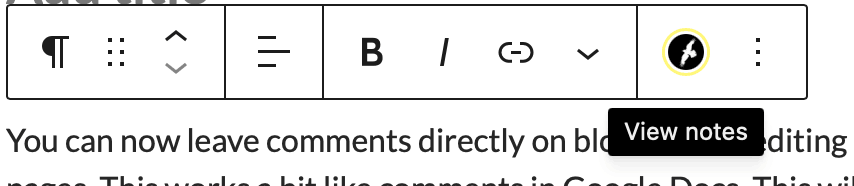
Block with notes attached show a users icon.
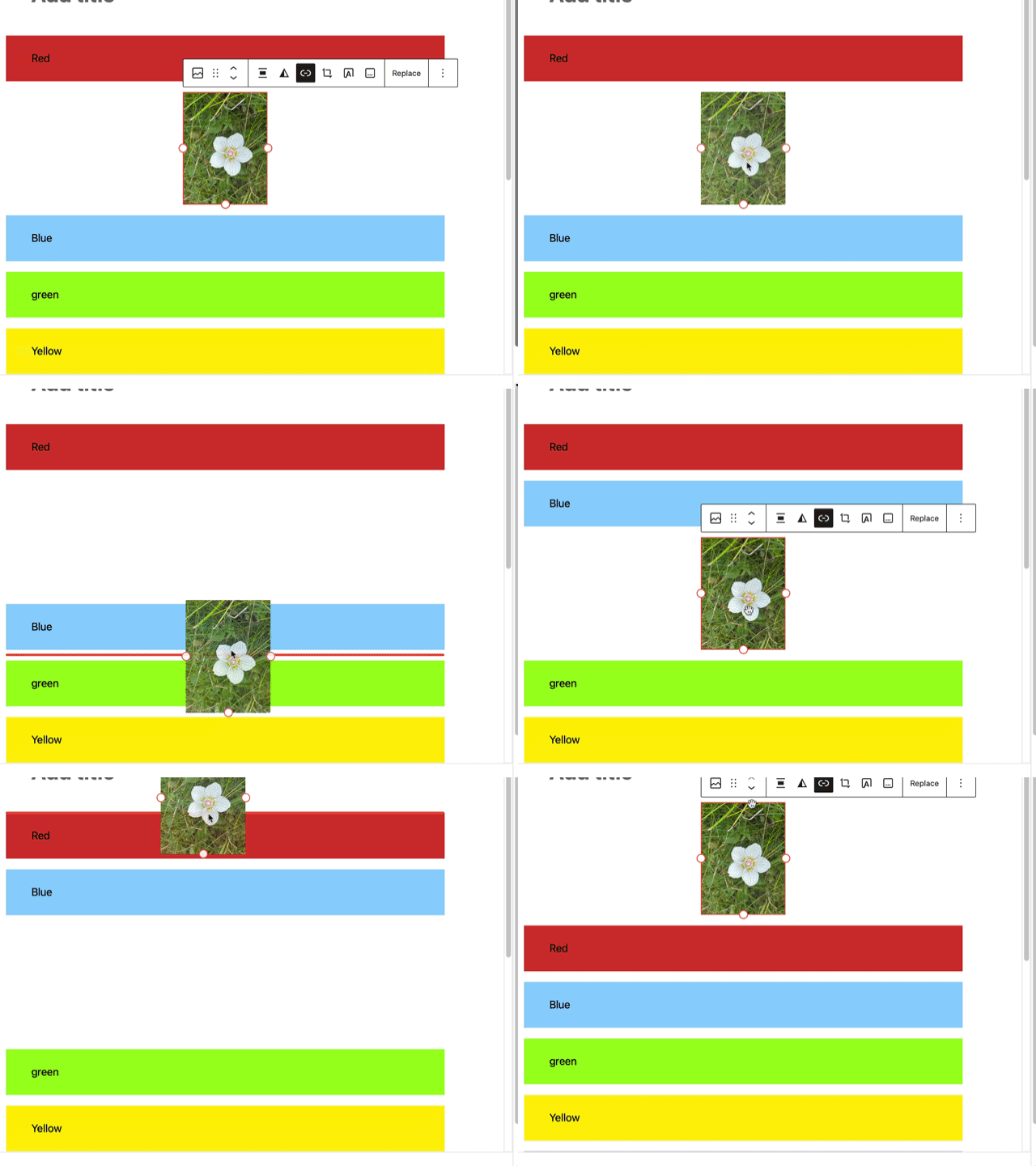
Moving blocks around is now more visual, with clearer drag handles and live previews while dragging content. This makes layout editing feel smoother and more predictable.
Gallery blocks can now enforce a consistent aspect ratio across images, helping galleries look tidier without manual image cropping.
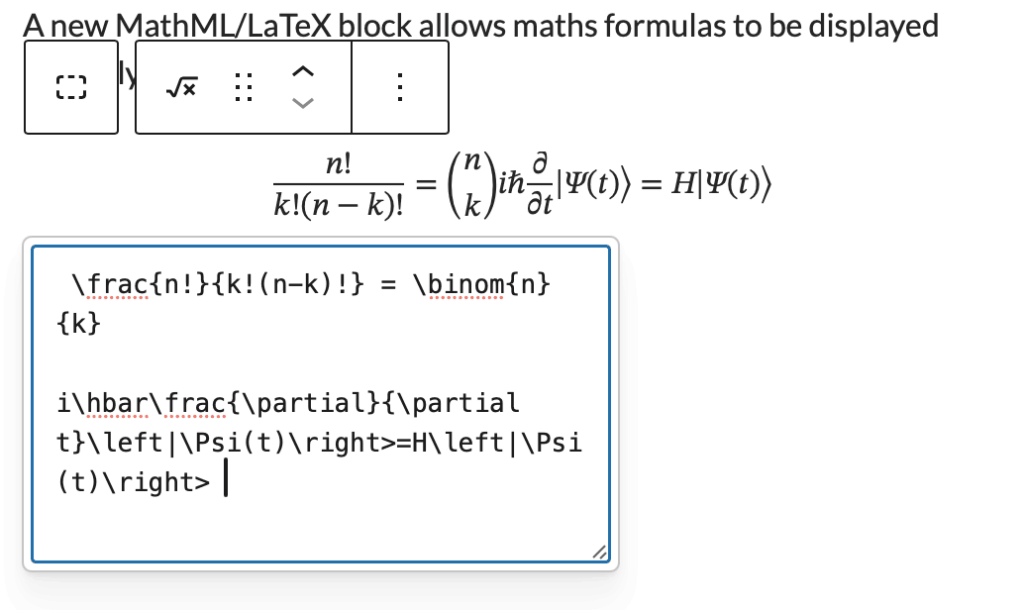
A new MathML/LaTeX block allows maths formulas to be displayed properly in posts and pages.
for example
You can automatically show estimated reading time for posts. This can be used in the Query Loop.
Several blocks for use in designing category or tag pages in the block editor, including term-count, term-name, term-template & terms-query. Of interest to people doing advanced editing in the site editor.
The Command Palette has expanded beyond the editor, letting power users jump quickly to templates, pages, settings, and other admin areas using keyboard shortcuts. Likely to be of interest to people who are doing a lot of site design work in the site Editor.
WordPress 6.9 includes a large number of accessibility fixes 70+ accessibility fixes and enhancements focus on central areas of the WordPress experience
.
Several frontend performance improvements aim to make sites load faster.
Remember that some of the information is for developers or individuals WordPress sites. This may differ on Glow Blogs.
A couple of posts ago I discussed what university lecturers (should) know about learning, viewing this within the issue of SoTL – the scholarship of teaching and learning in Higher Education settings.
I thought I’d follow this up with an example that is of great interest to me: study skills, and how new students adapt to college and university contexts. This is of notable relevance to school practitioners as well as to lecturers (not to mention parents and the students themselves!).
Unfortunately, it appears that many learners do not cope well with the changed demands and expectations of college courses compared to high school. Depending on the course, such demands may include:
A different level and style of reading material;
Increased independent learning;
More need for note-taking, e.g. during lectures;
A greater emphasis on process, methodology and analysis than on mastering a defined set of content.
As such, the transition to HE can be very challenging and, at times, highly stressful (Worsley et al., 2021). Naturally, in times of stress, people rely on tried and tested strategies, and many may be unaware that the guidance that served them well in the school system can actually undermine their university performance.
Researchers Nel and colleagues, in a study carried out in South Africa, wrote: “students are increasingly underprepared for higher education studies ... particularly learners from disadvantaged backgrounds” (Nel et al, 2009, p. 974). This mirrors findings in the USA and elsewhere.
I’m looking at this exact issue in some of my own work. I’ve spent time over the past year interviewing our first year students with a view to finding out their study habits, their views on learning, and what they have learned from previous context.
I hope to publish the findings in due course. Initial findings suggest that students vary widely in terms of how well prepared they have been in their earlier studies and in terms of the study strategies they are using now. Many draw heavily on parents and friends for advice on how to study and how to approach assessments – potentially disadvantaging first-generation students.

You can perhaps see in the above example that if practitioners are to carry out research in their own teaching contexts, it really helps to have some familiarity with learning, memory, metacognition, etc. The research I’ve just described is explicitly informed by the work of Kornell & Bjork (2007) on self-regulated learning.
A potential outcome from this research is to feed into advice given to incoming 1st year students next year, thus providing a helpful feedback loop between research and practice.
A related project on which I am working with several faculty colleagues is looking in detail at the way that school assessments here in Scotland are structured, and using this to guide lecturers about incoming students’ likely assumptions and expectations.
If anyone out there would like to find out more, or even to collaborate as this research develops, I’d love to hear from you.
Next time I will return with part 2 of my discussion of areas of confusion in cognitive science. Many thanks to those who commented on the first part!
All the best for the coming week,
Jonathan
I hope you are enjoying Memory and Metacognition Updates. Subscribe for free to receive new posts and support my work – and consider sharing it with colleagues!! Thank you!

Please note that my slides and similar materials are shared under a CC BY-NC 4.0 license. This means you can use or adapt them with attribution for non-commercial purposes. If you wish to use my materials for other purposes, feel free to get in touch.
from NomadWarMachine

Waterlilies flickr photo by NomadWarMachine shared under a Creative Commons (CC BY-NC-SA 4.0) license
from howsheilaseesIT
Apologies Dear Reader, it has been far too long since I last posted here. In fact, I wouldn’t blame you if you have given up completely on ever reading something new here. But I during the #edtech26 conference in Dublin this week I have been reminded of the joy of blogging by 2 stalwarts of the craft – Maren Deepwell and Jim Groom.
As I wait for my (annoyingly delayed) flight home, I see Maren has already published a post about the conference. As I sit and watch fellow travelers queue around me for their flights, I am slowly processing the past 2 days.
Of course the best part of any conference is always the people who are there. It was so lovely to catch up with so many colleagues and friends and meet new colleagues from the ILTA community.
It was refreshing to be at a conference and to speak with colleagues who aren’t all facing restructuring, endless rounds of VS and/or compulsory redundancies. The UK HE sector is a challenging place right now. The contrast between the Irish HE sector and the UK sector is quite stark. However we do all still have a common set of challenges around enhancing learning and teaching, integrating and using technology effectively and enhancing the student experience.
All the sessions I attended were really insightful and I could see many parallels with work I am involved in with UK universities. I was also delighted to be able to present an overview of the Jisc Beyond Blended Programme in a session that was chaired by Fiona Concannon who leads one of our pilot projects at the University of Galway.
The 3 keynotes (Abeba Birhane, Ben Williamson, Felicitas Mcgilchrist) were excellent – and can be viewed here For me they all had a common theme around how future and current narratives of edtech are being shaped and co-opted into all of our lives. They all highlighted key challenges not just facing the edtech and wider education domain, but wider society.
Abeba and Ben focused more on the “big tech” consumerist, market driven, AI centred narratives that are driving the seemingly inevitable narrative around the future of an enhanced AI driven and dominated education sector. One that is based on, well not that much evidence really but a whole lot of hype and a whole lot of money. Education’s market potential is huge – the investment companies are moving in. Their stakeholders don’t really care about quality and human impact as long as the shares are riding high on the stock market.
Felicitas looked at another side of the technology narrative -focusing on some of the narratives around use of technology and levels of anxiety and mental health, particularly in children and teenagers. She reminded us that some of the popular narratives around anxiety are gaining traction and leading to some oversimplified potential solutions such as banning smart phones in schools. The issues are far more complex. She reminded us of alternative, critical, scholarly research around notions of fragility, and the need to remember that fragility is part of being human. We all are all fragile, have moments of doubt about our abilities, are worried about failing. Education based on care – not made up of productivity and efficiency metrics (my words not Felicitas) is what we really need.
The conference was full of stories, ones we tell to each other as well as the “bigger” stories each of the keynotes explored. The whole “big tech” era were are currently living is terrifying. Perhaps I, like the rest of the conference delegates. are all too aware of the dystopian nightmare we seem to be hurtling towards. But there must be some hope . . . and I do think there is.
The debate motion:
Big EdTech is getting worse (exactly as planned)
This motion argues that educational technology has, for the last 25 years, been getting slowly worse. While we often talk about the tools and technologies of EdTech, the reality is that we are almost always speaking of commercial products. As products, they are not designed to be sustainable or equitable, but disposable and expensive.
As time has gone by, EdTech has moved relentlessly towards hosted metered services and away from installable, sustainable software. EdTech has become a tap that drip feeds us its services in billable minutes, words and tokens. Its products’ hype cycles rise as fast as its sustainability declines. We can never have equity with products that are designed to function as desirable educational status symbols rather than tools for human transformation and flourishing.
Along with Gavin Hendrick I was in conference co-chair Kate Malloy’s team opposing the motion. My contribution to the debate was that we needed to be better at creating our narratives around edtech and what our communitie do (“the way in which we think about who we are depends on the stories we tell about who we are” Sharon Blackie, Wise Women, 2024) and getting them adopted by our senior management. We need to be articulating in a more compelling way than the ‘big tech bros” what a university is for (We need to be able to articulate an understanding of what universities are for that is adquate for our time if we are to be able to decide what to do” Stefan Collini. 2017 Speaking of universities. I did feel quite a lot of pressure during my 4 minute section. So I will try and write another post about the it I know I did rush that perhaps one narrative to develop was to expand on the notions of sanctuary universities. To see if part of our university spaces could supported digital and data sanctuary for our students and staff. Spaces where we could provide equitable alternatives, systems that weren’t tracked, spaces where tech would only be allowed if it were completely transparent and for example shared all its algorithms, allowed them to be critiqued. However despite the far more articulate efforts of my team mates, we narrowly lost the motion.
It was a really enjoyable, thought provoking and fun conference. So huge thank you to all at ILTA for the organisation, to Kate and Rob for co-chairing so well and including me as one of the invited speakers.
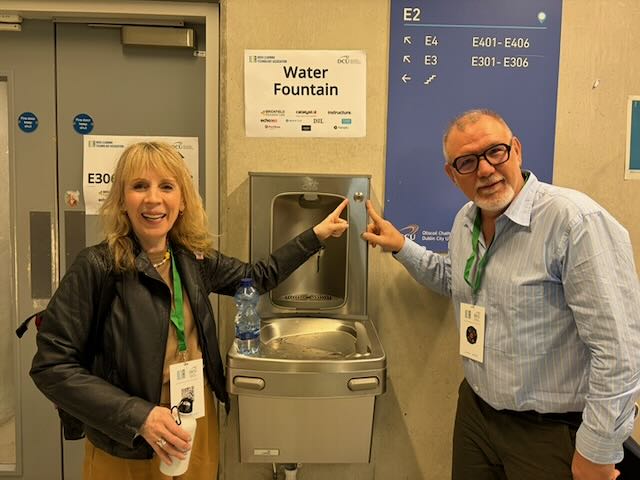
However, I am saving the best moment for last. It was so lovely to catch up with Jim Groom in person. Only Jim would hire a table top pac-mac console for their company “stand”. This retro fabulousness was positioned beside a wall mounted water fountain which I really couldn’t figure out how to work properly – so I was just using the lower (mouth jet) to fill my bottle, until a lovely new colleague wandered, placed his bottle in the “bottle space”, pressed what I had assumed was a button that needed a key or key fob and hey presto the water came out. It was a bit of a “mind blown” moment that had Jim and I in stitched laughing, particularly as our new friend said he had done the same as us until someone showed him “the way”. The joy in helping others for the next few minutes was, well at one point almost a business plan, but certainly had the potential for a new conference ice breaker.
Water cooler moments, they are still the best . . .
from Eva Wilkinson @ DigiLearn
This provocation-guide is written for the IDL network by Joanna Stell, who teaches at Impington Village College, a secondary school in Cambridgeshire. Whilst she writes in the context of a teacher in the English education system, her advice is no less applicable in almost any middle/secondary school.
As a practitioner-researcher in school-level interdisciplinarity, there were two particular reasons to get excited about the recent Interdisciplinary Learning and Teaching Conference at the University of Edinburgh’s Futures Institute. First, that there would be other teachers present. Thanks to a generous donation from The Royal Society of Edinburgh, this marked the first year that schoolteachers could attend the conference on a fully funded bursary. Second, that the conference would be in Scotland, where, unlike in England, “interdisciplinarity” is featured within the national curriculum for school students, known as Curriculum for Excellence. Here and now was the opportunity for thinking: if we were to introduce interdisciplinarity into every secondary school classroom in England, how would we do it? And so, surrounded by like-minded educators and inspired by countless successful university projects, I began to formulate the advice I’d give to the hypothetical schoolteacher wanting to turn their class into an interdisciplinary wonderland…
A community conundrum. The UN Sustainability Goals. A student’s personal inquiry. What all the best interdisciplinary projects seem to have in common is a wicked heart. Or should I say: a question that falls beyond the boundaries of any single discipline, necessitating the integration of multiple disciplinary perspectives or methods in its comprehensive comprehension and resolution. If you want to design an interdisciplinary project for your students, don’t start with the disciplines or schemes of learning: start with a question so complex and frustrating that it cannot be sufficiently answered by only one subject. In asking this question, you motivate, drive, and require the interdisciplinary thinking you hope to encourage. How is AI going to change society? Should we all go vegan for the environment? Can we create empathy for the villains of history? All good projects need a good start point, and for interdisciplinary projects, this good start point tends to be a wicked one.
Interdisciplinary learning does not require that every teacher become a polymath overnight. Teachers are subject-specialists, and that’s how they should remain within the interdisciplinary process. It is the students, accustomed to existing across multiple subjects as their timetables require, who actually engage in the interdisciplinary thinking, who are required in someways to become polymaths. Within this, the students must be exposed to varying disciplinary perspectives on the same wicked problem, and this can best be done by multiple subject teachers, each sharing their discipline’s take on the question at hand. A successful classroom interdisciplinary project is therefore likely to involve a revolving cast of teachers from different subjects, not a single classroom teacher attempting to wear different hats that do not belong to them. Multiple perspectives will require multiple colleagues.
School subjects are so much more than their exam syllabi, and it is important that any interdisciplinary project acknowledges this fact. As a maths teacher, I recognise that my subject is often reduced to numbers and graphs. But in solving complex problems, those wicked questions at the heart of interdisciplinary projects, there’s only so far that numbers and graphs can take us. If instead we view maths as its holistic discipline, as an academic way of thinking and doing, suddenly we have pattern spotting, abstraction of rules, systematic proof. The habits and methods of maths as a discipline are far more powerful than its topic contents; such is true for all school subjects. Teachers must be clear on what their subject has to offer and ensure that this is communicated both to their students as well as their interdisciplinary colleagues. Do not fall for subject cliches or disciplinary caricatures. Do not diminish a discipline’s power by taking a reductionist view. Instead, view each discipline richly.
It’s all very well looking to university modules for inspiration, but at the end of the day, our students are younger and undoubtedly less academically experienced. Significantly so. As such, we cannot expect them to have the sophisticated cognitive skills possessed by undergraduate students. If we want students to be able to move flexibly between disciplinary perspectives and eventually synthesise these into an integrated whole, we’ll need to nurture those skills. This isn’t an insurmountable task, and indeed one that educators have begun to tackle as they aim to foster similarly complex critical thinking skills through sentence starters, prompt questions, targeted teamwork. Through a process of modelling and scaffolding, teachers can hope to nurture the perspective taking and synthesising skills required by interdisciplinary thinking, but this will likely need to be an explicit activity that teachers intentionally engage in, students’ success in “interdisciplinarity” cannot be left to luck.
For the moment, interdisciplinarity within the state schools of England is a dream: mostly missing and largely unattainable. But that is no reason to stop dreaming. Within universities, interdisciplinarity is being praised for future-proofing both learners and education itself. Interdisciplinarity introduces students to complex problem solving, cognitive flexibility, and a whole host of smaller soft skills without abandoning the disciplinary traditions which have acted as the foundations of learning for millennia. It is the step from our current classroom norms to the dynamic learning experiences our students so desperately need. Which is why we must keep championing the pedagogy, trialling new pilot projects, and readying our classrooms to incorporate just a little bit more interdisciplinarity.
I’ve talked a lot about myths in these updates. As a recent example, update #128 focused on the learning styles myth. Generally speaking, the term neuromyths is used to refer to flawed ideas about learning that are widely believed in education (e.g. Howard-Jones, 2014). They are an example of metacognition, because the concern how we think about thinking/learning.
However, it’s worth noting that many myths are based on a kernel of truth that has been misunderstood. For example, the idea that some people are ‘right brained’ draws on some real differences between the left and right sides of the human brain, but extend this into an oversimplified and unhelpful way of categorising people, distorting the basic science (Hines, 1987).
Unfortunately, cognitive science is not immune to myths of its own. As with other areas of science, valuable ideas can be distorted and misunderstood, and those misunderstandings can spread through the teaching professions.
This relates to what by Ed Haertel has termed lethal mutations, as explained in this post by Kate Jones at Evidence Based Education. Lethal mutations are changes that modify an idea from the research in ways that harms its efficacy or even leads to it becoming harmful rather than helpful.
I thought I’d contribute to this discussion with my own take on misconceptions about cognitive science that I’ve noticed. Some of these might not be true lethal mutations (you can be the judge), but they strike me as significant oversimplifications of cognition research.
Retrieval practice is perhaps the best-embedded idea from cognitive science. In the dozen or so years since I first explored the research on this issue, I’ve seen a massive change in awareness. Many teachers today appreciate that it is worth testing their students to help knowledge to stick, that they should keep this low stakes.
I perceive a popular misconception, however, in conflating retrieval practice with tests. It seems that many people forget that that things like classroom questioning and discussions lead to retrieval (if structured properly). Retrieval practice is not always about quizzing, which is a key reason why researchers moved away from an older term, ‘the testing effect’.
I’ve heard interleaving described as one of the hardest topics to understand. I think the reason could be that teachers immediately assume that it’s about mixing up topics. In fact, the research evidence does not do this at all. Perhaps the term is the problem – the term ‘compare and contrast effect’ has been used in some research papers, and might be a better name for it.
The key idea is that interleaving needs to contrast relevant examples so that students see the difference between them. There is no interleaving benefit if unrelated information is mixed together.
(Read more here: update #14).

Like retrieval practice, cognitive load is pretty well embedded into the awareness of teachers, at least in some sectors and countries. However, it is also widely misunderstood. I could (and probably should) write a full post on that issue!
The key idea which makes sense, and which most people get, is that working memory is limited and can be overloaded, and it makes sense to manage how much we ask learners to think about at a given time.
The problem lies when simplification and reduction of content is seen as always desirable. This is not what the theory says – cognitive load researchers recognise that complexity is both necessary and desirable. Intrinsic load is the term for the key aspects of a task that can’t be removed. Further, germane load relates to useful forms of load, such as examples and visual cues that help the learner to make links to existing knowledge. These should not be cut out, and we shouldn’t be aiming for learning to feel easy.
I’ve also observed a lot of educators misunderstand the timescale of cognitive load. Working memory is really brief – a matter of seconds. Learners feeling overloaded over hours or days, this is a completely different issue, and therefore links to different theoretical concepts.
What are your thoughts on these points? Do you agree that they are common misconceptions? And could some of the guidance and CPD on these issues be leading to these or other mistakes arising?
I’ll tackle a further three areas next time. I haven’t quite decided which ones to cover, though, some that I have in mind include:
Dual coding
Spacing effect
Metacognition
Schemas
Suggestions/preferences? Perhaps you can suggest some more – if so, I’ll endeavour to cover those, too!
Hope you have a great week,
Jonathan
As a bit of further reading, here is a post I wrote a while ago about the left brain vs. right brain myth, mentioned above:
Firth, J. (2021). Creative neuroscience: The left-brain/right-brain myth. https://www.strath.ac.uk/humanities/schoolofeducation/blog/creativeneuroscience/
Last time: Should lecturers know how learning works?
Please note that my slides and similar materials are shared under a CC BY-NC 4.0 license. This means you can use or adapt them with attribution for non-commercial purposes. If you wish to use my materials for other purposes, feel free to get in touch.
from NomadWarMachine
from NomadWarMachine
A remix for today’s TDC

Warhol Clockwork Orange flickr photo by NomadWarMachine shared under a Creative Commons (CC BY-NC-SA 4.0) license
