Sent on behalf of Dr. Ramsey Affifi at the University of Edinburgh
You are warmly invited to a public lecture I have organised, and hosted by the Teacher Education, Curriculum and Pedagogy Hub at Moray House School of Education and Sport, as part of the Stewart Alan Robertson Lecture Series, funded by the Robertson Endowment:
Teacher Agency for Interdisciplinary Curriculum Making
Speaker: Professor Mark Priestley (University of Stirling) Date: Thursday 25 June 2026 Time: 17:00–19:30
Location: In person at G.1 Paterson’s Land, EH8 8AQ, and online on MS Teams
Agenda
17:00–17:30: Registration and refreshments 17:30–18:30: Sharing practice from PGDE tutors: IDL and curriculum making 18:30–19:30: Speaker: Professor Mark Priestley
This hybrid public lecture will explore teacher agency as a central feature of interdisciplinary curriculum making for social and environmental sustainability.
The event opens with a panel of Moray House tutors who will share insights from their work supporting student teachers to engage in interdisciplinary learning (IDL) curriculum development.
In the second half, Professor Mark Priestley will respond to the panel, drawing on curriculum theory, policy, and practice to examine the role of teachers as curriculum makers in the Scottish context. His response will foreground ecological understandings of teacher agency and highlight the critical importance of interdisciplinary approaches in addressing complex global challenges.
This is a free, hybrid event, and registration is required. Please register via the Eventbrite link on the webpage.
About the Speaker
Professor Mark Priestley is Professor of Education at the University of Stirling. His research interests focus on school curriculum theory, policy, and practice, particularly the processes of curriculum making across different layers of education systems. He was Lead Editor of The Curriculum Journal from 2018 to 2024, is a member of the Scottish Government’s Curriculum and Assessment Board, and is Co‑Convener of the EERA Network 3 (Curriculum). His publications include Teacher Agency: An Ecological Approach and Curriculum Making in Europe: Policy and Practice within and Across Diverse Contexts.
This provocation-guide is written for the IDL network by Joanna Stell, who teaches at Impington Village College, a secondary school in Cambridgeshire. Whilst she writes in the context of a teacher in the English education system, her advice is no less applicable in almost any middle/secondary school.
As a practitioner-researcher in school-level interdisciplinarity, there were two particular reasons to get excited about the recent Interdisciplinary Learning and Teaching Conference at the University of Edinburgh’s Futures Institute. First, that there would be other teachers present. Thanks to a generous donation from The Royal Society of Edinburgh, this marked the first year that schoolteachers could attend the conference on a fully funded bursary. Second, that the conference would be in Scotland, where, unlike in England, “interdisciplinarity” is featured within the national curriculum for school students, known as Curriculum for Excellence. Here and now was the opportunity for thinking: if we were to introduce interdisciplinarity into every secondary school classroom in England, how would we do it? And so, surrounded by like-minded educators and inspired by countless successful university projects, I began to formulate the advice I’d give to the hypothetical schoolteacher wanting to turn their class into an interdisciplinary wonderland…
Step 1) Start with a Question.
A community conundrum. The UN Sustainability Goals. A student’s personal inquiry. What all the best interdisciplinary projects seem to have in common is a wicked heart. Or should I say: a question that falls beyond the boundaries of any single discipline, necessitating the integration of multiple disciplinary perspectives or methods in its comprehensive comprehension and resolution. If you want to design an interdisciplinary project for your students, don’t start with the disciplines or schemes of learning: start with a question so complex and frustrating that it cannot be sufficiently answered by only one subject. In asking this question, you motivate, drive, and require the interdisciplinary thinking you hope to encourage. How is AI going to change society? Should we all go vegan for the environment? Can we create empathy for the villains of history? All good projects need a good start point, and for interdisciplinary projects, this good start point tends to be a wicked one.
Step 2)Call for Collaborating Colleagues
Interdisciplinary learning does not require that every teacher become a polymath overnight. Teachers are subject-specialists, and that’s how they should remain within the interdisciplinary process. It is the students, accustomed to existing across multiple subjects as their timetables require, who actually engage in the interdisciplinary thinking, who are required in someways to become polymaths. Within this, the students must be exposed to varying disciplinary perspectives on the same wicked problem, and this can best be done by multiple subject teachers, each sharing their discipline’s take on the question at hand. A successful classroom interdisciplinary project is therefore likely to involve a revolving cast of teachers from different subjects, not a single classroom teacher attempting to wear different hats that do not belong to them. Multiple perspectives will require multiple colleagues.
Step 3)View the Disciplines Holistically
School subjects are so much more than their exam syllabi, and it is important that any interdisciplinary project acknowledges this fact. As a maths teacher, I recognise that my subject is often reduced to numbers and graphs. But in solving complex problems, those wicked questions at the heart of interdisciplinary projects, there’s only so far that numbers and graphs can take us. If instead we view maths as its holistic discipline, as an academic way of thinking and doing, suddenly we have pattern spotting, abstraction of rules, systematic proof. The habits and methods of maths as a discipline are far more powerful than its topic contents; such is true for all school subjects. Teachers must be clear on what their subject has to offer and ensure that this is communicated both to their students as well as their interdisciplinary colleagues. Do not fall for subject cliches or disciplinary caricatures. Do not diminish a discipline’s power by taking a reductionist view. Instead, view each discipline richly.
Step 4) Scaffold the Skills
It’s all very well looking to university modules for inspiration, but at the end of the day, our students are younger and undoubtedly less academically experienced. Significantly so. As such, we cannot expect them to have the sophisticated cognitive skills possessed by undergraduate students. If we want students to be able to move flexibly between disciplinary perspectives and eventually synthesise these into an integrated whole, we’ll need to nurture those skills. This isn’t an insurmountable task, and indeed one that educators have begun to tackle as they aim to foster similarly complex critical thinking skills through sentence starters, prompt questions, targeted teamwork. Through a process of modelling and scaffolding, teachers can hope to nurture the perspective taking and synthesising skills required by interdisciplinary thinking, but this will likely need to be an explicit activity that teachers intentionally engage in, students’ success in “interdisciplinarity” cannot be left to luck.
Step 5) Keep Dreaming
For the moment, interdisciplinarity within the state schools of England is a dream: mostly missing and largely unattainable. But that is no reason to stop dreaming. Within universities, interdisciplinarity is being praised for future-proofing both learners and education itself. Interdisciplinarity introduces students to complex problem solving, cognitive flexibility, and a whole host of smaller soft skills without abandoning the disciplinary traditions which have acted as the foundations of learning for millennia. It is the step from our current classroom norms to the dynamic learning experiences our students so desperately need. Which is why we must keep championing the pedagogy, trialling new pilot projects, and readying our classrooms to incorporate just a little bit more interdisciplinarity.
Residential outdoor education is characterised by its place, its activities, and its learning processes. It is located within the natural environment, usually some distance from the participating school, with traditionally adventurous outdoor activities, which may also be curriculum-related. Whilst the learning processes of residential outdoor learning are predominantly experiential, they have potential across all domains of learning.
The Scout movement was an early example of organised residential outdoor education, focusing on character building, but more recently outdoor education has been seen to enable the development of life skills. Such skills include social effectiveness, teamwork, resilience and problem solving, as well as the promotion of connectedness to nature, and health and wellbeing. It has recently been very much in the news in Scotland with the passing of the Schools Residential Outdoor Education Act by the Scottish Parliament in December 2025, which is expected to come into effect from 2027. Through this Act, all Scottish school pupils will be entitled to a 5-day long residential experience at some time during their years in school.
One of the most obvious aspects of education outdoors is that there is a lot going on
Complexity, in a nut shell, is ‘the state of having many parts and being difficult to understand or find an answer to’ (Cambridge Dictionary). Two significant but different cases have been made for the complexity of outdoor education. Firstly, in 2001, Higgins said, ‘One of the most obvious aspects of education outdoors is that … there is a lot going on’. Importantly, the ‘lot going on’ ranges across and between the affective, cognitive and psychomotor domains of learning, a process referred to as ‘intertwining’ by Krathwohl et al. It is an adventure, and by its very nature has an uncertain outcome. Higgins concluded that education outdoors is a complex learning process, encompassing social (soft) and scientific (hard) examples of complexity. He argued that it is an educational imperative to introduce pupils to the complexity of learning outdoors to complement the prescriptive and compartmentalised nature of the educational experiences of the day.
The second case for the complexity of outdoor education comes from Williams in 2013, who was concerned with the learning process during a residential adventure education course for primary pupils. He doesn’t refer to Higgins’ 2001 paper but adopts complexity theory following discussions with educationalists to throw light on the inter-relationships between different aspects of the residential experience. In summary, he concluded that pupils demonstrate emergence at the conclusion of a residential experience due to the complex interactions acting on them. Emergence is a phenomenon associated with complex systems, referring to a step change in growth (personal growth in this case) which emerges only when properties or behaviours interact with one another.
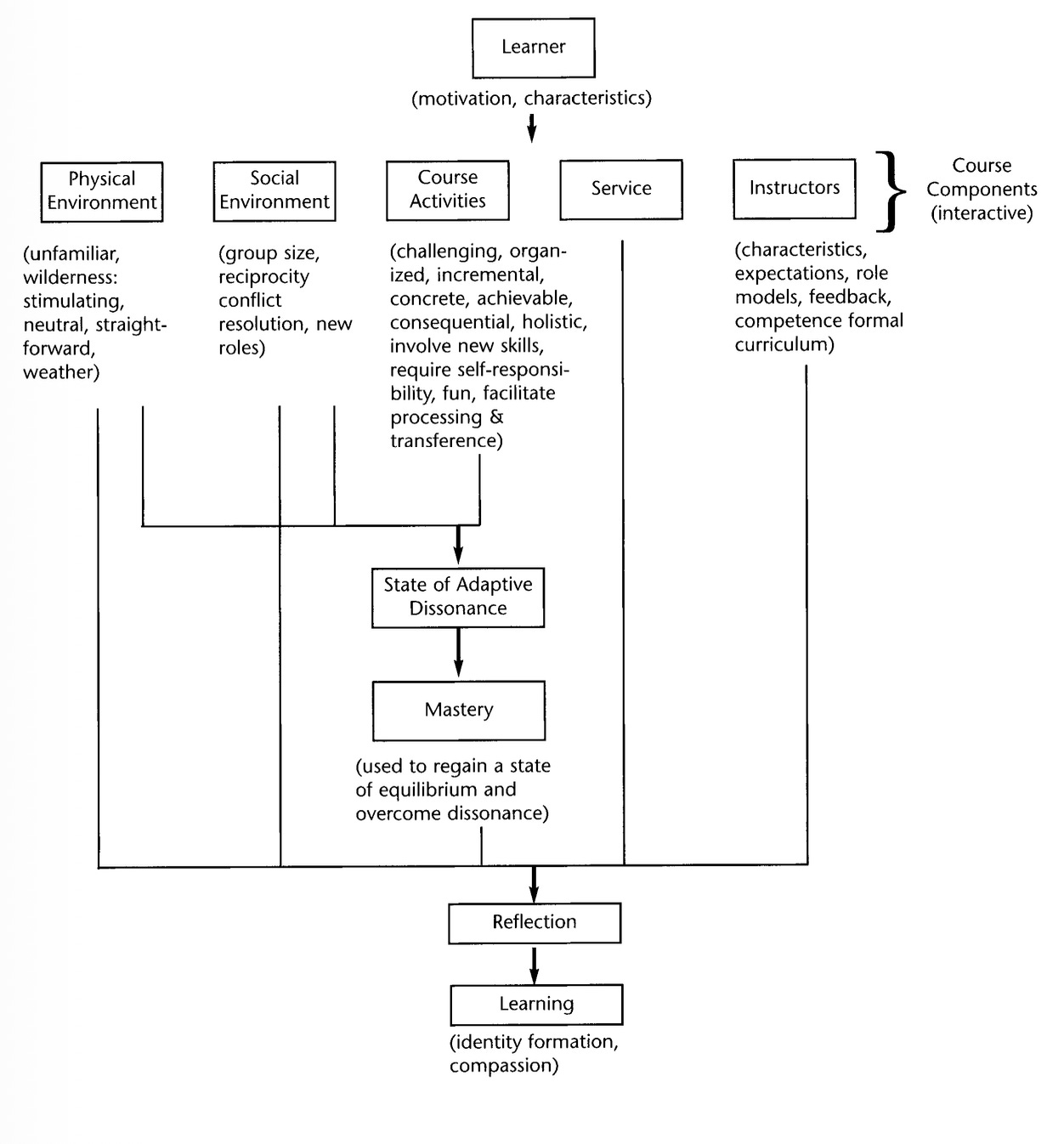
Williams made passing reference to a 2003 paper by McKenzie. This paper, on the learning process during Outward Bound courses, was too late for Higgins to take into consideration; but to my mind it is deserving of more than a passing reference because it presents the complex nature of residential adventure education graphically (see figure, below). The publication doesn’t refer to complexity at all, but it does make the point that course elements interact. The graphic doesn’t need much explanation. It includes the inputs to the complex process – the learner, the physical and social environments, course activities, service and instructors – and towards the bottom, reflection and the emergent learner. The involvement of instructors at a late stage in the process is misleading though, since outdoor instructors are teaching, encouraging, reviewing and reflecting with the learners throughout the residential experience.
McKenzie’s model of outward bound learning (2003)
Of these three research papers only Higgins 2001 referred explicitly to interdisciplinary learning, yet all the authors were aware of residential course components interacting on the learner during the learning process. However, other papers do refer. In 2012, Allison and co-authors, writing about Scotland, said, ‘It is arguable that outdoor learning, conceived in an interdisciplinary way, might well provide the kind of educationally meaningful links for which recent curriculum initiatives like Curriculum for Excellence have sought.’; and in 2024 Higgins said, ‘Education outdoors has long been a feature of Scottish education in school grounds, locally and at residential centres, and lends itself to practical, innovative interdisciplinary pedagogies’. Allison et al. made a passing reference to complexity to bemoan the fact that at their time of writing pupils had very limited appreciation of the importance of complex problem solving. However, in 2010 Learning and Teaching Scotland had already moved on this and said, ‘The introduction of Scottish Baccalaureates, particularly in Science, at Higher and Advanced Higher together with an interdisciplinary project will offer opportunities for the outdoors to be used as a context for learning.’
Learning in the outdoors is one of the four contexts for learning in the Scottish Curriculum for Excellence not least because it provides opportunities for personal development, and the development of life skills that bear on pupils’ motivations and attitudes towards learning.
Dr. Roger Scrutton has a background in geology and geophysics as a member of academic staff in the School of Geosciences at Edinburgh University from 1974. He is now an Honorary Research Fellow in the Outdoor Education Group at Edinburgh.
References
Allison, P., Carr, D., & Meldrum, G. (2012). Potential for excellence: interdisciplinary learning outdoors as a moral enterprise. Curriculum Journal, 23(1), 43-58.
Higgins, P. (2001). Learning outdoors: Encounters with complexity. Other ways of learning, 99-106.
Higgins, P. (2024). Nature’s classroom: Tackling the climate and nature crisis through Scottish schools. Resource, Royal Society of Edinburgh, Spring, 2024, 16.
Krathwohl, D.R., Bloom, B.S., & Masia, B.B. (1964). Taxonomy of educational objectives: The classification of educational goals. Handbook II: The affective domain. New York: David McKay.
Learning and Teaching Scotland (2010). Curriculum for excellence through outdoor learning. 28pp.
McKenzie, M., & University, S. F. (2003). Beyond “The Outward Bound process:” Rethinking Student Learning. Journal of Experiential Education, 26(1), 8-23.
Williams, R. (2013). Woven into the fabric of experience: Residential adventure education and complexity. Journal of Adventure Education & Outdoor Learning, 13(2), 107-124.
Criminology is a multidisciplinary field. It draws on sociology, psychology, law, neuroscience, philosophy, and more. But multidisciplinary is not the same as interdisciplinary — and that difference matters enormously, both for the researchers in the discipline and for how we teach it.
A multidisciplinary field borrows from many places, but an interdisciplinary one asks how those borrowings fit together. Criminology has historically done a great deal of the former and rather less of the latter. As Gerben Bruinsma argued in his 2015 ESC presidential address1, the field has generated hundreds of crime causation theories without necessarily achieving greater explanatory power and resembles a ‘battlefield of conflicting ideas’. Theories proliferate, but they often operate on different — sometimes mutually exclusive — assumptions, and scholars tend to form camps that rarely interact. The result is fragmentation: a field rich in perspectives but lacking the integrative frameworks to connect them.
This creates a real problem in the classroom. First-year students arrive to find a dizzying array of theories taught week by week, discipline by discipline, with little explicit guidance on how these perspectives relate to one another or why they sometimes conflict. Students default to what feels familiar — typically the sociological approaches they encountered at A-level — and struggle to move beyond description toward genuine critical engagement.
Our paper2, which I published with my PGTAs on the module, published earlier this year in Humanities and Social Sciences Communications (2026), asks a simple question: what happens when you deliberately bring interdisciplinary thinking into a multidisciplinary field? We used a first-year Criminological Theory module at the University of Birmingham as our case study, and the findings suggest it makes a real difference.
What we did
We redesigned the module around an explicitly interdisciplinary structure. From the very first lecture, we introduced students to epistemology and the philosophy of science — not as abstract prerequisites, but as practical tools for evaluating the theories they would encounter throughout the semester. We asked: what counts as evidence? What assumptions does each theory rest on? How do different disciplines approach the same question — the question of why crime happens — with different methods and different starting points?
We gave students integration frameworks to work with: end-to-end integration (proposing a causal order between theories), side-by-side integration (recognising that different theories may fit different types of crime), and up-and-down integration (understanding that different explanations operate at different levels of analysis). These frameworks gave students a shared vocabulary for talking about how theories relate to one another — moving them from a multidisciplinary encounter with many perspectives toward an interdisciplinary practice of connecting them.
The module combined lectures, seminars built around structured debates, circle-of-voices discussions, comparison tables, and concept maps, a self-guided online “jigsaw module” developed with Florida International University’s Science and Fiction Lab, and a summative essay that rewarded cross-disciplinary comparison and epistemological reflection.
What students told us
We conducted semi-structured focus groups with five students and analysed the data thematically. Four themes emerged, and they speak directly to the multi-to-inter shift.
Students described moving from what happened to why it happened — from cataloguing theories to interrogating the assumptions beneath them. As one student, Emma, put it: “I now think about why a crime happened … not just that it happened.” Seminar discussions evolved from what another student, Mary, called “versus debates” into “together debates,” reflecting a growing capacity to hold multiple perspectives in productive tension rather than picking sides.
The jigsaw module — combining criminology, neuroscience, and supernatural fiction — was described as “eye-opening” but also abstract. Students valued the interdisciplinary connections it surfaced but wanted clearer scaffolding. This is a useful reminder: moving students from multidisciplinary exposure to genuine interdisciplinary thinking requires deliberate structure, especially when the task is unfamiliar.
Students consistently praised practical tools — Coleman’s boat for bridging micro and macro analysis, comparison tables, concept maps, and real-world case studies — as the moments where integration became tangible. And they reported a “comfort zone bias” toward sociological theories, asking for more sustained engagement with psychology and biology. The multidisciplinary habits of the field, it turns out, are reproduced in students’ own instincts — which is precisely why an interdisciplinary intervention matters.
Why this matters beyond criminology
Many fields are multidisciplinary in practice — they draw on multiple traditions — without being interdisciplinary in pedagogy. Students in these fields encounter diverse perspectives but are rarely taught how to integrate them, compare their epistemological foundations, or evaluate where they genuinely complement or contradict one another.
Our findings suggest that when you make interdisciplinarity a deliberate, scaffolded part of the curriculum — when you give students the tools and vocabulary to do the integrating themselves — it supports critical thinking across three dimensions: analytical depth, cross-disciplinary synthesis, and reflective engagement. These are transferable outcomes. The specific theories belong to criminology; the pedagogical approach does not.
For anyone teaching in a fragmented or multidisciplinary field, the invitation is straightforward: make the interdisciplinary character of your discipline visible and deliberate. Name the epistemological differences. Give students frameworks for navigating them. Design assessments that reward integration rather than reproduction. And then ask your students what happened — because, as we found, they will tell you.
Evelyn Svingen is an Assistant Professor in Criminology at the University of Birmingham, where she teaches criminological theory and serves as Programme Director of the BASc in Social Sciences. She has also served as Program Director for the MRes in Interdisciplinary study and as Academic Lead in Social Sciences at the Liberal Arts and Natural Sciences (LANS) program. Her research spans evolutionary and biosocial criminology, cooperation, and punishment. She is the author of Evolutionary Criminology and Cooperation: Retribution, Reciprocity, and Crime (Palgrave, 2023), winner of the 2024 European Society of Criminology Book Award, and lead editor of Building and Sustaining Interdisciplinary Higher Education: Lessons from LANS (Palgrave, forthcoming).
Egle Tsirova and Ulviyya Khalilova are postgraduate teaching assistants in the Department of Social Policy, Sociology and Criminology at the University of Birmingham, where they co-designed and co-facilitated the module’s seminars and focus group research.
Bruinsma, Gerben. “Proliferation of Crime Causation Theories in an Era of Fragmentation: Reflections on the Current State of Criminological Theory.” European Journal of Criminology 13, no. 6 (November 2016): 659–76. https://doi.org/10.1177/1477370816667884.
Svingen, E., Tsirova, E. & Khalilova, U. Developing critical thinking through the lens of interdisciplinarity: a case study of a criminological theory module. Humanit Soc Sci Commun13, 211 (2026). https://doi.org/10.1057/s41599-026-06517-4
Graduate employability is often discussed as if it were a single attribute: either you have it or you don’t. For the London Interdisciplinary School (LIS), that framing is too blunt to be useful. Employability is better understood as a pipeline: students develop skills and gain knowledge, gather evidence that both are relevant and valuable, and receive structured support to translate that evidence into opportunities.
To create that pipeline effect, LIS’s employability offer is carefully designed to be curriculum-integrated. It is not limited to end-of-degree careers advice; it is built through the degree experience itself, reinforced by academic coaching, practical internship experience, and targeted careers support.
Graduate outcomes: the headline and what sits behind it
LIS’s first undergraduate (BASc) cohort outcomes show 89% of graduates in skilled work and/or further study15 months after graduation. Just as importantly, graduates are moving into a spread of sectors rather than clustering into a single destination: the largest share go into business and consulting, followed by research and data, sustainability and ESG (Environmental, Social and Governance), and tech and software, with others progressing to finance and investment, government and policy, and media and marketing, or entrepreneurship and sport and youth engagement.
This mix matters because it gives context to the headline figure: it suggests outcomes are being driven by transferable capability (and the ability to evidence it) rather than narrow occupational training. In other words, a strong “how” sits behind the percentage: repeated practice applying learning to real problems, credible outputs that can be shown to employers, and structured support that helps students translate what they can do into what employers can recognise.
A labour market shaped by skills signals
LIS builds employability against a national shift toward skills-based recruitment. According to the Institute of Student Employers (ISE), 58% of UK employers already hire for skills - a reminder that recruitment is increasingly driven by demonstrable capability rather than by credentials alone.
This has a direct implication for an interdisciplinary degree, and for graduates from all institutions, entering the labour market at a time of AI disruption (FT.com, paywalled) and the possible shrinking of the graduate labour market. An interdisciplinary education with its corresponding breadth can be an advantage, but only if students make that breadth legible: what they can do, how they do it, and what evidence proves it. In practice, employability support needs to help students produce that evidence and tell that story clearly.
Employability through programme design
The LIS BASc degree is structured around tackling complex, real-world problems using interdisciplinary perspectives and methods. The point is not only to learn concepts, but to use them, turning knowledge into outputs that are meaningful beyond the classroom.
A core mechanism is regular, timetabled coaching in small groups. This is where students are pushed to synthesise learning across domains, reflect on how their thinking is changing, and develop the habits that matter in work settings: problem definition, collaboration, judgement under uncertainty, and clear communication. In employability terms, coaching helps students do something many graduates struggle with: explain not just what they learned, but how they can work as a result.
Practical experience and targeted careers support
The LIS employability offering complements teaching and curriculum design with structured support that makes skills visible in employer-recognised ways:
Internships and applied work: students work on real organisational problems in the curriculum and on internships that evidence their capability in real settings.
One-to-one careers coaching: support is available to help all students define goals, prepare applications, and develop a coherent professional narrative.
Networked employer engagement: brokered and facilitated interaction with employers and organisations helps students understand sectors and career pathways as well as role requirements and hiring processes.
We also recognise that employability is a moving target, and map programme learning outcomes to forward-looking skills themes, including those set out in the World Economic Forum’s Future of Jobs reports. The intention is not to train students for a single first role, but to build durable capabilities - analytical and creative thinking, technological fluency, and adaptive problem-solving - that travel across sectors as roles evolve.
Widening participation and transition risk
A final dimension is transition support for students at higher risk of becoming NEET (not in education, employment, or training). At LIS, employability is strengthened when support is personalised and cross-functional, combining academic delivery, coaching, and careers interventions as a joined-up system rather than separate services.
What to take away
LIS’s employability offering works because it is an integrated system: the degree builds capability through interdisciplinary problem-solving; coaching develops synthesis and articulation; and practical experience plus careers support ensures students leave with evidence that employers can recognise. The outcomes data is remarkable, but the differentiator is the mechanism: employability is designed into the student journey, so graduates can demonstrate their skills, not merely claim them.
Ahead of more official outputs, here are a few of my own brief notes from yesterday’s IDL Conference at the Edinburgh Futures Institute.
The event was opened, after the introductory welcome from David Overend and the director of the EFI, Marion Thain, with a superb keynote from Helena Good, OBE, MD of Daydream Believers, a visionary group of people who are making real impact on young lives through their qualifications for young people on creative thinking and innovation. Helena shared some of her journey with us and a video of Stanley, ambassador and alumnus. It’s worth a look, especially if you are a teacher in school:
I spent the rest of my day hearing from some great speakers and presenters, from PhD students to educators of long experience working in interdisciplinary ways, not least of which was Dr. Roger Scrutton, champion of outdoor learning who anticipates the impact of the recently passed Scottish Residential Outdoor Education Bill. This Act gives all pupils in state and grant-aided schools in Scotland the chance to experience residential outdoor education. If there is capacity in our outdoor provision, this will be, in my opinion, a great thing.
There were far more talks and presentations available than one person could attend but instead of carving myself a highly personalised selection from the programme (that would have demanded walking between venues), I took the lazy option of staying in one room and taking my chances. It was a good strategy because the quality of talks was very high. The challenge for presenters of the “lightning talks” was time, being limited to five minutes, carefully policed by a time-keeper. I was skeptical about this at first, hardly being able myself to deliver a joke in that time, but all of those I saw managed to step up and make a coherent and confident impression. It was a joy to watch.
It could be said that higher education dominated the programme but the organisers had tried hard to extend the opportunity to the school sectors, and the RSE bursary helped achieve a better balance. Alison Murray and Nuzhat Uthmani from Stirling University explained their spiral curriculum approach to teaching across the responsibilities for all (health and wellbeing, numeracy and literacy) for primary student teachers. Joanna Stell from Impington Village College talked in detail about the development and success of interdisciplinary projects for secondary pupils on the international baccalaureate programme. For me, the strength of her talk was the stance of critical evaluation taken by the educators involved in the trial and development. She asked what factors might be in play and refused to accept that for the successful examples, such as “the Cambridge witches in iambic pentameter”, a project spanning English and History within a local context, it was a matter of luck. Here, for me, lies the critically inquiring stance of professional education.
I am conscious that I can not do justice in this short post to my day at the IDL conference, so I am going to do the injustice of stopping here with an apology to those I ought to have mentioned. What I will say is that it was really refreshing to experience such warm reflection and creativity in a collaborative and collegiate atmosphere at the EFI. I am encouraged that we are finally beginning to “get it” perhaps, and I am excited to find out more of the curricular reform currently under way in Scotland that promises to finally address the missing leg of Curriculum for Excellence, that of interdisciplinary learning. Throughout the day there were so many good opportunities to network with friends old and new, including a number of teachers who had been supported by a bursary from the Royal Society of Edinburgh. Our own Professor Colin Graham closed out the conference to the clink-clink of beverages arriving for the post-conference soirée.
The title of the Interdisciplinary Learning and Teaching Conference 2026 is “Interdisciplinary Pathways: Engaging Learners and Creating Opportunities”. Organisers have issued a call for papers for this annual conference, to be held in Edinburgh at the Edinburgh Futures Institute, on Thursday 16th April 2026.
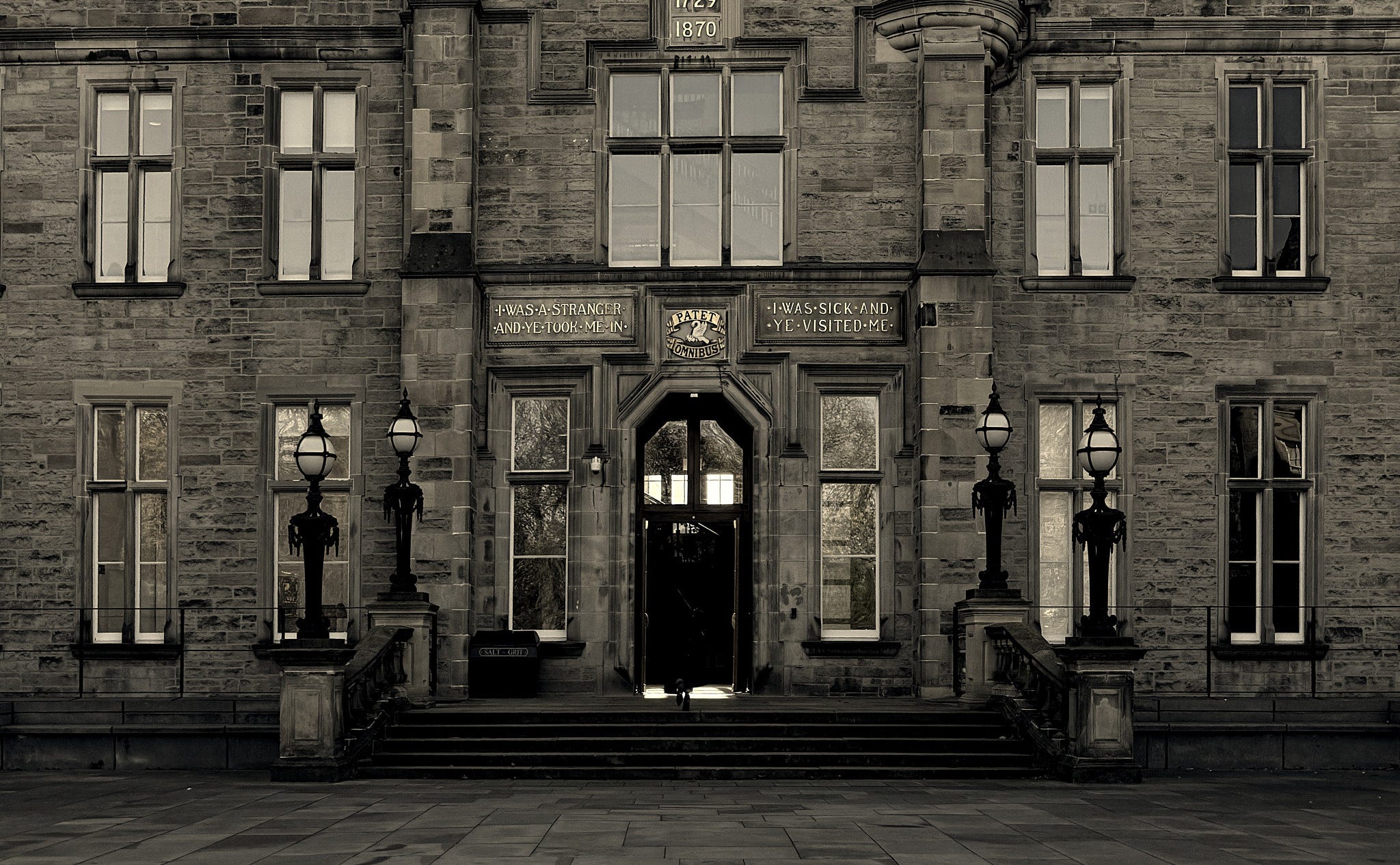
The Edinburgh Futures Institute
This year’s Conference will focus on how interdisciplinarity can be supported, structured and created in different educational contexts, including those before and beyond higher education.
A learner’s interdisciplinary journey may start at various points and this Conference will focus on the place for interdisciplinary opportunities - including points within the curriculum as well as physical and intellectual spaces.
The focus will also consider collaborations for transdisciplinarity across disciplines and across organisational boundaries – within universities, with primary and secondary schools, with the local community or external partners.
The Conference welcomes examples of how interdisciplinary activities can impact learners through projects which transcend university or academic boundaries. Outcomes from these opportunities which might measure transferable and lifelong skills and experience are particularly welcome. Student perspectives and contributions are greatly valued within all submissions.
Conference themes
All submissions should address one or more of the following conference themes. You will be asked to identify the relevant theme(s) when submitting your application:
Pathways for Interdisciplinary Activities
This theme relates to ways in which interdisciplinarity can be introduced and extended in a learning journey, perhaps in secondary schools, in the early years of university, in short courses, or in lifelong learning. Submissions should outline or explore ways in which interdisciplinary activities and experiences can be sustained over time, including ways to identify interdisciplinary opportunities within existing curriculum as well as focused interdisciplinary events or projects. Examples of long-term interdisciplinary ventures or ways in which the interdisciplinary conversation are opened in different spaces are particularly welcome.
Spaces for Creativity in Interdisciplinarity
Making a place or carving out space for interdisciplinary opportunities can be difficult as pressures on students to achieve goals related to attainment and potential future employment become stronger. But re-defining interdisciplinary activities in terms of creativity or independent thought might provide new routes into interdisciplinary activities. If interdisciplinarity is framed in terms of ‘making something new’, this may provide a justification for students and faculty that resonates beyond the established curriculum; the ‘unique selling point’ perhaps. Contributions to this theme should include examples of how creativity and creative thought are embedded in interdisciplinary activities and ways to enhance existing interdisciplinary activities through creativity.
Collaboration to Support Interdisciplinary Opportunities
Increasingly, interdisciplinary opportunities attempt to transcend traditional boundaries, such as those between disciplines, across disciplines or between the institution and the local community. These challenge-based and experiential projects offer a focus for multi-subject considerations of complex systems, and provide a valuable connection between the university and the local community. Collaboration can also take place within campus environments, such as between faculty, academic support services and archival evidence. Contributions to this theme should highlight examples of where collaboration has worked well and provide guidance for how this might be implemented in other contexts.
Wildcard
An important development within the interdisciplinary learning and teaching arena which may not fit neatly into one of the themes above. Please make the rationale for the wildcard clear in the abstract submission.
Submission formats
The organisers invite submissions for short papers and lightning talks. We will do our best to accommodate your preferred format, but this will depend on space available within the schedule, and we may contact you to discuss an alternative format.
Short paper Presentation which follow traditional conference presentation format, though we also welcome submissions offering opportunities for interaction. These should be limited to 15 minutes to be followed by five minutes for questions.
Lightning talks should be limited to 5 minutes, and no more than 5 slides (or equivalent). Lightning talks offer a fantastic opportunity to share new ideas, capture insights gained, generate hallway conversation, and receive helpful feedback. They might:
- focus on a particular element of successful practice
- recount lessons learned
- capture an account of impact
- describe a challenge that would benefit from community feedback
- propose a collaborative project
We would particularly welcome lightning talk submissions from students, educators who are new to interdisciplinary teaching, and non-academic staff working to support interdisciplinary education (e.g., learning technologists, librarians and professional services).
Conference format
In addition to hosting conference papers and lighting talks, additional sessions which support more informal ways to share experience may be offered. These sessions will be designed by the conference organisers, but we will invite delegates to submit their ‘interdisciplinary challenges’ to shape their focus. We will ask for these when you register to attend the conference.
Our goal of encouraging active participation and dynamic exchanges means that the conference will only run as an in-person event.
Closing date for Submissions: 16 January 2026
The submission form can be found at this link. It asks for the following details, which you may wish to have ready:
Name and contact details of the presenter(s)
The Type of Submission (Short Paper/Lightning Talk) and the sub-theme of the submission (Pathways for Interdisciplinary Activities/Spaces for Creativity in Interdisciplinarity/ Collaboration to Support Interdisciplinary Opportunities/Wildcard)
Short Paper: A Title of the Submission and an Abstract of no more than 250 words
Lightning Talk: A Title of the Submission and an Abstract of no more than 150 words
A short biography of the presenter(s) of no more than 150 words (each)
This is the ninth Interdisciplinary Learning and Teaching Conference and information regarding previous conferences can be found at this website.
For further information please contact the conference organisers:
Education, as with other professions, expects practitioners to sustain their own development. Often this may be connected to self-reflection on experience and engagement in keeping up with new developments in the field. Developments in education are ever present. They may be driven by local and national policy changes; curriculum improvement initiatives; or perhaps changes in society, community context or technology. Teachers can struggle to keep ahead of the demands of the profession all around them but perhaps the greatest pressure can come from ourselves as we try our best to not let the kids down and give them the best chances.
I had the chance recently to reflect on some of these matters in a conversation with Louise Darcy, a practitioner who had been looking at her own development. Louise is an experienced Primary Teacher who, returning to school after a summer break, felt that there were aspects of Scottish Education that she wanted to better understand, interdisciplinary learning being one. Finding the Teaching Matters blog, she contacted the chief editor Dr. Jenny Scoles, who kindly put Louise and I in touch. We arranged to talk over an online call after school.
We both imagined a half hour chat but found that a professional conversation can become a rich exploration of policy, ideas, practice, shared concerns and experience. Louise wrote a post about it on her own SubStack:
In that post, Louise shares her motivation and professional curiosity in exploring interdisciplinary learning, some of the resources she found helpful, and the next steps she is planning for herself and the children she teaches. Her follow up post should be read also, for the sound advice Louise has for other classroom practitioners about knowing when to stop; self-care is possibly (in my view, at any rate) the most significant duty of the professional. It is important to develop capacity in professions like teaching and to remain committed to being the best version of yourself that you can be. Developing confidence and competence in situating your practice within the interdisciplinary context for learning is an essential, if sometimes neglected or poorly understood foundation of our education system. All practitioners should continue to strive, as Louise is doing, to bring that foundation to the lives of the children in their care, but do not forget to “put your own mask on first.”
Look out for more from Louise on her SubStack soon. She is already reporting that “it's been great to see how the children have responded and how, slowly but surely, real progress is being made.“
Inspired by the Edinburgh Biodiversity Action Plan and the Fountainbridge Canalside Initiative (now the Fountainbridge Canalside Community Trust), this design for a problem-based interdisciplinary unit of work for secondary children offers opportunities for learner agency. Options are provided for a learner pathway that build on the foundational lessons introducing biodiversity within a problematised urban context.
This presentation, like others in the Natural Partners collection here on the IDL network, is part of a formative assessment activity in which peers, tutors and invited IDL experts are asked to provide advice and next steps guidance to students who will go on to trial aspects of their detailed IDL planning in a subsequent placement. You can see that in the penultimate slide in this particular deck. As the product of creative design and planning, these offer great ideas for other teachers seeking encouragement for their own implementation of the fourth context for learning in Scotland’s Curriculum for Excellence, currently under review. Following the Hayward report, it is expected that interdisciplinary learning will feature at least as strongly in Scotland’s schools into the future, engaging with sustainability and the demand for stronger critical skills in our citizens.
Teachers are welcome to adapt the designs in these outline units of work for their own planning of interdisciplinarity and learning for sustainability.
Urban environments, especially when highly populated, face significant challenges around food sustainability, green space, and community. This is evident around the Union canal but has the potential to be transformed into a productive and vibrant green area. In this interdisciplinary project, learners look at vertical farming systems as a solution to transform the area around the canal into a community-centred green space that promotes healthy food, environmental awareness, and social connection.
Sophie’s unit design idea sets out details for problem-based interdisciplinary learning that addresses outdoor learning, STEM and sustainability, linked to specific UN development goals, all connected within the four capacities of the curriculum.