Tag Archives: policy

Co-creating open solutions through interdisciplinary collaboration for the future of education⤴

from @ ...........Experimental Blog


It was a pleasure to attend the Open Solutions Workshop in Bilbao as a guest of #UNESCO and the University of Monterrey.

The eProjects Bootcamp is an initiative that focused on equipping participants with the skills and knowledge needed to develop and implement innovative projects using technology. 

I am now working on a global education project around applications of the open badges framework. A number of the other projects have a focus on AI and teachers and learner skills and around Open Educational Resources. 

It was great to work with focused colleagues from around the world and have a little time to see around Bilbao and enjoy Spanish hospitality. 


In due course I will be in touch with relevant institutions and agencies in UK who will benefit from working with this collaborative. 

It was well run, very focused, and a challenging couple of days.  It was good to work with teams who were technically able and prepared to hit the ground running. We made full use of the tools that were available to us including https://grantedai.com/  


Turkish Vocational Qualifications Authority Exchange Ankara⤴

from @ ...........Experimental Blog


It was an amazing privilege to be invited to make two presentations, chair and  participate in a series of workshops in Ankara following catching up with the Turkish delegation in Scotland some seven months ago.

I was on familiar ground around talking occupational standards, national awarding , accreditation, credit and levelling and quality control at national and centre level, but my talk was about how centres can use technology to support innovative delivery  and personalised assessments which is my current day job, reflecting the work of our team. 

I know we as a centre can support centres and training staff in Turkey to innovate their practice. I hope a partnership can grow around that. 

Interesting opportunities too with a large centre in France for learner and staff exchange and with a centre in Italy keen to figure out portfolios, microcredentials and digital badging with us. I'll take these back to our international team. 

It was great to hear the progress that has been made in Turkey where they have broadly adopted the Scottish Vocational system. Like many other countries. Unit based awards with clear approval criteria for centres and a sensible sampling quality assurance process is a sensible option. Well done SQA who were along to support event and great to catch up with Roderic Gillespie and Donald Paterson two former SQA colleagues supporting the developments in Turkey. Well done too to the SCQF partnership who were truly european trail blazers around setting up a national qualifications framework. 

We visited a really well equipped training centre and sampled their processes. These would be familiar to any training centre or College in Scotland. One thing stood out, when assessing candidates on solar panel installation or working at height on powerlines, all of the practical assessments are videoed as evidence and kept for later sampling. At moment evidence is required to be kept for 100 years. In Scotland we just need to hold evidence for around 12 months, though we do keep records of resulting for 3 - 5 years.

It was good to hear too the progress that has been made in France, Italy and Germany who made presentations on their own systems. 

All have clear employer levies that support employers and trainees. France and Italy have perhaps the most flexible system to support employers and employees upgrade their skills.  Germany is looking to modernise their established system - the delegates knew that many countries look at their system as leading.  It was interesting to hear them describe their own system as like Sputnik - a world first but now in need of upgrading. Their system is creaking a bit in terms of it ability to innovate and on the ground they are having challenges around recruiting and retaining assessors. 

My own reflections - 

  • I think we need clearer line of sight in Scotland between the employer levy and where money is then committed to the vocational system. It is clear that is an essential element of a successful vocational system. 
  • Ankara is a modern metropolis of 6 million people, it's very cold in winter - but with warm friendly people and amazing food. Turkey has a population of 84 million. 
  • I've encountered the massive success of Scottish vocational system all around the world. It is easy to forget for a tiny country, we have always hit well above our weight on educational exporting, developing global thinking not at institutional but at national level, this around our vocational system - not school assessments nor the Scottish University system. I am still concerned this will be seriously disrupted or even lost when reforms come to SQA. 
  • Other countries are making strong progress around digital certification. In Turkey you can request your certificate in any major language. 
  • It was great to meet again colleagues from the European Training Foundation and from GOPA  and great to hear that expat Glaswegians in their ranks  follow my wee brother's Lost Glasgow Facebook and Twitter pages. 

Here in full flow speaking and chairing and  presentation linked to this blog post.  The work here is a reflection of work across the Learning and Teaching Academy at City of Glasgow College. I'm taking some Turkish delight back to my team
. 


Talking about digital learning with QAA Scotland⤴

from @ ...........Experimental Blog

Here is video and  summary transcript of video I was asked to share with QAA Scotland for recent conference. 

What is your role at City of Glasgow College?

I am head of digital skills - but what it means is that I look after College learning technology and push out models for blended learning. 

Biggest task in the last 2 years has been taking College from self hosted Moodle on to Canvas by Instructure. 

We do everything in the open - so most of this is reflected in learning and teaching academy website - along with staff and student support materials. 

What is some recent work that you have been working on regarding blended?

Simply encouraging staff to use full range of tools available to them appropriately. 

Using Jisc survey feedback from staff and students to shape our offer.

Learners want a more standard blended learning experience. 

Staff want more training and support - and time. We can offer the first two.

How does City of Glasgow College approach blended?

We work from a model based on UCL ABC model at City of Glasgow College we call this Active, Blended and Connected. 

Boring but necessary things like consulting on , creating and promoting a standard Canvas template. Students want basic elements in any online course. 

What course is about , a sensible order of course materials , a introduction to teaching staff and  information on how to contact them.

On course materials been encouraging more use of quizzes and different forms of assessment and more use of pre-recorded video ( short 8 minutes) 

Post pandemic courses are delivered in mixed mode some on site and some online.

We have some rooms set up for hybrid teaching - but most staff simply cannot cope with this - it is very difficult to give face to face and online learners a positive experience synchronously. 

What are you hoping for in the future?

My hopes haven't really changed since late 1990's when as a lecturer all my materials were on the internet and available for all my students and for any colleagues that wanted to augment these or adopt them. I think we still have a long way to go before staff and students are confident open practitioners and collaborators around learning and assessment. 

We can see AI arriving and we have a policy in place - but the next thing is really training AI on our own data sets. 

I can see role too for more intermediate tools like Teachermatic .

VR/AR still had enormous potential but challenge is using these tools in a cost effective and sustainable way - tools like ThingLink will open door here.

The CDN/GTCS digital standard for lecturers will become a great driver in terms of professional review. I don't think staff are really aware that they now have a benchmark to meet. 

We are working to a set of College attributes for all learners - remember core skills and meta skills are a thing in College landscape - these attributes will help us move on digital skills. 

We work within a lifelong learning - national system - Colleges can play their part - it would be good to see more examples of resource sharing both across the College landscape and between University system and College system. Colleges should be doing a lot more for schools too. 

We will do more with Canvas commons, Canvas credentials, Canvas Folio  - Commons to share whole courses with other Colleges and internationally. Credentials to support initially our College attributes and then to offer certification for some open less formal provision - open to all.  Canvas Folio to give learners a folio of their own work to take with them when they leave college. 

I'd still like to see more lecturers and managers across Colleges in Scotland maintain reflective blogs or journals. Social media and networking is driven by activities like this - too much practice is siloed across the school , college and university system. 


That Digital Presence and Social Media Question⤴

from @ ...........Experimental Blog


We have become enthralled by the ceaseless hum of our electronic companions, those pocket-sized devices that have ensnared our attention and stolen our souls. We wander through life like sleepwalkers, heads bowed in reverence to the glowing altar of our screens, checking our social media, oblivious to the richness of the world that unfurls before us. 

Our digital avatars proliferate, each one a carefully constructed facade, a desperate attempt to assert our relevance in an increasingly disconnected world, and/or how you manage your digital presence actually matters. 

So, should you use; Twitter, Threads, Mastodon, LinkedIn, Facebook, Instagram, SnapChat , TikTok or Tumblr, or just walk away, or be simply terrified by social media.

And what about good old-fashioned blogging?

I've been using social media since it arrived. In the last century incidentally - though none of the platforms that existed then were actually called social media and they don't exist anymore. (ICQ, MySpace, Vine and many more etc)

I once set out what I use and why and I think given the recent proliferation of platforms perhaps time to do that again. Amusement too by overhearing a teaching colleague on the importance of online networking for learners, but not them ;-) 

Some past observations 

You do need to manage your online presence; it is a good thing to do. You can see 30 years of avatars on some of these sites.
  1. I am old and uncool, I use facebook with friends and family and try to keep it that way. If I don't know you really well, we won't be friends on facebook, sorry and no link with this item.
  2. LinkedIn for professional stuff - no chit chat or jokes - some links that reflect interesting things I am doing professionally, and I link with like-minded professionals. Always useful, I have had some very genuine job opportunities come along through LinkedIn. Be over familiar and or unbusinesslike and you're off my contact list. I only accept contact requests from folks that look relevant. So sorry not looking for a new life partner. Strangely now 6500 followers and over taking ..
  3. Twitter - controversial perhaps - but with #hashtags for topic searching and an established network 4500 followers approx. I post things that matter to me and use it as source of information and for networking. If you want to get the news first twitter is still best. Still a really useful tool. Anyone can follow me on twitter, and I think with one exception, a supporter of Russia's war in Ukraine, I've never blocked anyone. You may have concerns about new platform owner, but system still works well.
  4. Mastodon - I like the idea but seems to be lots of islands and I've had very few meaningful exchanges - has potential but not enough yet to get me to switch off my Twitter account. Usual suspects educational technologists seem to be first of my extended community here. It's too early as some have publicly done to ditch twitter account in favour of Mastodon. Academic posturing? is that a positive or a derogatory term?
  5. Threads even more esoteric. As it brought across everyone that I am linked to on Instagram looks like it may useful and I'm very popular - but the jury's out. No tag searching etc - I am just not sure.
  6. Instagram, Snapchat, TikTok and Tumblr - I'm there - dig around and you will find me, but they are just not my thing. They are on my phone as my children wanted a look at these at some point. I can see appeal, but I am not making short video clips etc.
  7. Blogger and Blogging - Yes, I have my own domain and I can run instances of WordPress, but I stick to Blogger, it's simple and I've been posting since almost last century.  If you want to develop an idea and share it publicly, get a blog, would be my advice. You can do things just like this.
If you are a student or a teacher you really should have an awareness of how useful social media is - but it can make you or break you.  

What is your social media strategy ? Only you can figure this out but if done correctly it will help you personally and professionally.

And same sentiments mixed by Chat GPT 


Oh, the tangled web of social media! We've become prisoners of these pocket-sized devices that demand our constant attention, stealing our souls as we bow before their glowing altars. Life's a stroll in Slumberland, with our heads buried in screens, checking social media like clockwork, all while the world around us goes unnoticed.

Our digital avatars are multiplying like rabbits, each one carefully constructed to show off how relevant we are in this disconnected universe. Do we stay in this wild virtual dance, juggling Twitter, Threads, Mastodon, LinkedIn, Facebook, Instagram, SnapChat, TikTok, and Tumblr? Or do we pull the plug and walk away?

Good old blogging! I've been at it since before the dinosaurs roamed the web. Back in the day, we didn't call it social media, and now those platforms are as extinct as the dodo. Time to lay out my online empire.

First up, Facebook – that's where I hang with friends and family, no room for strangers on my digital porch. LinkedIn's my playground for the business world, strictly no chit chat or jokes here. It's all about connections with like-minded professionals, and maybe, just maybe, some job opportunities, if you're lucky. No unprofessional shenanigans allowed, folks!

Twitter, the land of hashtags and 4500 followers. Here, I post what matters to me, find all the juicy info, and hobnob with other birds of a feather. I'm not one to block, but if you're a fan of Russia's Ukrainian war, sorry, but we're not on tweeting terms.

Now, let's talk Mastodon – an intriguing concept, but feels like a bunch of little islands. I've had a few exchanges here, so it hasn't wooed me away from Twitter's snazzy nest just yet.

Threads? Oh, that's an enigma wrapped in a mystery. Since it imported all my Instagram friends, it appears I'm a superstar over there, but I'm not entirely sold on the whole shebang. Jury's still out on this one.

As for Instagram, SnapChat, TikTok, and Tumblr, they're just not my cup of tea. My kids dragged me into these realms, but I'm more of a bystander, not a performer in the short video circus.

Ah, Blogger, my trusty sidekick. It's simple, it's reliable, and I've been rambling on here since the digital dark ages. If you wanna share your thoughts with the world, get a blog – it's just like this ramble you're reading!

For students and teachers, social media can be your best friend or your worst enemy, so plan your strategy wisely. It can catapult you to greatness or crash your dreams like a runaway train. So, what's your social media game plan, folks? It's a wild digital ride out there!

Open Scotland @10 Plenary Panel synthesis & outputs⤴

from

To mark 10 years of the Open Scotland initiative, Joe Wilson and I ran two events as part of the OER23 Conference at UHI in Inverness, which provided an opportunity for members of the education community to reflect on how the open education landscape in Scotland has evolved over the last decade, and to discuss potential ways to advance open education across all sectors of Scottish education. 

Open Scotland Pre-Conference Workshop

Joe has already written up our pre-conference Open Scotland workshop, which brought together around 40 colleagues, in person and online, to discuss key challenges and priorities. You can read Joe’s summary of the workshop here: Open Scotland Reflections on Pre-Conference Workshop.


OpenScotland @10 Plenary Panel

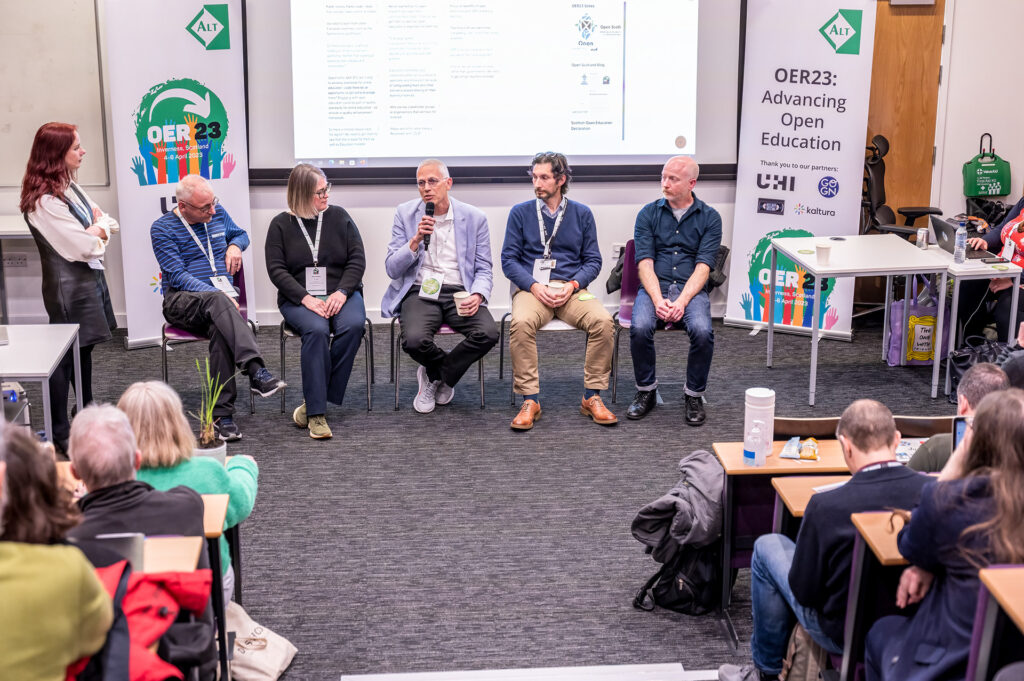
The closing plenary panel of OER23 brought together open education practitioners from within Scotland and beyond.  Panel participants were Lorna M. Campbell, Open Scotland and University of Edinburgh; Scott Connor, UHI;  Maren Deepwell, ALT; Stuart Nicol, University of Edinburgh; Robert Schuwer, consultant and former UNESCO Chair on Open Educational Resources; Joe Wilson, Open Scotland and City of Glasgow College.  Each member of the panel was invited to briefly share their thoughts on future directions for Open Education, before we opened the discussion to the floor. 

Photograph of Open Scotland Plenary Panel at the OER23 Conference.

Open Scotland Plenary Panel by Tim Winterburn.

Stuart Nicol, Head of Educational Design and Engagement at the University of Edinburgh, acknowledged that while it’s disappointing that there hasn’t been more support from Scottish Government, there has been a support for open education at a number of institutions, including the University of Edinburgh.  Stuart highlighted the important role of committed people who have pushed the open agenda within institutions.  Short of having government level commitment and policy, Stuart suggested we need to provide opportunities for people to come together to share practice and to encourage institutions to work together.

Scott Connor, Digital and Open Education Lead at UHI’s Learning and Teaching Academy, outlined UHI’s strategic commitment to open education which is underpinned by an OER Policy and a framework for the development of open educational practices. Scott highlighted lack government mandates and funding as a barriers to engagement with open education and suggested that real impact would come through the government adopting the Scottish Open Education Declaration and using it to mandate that resources created with public funding should be shared openly to benefit everyone. 

Both Scott and Stuart highlighted the OER policies adapted and adopted by the University of Edinburgh and UHI as a prime example of open education collaboration.

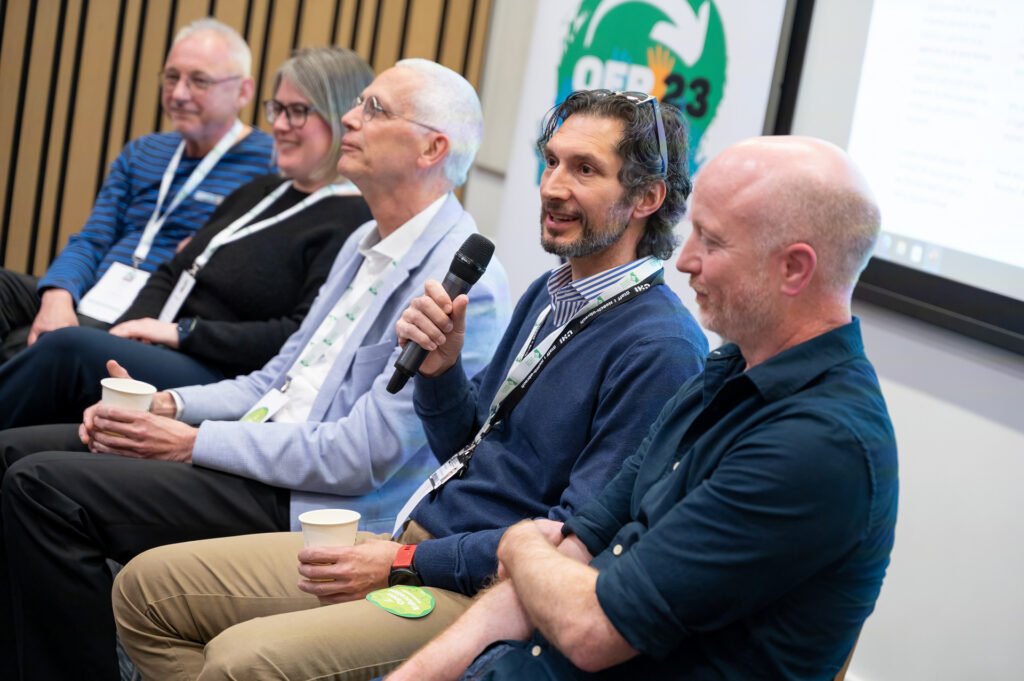
Photograph of Open Scotland Plenary Panel at the OER23 Conference.

Open Scotland Plenary Panel by Tim Winterburn.

Robert Schuwer, independent consultant and former UNESCO Chair of OER, provided an overview of open education in The Netherlands where the government has supported a range of OER initiatives and stimulation grants since 2006. In 2014 the Education Ministry issued a  strategic agenda stating that by 2025 all teachers should share their learning materials. Although some institutions such as TU Delft are front-runners, other smaller institutions are just getting started. 

Robert suggested that the biggest challenge is to cross the chasm from early adopters and innovators to the majority of teachers to encourage them to adopt principles of openness in education.  He suggested connecting to teachers passion, which is teaching, not sharing materials, and highlighting how open education can help them to become better teachers. 

Maren Deepwell, CEO of the Association for Learning Technology, reminded us that we’re not just talking about openness in Higher Education we’re looking at all sectors including schools, training, vocational education, FE, HE, and research. UK Government looks at Open Access research and thinks the open box is ticked. ALT has tried to reach out to both Scottish Government and the Department of Education, but often there is no one with responsibility for open education policy beyond Open Access and Open Research funding. 

Maren noted that we tend to see open education as another challenge alongside Brexit, the cost of living crisis, climate change, sustainability, etc., and ultimately it is never at the top of the agenda.  She suggested that our opportunity is to present openness as a way to solve these challenges.  It’s ingrained in us that openness is the extra step that teachers need more time, more funding, more skills, to take.  Instead we need to highlight how openness could solve resource scarcity and training issues, and help small independent providers collaborate across sectors.  We need to show openness as a way to solve these challenges, rather than as a stand alone challenge in its own right.

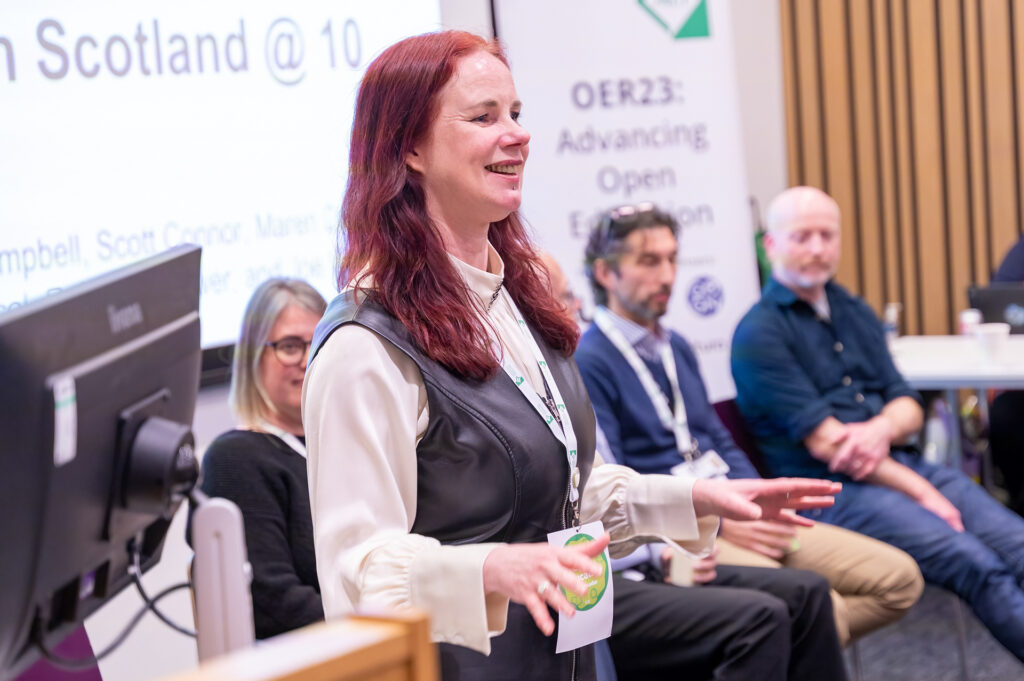
Photograph of Open Scotland Plenary Panel at the OER23 Conference.

Open Scotland Plenary Panel by Tim Winterburn.

Opening the discussion to the floor, members of the community put forward a range of comments and suggestions including: 

  • Taking a whole population approach to education rather than a sectoral approach. Open education is a way to educate for all our futures, not just those who can afford a good education. Open educators should collaborate with demographic data experts to see how open education could address key challenges of our ageing population, including health and social care. 
  • Start with early interventions at primary school level. How do children learn, what do they learn, what role models  do they see? Start to train a new generation of people to think in different ways. Currently there is no mention of openness in the General Teaching Council programme, but a logical place to start would be with teaching staff who are teaching children how to learn.  However because of concerns about GDPR, teachers work in closed environments, there are challenges around safeguarding and managing digital identities. 
  • Scotland’s baby box has been an import mechanism for learning for both parents and children, why not add a leaflet about open education?
  • Scotland has always had a very egalitarian tradition of education, the principles of openness fit well with this tradition, from school all the way up, so it’s frustrating that we haven’t been able to introduce open education at school level.
  • Maybe we’re trying too hard to change policy, perhaps it would be better to focus on doing fun stuff and sharing open practice. Do what you can at the small level; small OER, rather than big OER. This can be really powerful. Sharing in small ways can make a difference.
  • People hear about Open Scotland and are interested in open education, but they’re constrained by their local authorities or their college marketing teams. 
  • The strength of open education is in the grass roots, as soon as it get sucked into politics, it gets watered down. There is a risk that comes with government policy and funding. You cede some control when policy is dictated at that level.  At grass roots level we can control it, shape it and manage it.  It’s hard work pushing upwards but there is a danger when it comes from the other direction that we lose something and open education gets co-opted by people we may not wish to work with. 
  • Robert Schuwer countered this point by noting that this has not happened in The Netherlands.  Government support is provided at all levels of education but there is a lot of autonomy within institutions. The only mandates were the 2014 strategic agenda and a 2020 Open Access research mandate, both of which have been beneficial.  Robert also noted that students lobbied the Education Minister and had directly input to the 2014 sharing agenda.  This was also the case at the University of Edinburgh, where EUSA encouraged the University to support open education and OER. 
  • We have a political problem in that our education ministers don’t know much about education, so openness is never a priority.  We need to trust ourselves and continue with the grass roots work.  We need to feed messages up to government ministers that open education can be a solution to sustainability and other strategic agendas.  We need to take our advocacy up a notch, perhaps take out an advert in the press. 

Next steps

The next step will be to continue synthesising the outputs of the workshop and plenary panel, captured in this Padlet, with a view to drafting a new Open Scotland manifesto to share with the community and move the open education agenda forward. 


Made with Padlet


History of #OER in Scotland Ushare⤴

from @ ...........Experimental Blog


ChatGPT-  knows more about U-Share than many Scottish teachers or College lecturers 

Ushare is an online platform provided by the Scottish Qualifications Authority (SQA) that allows teachers and lecturers in Scotland to share resources and materials related to teaching and learning. The platform is part of the SQA's wider commitment to promoting and supporting the use of open educational resources (OER) in Scotland's education system.


Through Ushare, teachers and lecturers can upload and share a wide range of resources, including lesson plans, worksheets, presentations, and multimedia materials. The platform also includes a range of tools to help teachers and lecturers find and discover resources that are relevant to their teaching needs, including search functions and browsing by subject or level.

One of the key benefits of Ushare is that it allows teachers and lecturers to access resources created by their colleagues across Scotland, helping to promote collaboration and sharing of good practice. The platform is also designed to be easy to use, with a simple interface and straightforward upload and sharing functions.

Overall, Ushare is an important resource for teachers and lecturers in Scotland, providing a way to access and share a wealth of teaching and learning materials. The platform is free to use and open to all teachers and lecturers working in Scotland's education system.

Open Scotland @10⤴

from

OER23 Conference logoThis blog post was originally posted on the Open Scotland blog. 

To mark 10 years of the Open Scotland initiative we will be holding two events as part of the OER23 Conference to bring together members of the education community in Scotland to reflect on how the open education landscape in Scotland has evolved over the last decade against the backdrop of global crisis and uncertainty (Campbell and Wilson 2021). Hosted by ALT and the University of the Highlands and Islands, the OER Conference is taking place in Scotland for the first time since 2016. One of the main themes of the conference is “Open Education in Scotland – celebrating 10 years of the Scottish Open Education Declaration.”

Thigibh a-steach! Come and join us at the OER23 Conference in Inverness to contribute to shaping the future of open education in Scotland.

Open Scotland Pre-Conference Workshop

When: Tuesday 4th April, 15.30 – 17.00
Where: UHI Inverness and online
Who: Open to all.

This pre-conference workshop, facilitated by Joe Wilson and Lorna M. Campbell, will reflect on the Open Scotland initiative and discuss ways forward for the open education community. We’ll briefly address the history and impact of Open Scotland and explore the role of Open Scotland and the Scottish Open Education Declaration going forward.

We’ll ask whether the aims of Open Scotland are still relevant, whether the Scottish Open Education Declaration has a role to play in the future, and how it can be reframed to reflect current challenges and priorities.

How can we encourage more teachers, learners and education institutions across the sector to engage with open education?

How do we ensure that the Scottish education community tunes in to global open practice and makes most of the possibilities of open educational resources , open research , open textbooks and other opportunities?

Can we effectively lobby the Scottish Government to adopt policies that support open education and OER at the national level?

How can we in Scotland, the UK, and internationally, align with the principles of the UNESCO Recommendation on OER (UNESCO 2019)?

We invite key leaders, influencers, educators, open practitioners and advocates across the Scottish education community to join us. This workshop is free and open to all. Remote participation will be available for those who are unable to join us in Inverness. 

Registration
If you are not an OER23 delegate, please register here in order to participate: Open Scotland Pre Conference Session for External Delegates

OER23 Conference Closing Plenary: OpenScotland @10

When: Thursday 6th April, 16.20 – 17.00
Where: UHI Inverness and online
Who: OER23 Conference delegates

The closing plenary panel of the OER23 Conference will bring together open education advocates from Scotland and The Netherlands to reflect on the open education landscape in Scotland and internationally. We’ll discuss engagement with open education across Scotland, focusing on the benefits and affordances of open education and OER and how it can help to address local and global education challenges and priorities, while reflecting on the relevance of the original aim of Open Scotland: To raise awareness of open education, encourage the sharing of open educational resources, and explore the potential of open policy and practice to benefit all sectors of Scottish education.

Panel participants: Lorna M. Campbell, Open Scotland and University of Edinburgh; Scott Connor, UHI;  Maren Deepwell, ALT; Stuart Nicol, University of Edinburgh; Robert Schuwer, consultant and former UNESCO Chair on Open Educational Resources; Joe Wilson, Open Scotland and City of Glasgow College.

Background

Open Scotland is a voluntary cross-sector initiative, established in 2013, to raise awareness of open education, encourage the sharing of open educational resources, and explore the potential of open policy and practice to benefit all sectors of Scottish education. In the decade since its launch, Open Scotland has been supported by Cetis, the Scottish Qualifications Authority, the Association for Learning Technology, Reclaim Hosting, the University of Edinburgh and Creative Commons. Openness remains a key strategic principle for many of these organisations.

In order to achieve its aims, Open Scotland hosted the Open Scotland Summit (2013) and Open Education, Open Scotland (2014) at the University of Edinburgh, which brought together senior managers, policy makers and key thinkers to explore the development of open education policy and practice in Scotland. Members of Open Scotland contributed regularly to national conferences, and participated in international events including Open Education Global in Ljubljana, OERde14 in Berlin, Morocco Open Education Day, the Open Education Policy Network, UNESCO European Regional Consultation in Malta, and the 2017 UNESCO OER World Congress.

In 2014, inspired by the UNESCO Paris OER Declaration (UNESCO 2012), Open Scotland launched the Scottish Open Education Declaration (Open Scotland 2014), an open draft document that all members of the community were invited to contribute to. The Declaration called on the Scottish Government, the Scottish Funding Council and all sectors of Scottish education to endorse the principles of the UNESCO OER Declaration and ensure that educational materials produced with public funding are freely and openly available to all. With support from ALT Scotland and Creative Commons, the Declaration was brought to the attention of three consecutive Cabinet Secretaries of Education, however the Scottish Government declined to engage with these principles. Despite this lack of response, the Scottish Open Education Declaration has been influential elsewhere. It inspired the OER Morocco Declaration (Berrada and Almakari 2017), informed the OpenMed Project, and has raised awareness of open education within institutions, triggering discussions about open education at policy level.

Visit the Open Scotland blog to find out more about the initiative. 

References

Berrada, K. and Almakari, A. (2017) Déclaration du Maroc sur les Ressources Educatives Libres / OER Morocco Declaration. Available at: https://openmedproject.eu/wp-content/uploads/OER-Morocco-Declaration.pdf (Accessed: 9 January 2023).

Campbell, L.M. and Wilson, J. (2021) Open Educational Resources: An equitable future for education in Scotland. Available at: https://openscot.net/further-education/open-educational-resources-an-equitable-future-for-education-in-scotland/ (Accessed: 9 January 2023).

Open Scotland. (2014) Scottish Open Education Declaration. Available at: https://declaration.openscot.net/ (Accessed: 9 January 2023).

UNESCO. (2012) The Paris OER Declaration. Available at: https://en.unesco.org/oer/paris-declaration (Accessed: 9 January 2023).

UNESCO. (2019) Recommendation on Open Educational Resources. Available at: https://www.unesco.org/en/legal-affairs/recommendation-open-educational-resources-oer (Accessed: 9 January 2023).

Open for Good – New brochures from the OER and Online Course Production Services⤴

from

I’m very excited that the OER Service has a new brochure to celebrate 5 years of support for open education at the University of Edinburgh. Writing the text and gathering the images for this brochure has taken up a lot of my time over the last couple of months and I’m really pleased with the way at turned out, thanks to the fabulous design skills of Nicky Greenhorn from Information Services Group’s Graphic Design Service.

Open for Good: OER at the University of Edinburgh tells the story of five years of support for OER and open knowledge at the University of Edinburgh.  The brochure includes information about our award-winning open policies, our outreach activities, and our commitment to the United Nations Sustainable Development Goals.  It also features case studies of student engagement and OER in the curriculum from across the University, along with a timeline of significant open education developments and events.

We worked alongside our Online Course Production Service, who also produced their own brochure: 

Short Online Courses unpacks our open course development process from a learning design perspective, covering our commitment to accessibility, continuing professional development, and learner-centred approaches to online learning. The brochure highlights our partnerships with Coursera, EdX and Futurelearn, and provides access to a wealth of online courses, and free resources, including open course production templates and Creative Commons licensed media.

Both brochures showcase open licensed images from the University’s unique archives and collections, and feature forewords by Dr Melissa Highton, Assistant Principal and Director of Learning, Teaching and Web Services, along with testimonials from our staff and students. 

We’re planning to make online versions of both brochures available to browse and download shortly.  If you would like printed copies in the meantime, please e-mail open.ed@ed.ac.uk or course-production-team@ed.ac.uk.

Open Education and OER in the Curriculum⤴

from

Principles of Open Education and OER 

This blog post was originally posted on the University of Edinburgh’s Curriculum Transformation Hub.

The principles of open education were initially outlined in the 2008 Cape Town Declaration [1], which advocates that everyone should have the freedom to use, customize, and redistribute educational resources without constraint, to nourish the kind of participatory culture of learning, sharing and cooperation that rapidly changing knowledge societies need. 

Broadly speaking, open education encompasses teaching techniques and academic practices that draw on open technologies, pedagogical approaches and open educational resources (OER) to facilitate collaborative and flexible learning. This may involve both teachers and learners engaging in the co-creation of learning experiences, participating in online peer communities, using, creating and sharing open educational resources (OER) and open knowledge, sharing experiences and professional practice, and engaging with interdisciplinarity and open scholarship. 

Although open education can encompass many different approaches, open educational resources, or OER, are central to this domain. The UNESCO Recommendation on OER [2] defines open educational resources as 

 “teaching, learning and research materials in any medium, digital or otherwise, that reside in the public domain or have been released under an open license that permits no-cost access, use, adaptation and redistribution by others with no or limited restrictions.” 

Open Education and OER at the University of Edinburgh 

At the University of Edinburgh, we believe that open education and OER, are fully in keeping with our institutional vision, purpose and values, to discover knowledge and make the world a better place, while ensuring that our teaching and research is diverse, inclusive, accessible to all and relevant to society.   In line with the UNESCO Recommendation on OER, we also believe that OER and open knowledge are critical to achieving the aims of the United Nations Sustainable Development Goals [3].   

To support open education and the creation and use of OER, the University has an Open Educational Resources Policy [4], approved by our Learning and Teaching Committee, which encourages staff and students to use, create and publish OERs to enhance the quality of the student experience, expand provision of learning opportunities, and enrich our shared knowledge commons.  We also have a central OER Service [5], based in Information Services Group, that provides staff and students with advice and guidance on creating and using OER, engaging with open education and developing digital and copyright literacy skills.  Understanding authorship, copyright, and licensing is increasingly important at a time when both staff and students are actively engaged in co-creating digital resources and open knowledge.    

Benefits and Risks of Openness  

Open education approaches, such as collaborative flexible learning and co-creation of learning experiences, can be beneficial in many different contexts, but they are particularly well suited to hybrid teaching and learning, where no separation is made between digital and on campus student cohorts, and students are brought together by the way teaching is designed, enabling them to move between digital and classroom-based learning activities. 

Engaging with open education, OER and open knowledge through curriculum assignments can help to develop a wide range of core disciplinary competencies and transferable attributes including: 

  • Digital, data and copyright literacy skills, 
  • Understanding how knowledge and information is created shared and contested online, 
  • Collaborative working and collective knowledge creation, 
  • Information synthesis, 
  • Critical thinking and source evaluation, 
  • Writing as public outreach.  

However, it’s also important to consider the risks of openness, as any understanding of openness is highly personal, contextualised and continually negotiated. We all experience openness from different perspectives, depending on different intersecting factors of power, privilege, inclusion and exclusion.  

In his 5Rs for Open Pedagogy [6] Rajiv Jhangiani identifies Risk as being one of his values for Open Pedagogy. 

“Open pedagogy involves vulnerabilities and risks that are not distributed evenly and that should not be ignored or glossed over. These risks are substantially higher for women, students and scholars of colour, precarious faculty, and many other groups and voices that are marginalized by the academy.” 

Many systemic barriers and structural inequalities exist in open spaces and communities; open does not necessarily mean accessible to all.  When engaging with open education, we need to be aware of our own privilege and be sensitive to those who may experience openness differently, and we need to address the systemic barriers and structural inequalities that may prevent others from engaging with open education and to enable everyone to participate equitably, and on their own terms. 

The University has an invaluable Digital Safety and Citizenship Web Hub [7], that offers comprehensive information and resources on a range of digital safety and citizenship-related issues, including training and events, and advice on being an informed digital citizen.   

If we’re sensitive to these risks and inequities and work to mitigate them, integrating open education and OER into the curriculum can bring significant benefits, including building networks, relationships and communities, fostering agency and empowerment, developing strong societal values and an appreciation of equity, intersectionality and social justice. 

Open Education in the Curriculum 

Wikimedia in the Curriculum 

One way to engage with open education and the creation of open knowledge is by contributing to Wikipedia, the world’s biggest open educational resource and the gateway through which millions of people seek access to knowledge.  Working together with the University’s Wikimedian in Residence, Ewan McAndrew, colleagues from a number of schools and colleges have integrated Wikipedia and Wikidata editing assignments into their courses.  Editing Wikipedia provides valuable opportunities for students to develop their digital research and communication skills, and enables them to contribute to the creation and dissemination of open knowledge. Writing articles that will be publicly accessible and live on after the end of their assignment has proved to be highly motivating for students, and provides an incentive for them to think more deeply about their research. It encourages them to ensure they are synthesising all the reliable information available, and to think about how they can communicate their scholarship to a general audience. Students can see that their contribution will benefit the huge audience that consults Wikipedia, plugging gaps in coverage, and bringing to light hidden histories, significant figures, and important concepts and ideas. This makes for a valuable and inspiring teaching and learning experience, that enhances the digital literacy, research and communication skills of both staff and students. 

Talking about a Wikipedia assignment that focused on improving articles on Islamic art, science and the occult, Dr Glaire Andersen, from Edinburgh College of Art commented 

“In a year that brought pervasive systemic injustices into stark relief, our experiment in applying our knowledge outside the classroom gave us a sense that we were creating something positive, something that mattered. As one student commented, “Really love the Wikipedia project. It feels like my knowledge is actually making a difference in the wider world, if in a small way.”   

Other examples include Global Health Challenges postgraduates collaborating to improve Wikipedia articles on natural or manmade disasters. History students re-examining the legacy of Scotland’s involvement in the transatlantic slave trade and presenting a more positive view of black British history. Digital Education Masters students collaborating to publish a new entry on Information Literacies. And Reproductive Biology Honours students work in groups to publish new articles on reproductive biomedical terms. 

Wikimedia in the Classroom assignment, Aine Kavanagh, Reproductive Biology, by Ewan McAndrew, Wikimedian in Residence, University of Edinburgh, CC BY SA.

Our Wikimedian in Residence provides a free central service to all staff and students across the University, further information including testimonies from staff and students who have taken part in Wikimedia in the Curriculum assignments is available here: Wikimedian in Residence. 

Open Education and Co-creation – GeoScience Outreach 

Another important benefit of open education is that it helps to facilitate the co-creation of knowledge and understanding.  Co-creation can be described as student led collaborative initiatives, often developed in partnership with teachers or other bodies outwith the institution, that lead to the development of shared outputs.  A key feature of co-creation is that is must be based on equal partnerships between teachers and students and “relationships that foster respect, reciprocity, and shared responsibility”[8]. 

One successful example of open education and co-creation in the curriculum is the Geosciences Outreach Course, which provides students with an opportunity to work with a wide range of clients including schools, museums, outdoor centres, and community groups, to design and deliver resources for STEM engagement. Students may work on project ideas suggested by the client, but they are also encouraged to develop their own ideas.  This provides students with the opportunity to work in new and challenging environments, acquiring a range of transferable skills that enhance their employability. They gain experience of science outreach, public engagement, teaching and learning, and knowledge transfer while at the same time developing communication, project and time management skills.  

A key element of the course is to develop resources with a legacy that can be reused by other communities and organisations. Open Content Curation student Interns employed by the University’s OER Service repurpose these materials to create open educational resources aligned to the Scottish Curriculum for Excellence, which are shared online through Open.Ed and TES Resources [9] where they can be found and reused by school teachers and learners.  These OERs, co-created by our students, have been downloaded over 58,000 times and the collection was recently awarded Open Education Global’s Open Curation Award [10].  

Open Education Awards for Excellence: Open Curation / Repository – University of Edinburgh by Stephanie (Charlie) Farley, CC BY SA. 

OER Assignments – Digital Futures for Learning 

OER creation assignments are also incorporated into the Digital Futures for Learning module, part of the MSc in Digital Education, where students create open resource that critically evaluate the implications of educational trends, such as the future of writing, complexity in education, and radical digital literacy.  Creating genuinely open resources that are usable and reusable requires careful attention to issues such as accessibility, structure, audience, and licensing. The students need to critically consider and apply their learning, and in doing so are able to create practical re-usable resources, while demonstrating a range of transferable skills and competencies.  

Commenting on this OER creation assignment, course leader Dr Jen Ross said 

“Experiencing first-hand what it means to engage in open educational practice gives student an appetite to learn and think more.  The creation of OERs provides a platform for students to share their learning. In this way, these assignments can have ongoing, tangible value for students and for the people who encounter their work.” [11] 

Reusing and Repurposing OER 

Reusing and customising existing open educational resources can help to diversify and expand the pool of teaching and learning resources available to staff and students. 

LGBT+ Resources for Medical Education 

In 2016 undergraduate medical students developed a suite of resources covering lesbian, gay, bisexual and transsexual health. Although knowledge of LGBT+ health and of the sensitivities needed to treat LGBT patients are valuable skills for qualifying doctors, these issues are not well-covered in the medical curricula. This project remixed and repurposed resources originally created by Case Western Reserve University, and then contributed them back to the commons as OER. New open resources including digital stories recorded from patient interviews and resources for Secondary School children, were also created and released as OER. In a recent blog post on Teaching Matters [12], Dr. Jeni Harden, Senior Lecturer in Social Science and Health, reflected on how these resources have contributed to the medicine curriculum over the past five years. 

Fundamentals of Music Theory 

Fundamentals of Music Theory [13] is an open textbook co-created by staff and students from the Reid School of Music with support from the University’s OER Service.  This Student Experience Grant funded collaborative project [14] repurposed existing open licensed MOOC content and blended-learning course materials to co-create a proof-of-concept open textbook. The project enabled our student partners to develop digital and copyright literacy skills, an understanding of OER and open textbooks, familiarity with ebook applications, and experience of working with educational media and content. Their input enhanced the original teaching materials and brought about further teaching and learning enhancement. Open textbooks have the potential to benefit universities in the post-pandemic world by reducing textbook costs, benefit staff by providing access to easily customisable open textbooks, and benefit students by providing free, high quality digital learning materials. Furthermore, open textbooks and OER have the potential to facilitate the democratic reshaping of teaching materials through student engagement and co-creation. 

Further Information  

These are just some examples of ways that open education and OER have already been integrated into the curriculum here at the University of Edinburgh.  They demonstrate how valuable co-creating open knowledge and open educational resources through curriculum assignments can be to help students develop essential digital skills, core competencies and transferable attributes, and enable our learners to become fully engaged digital citizens. 

For further information about open education and OER please visit the University’s OER Service at Open.Ed or e-mail us at open.ed@ed.ac.uk.  

References 

  1. Capetown Open Education Declaration https://www.capetowndeclaration.org/read/
  2. UNESCO, (2019), Recommendation on Open Educational Resources, http://portal.unesco.org/en/ev.php-URL_ID=49556&URL_DO=DO_TOPIC&URL_SECTION=201.html
  3. United Nations Sustainable Development Goals https://sdgs.un.org/goals
  4. University of Edinburgh Open Educational Resources Policy, https://www.ed.ac.uk/files/atoms/files/openeducationalresourcespolicy.pdf
  5. OER Service, https://open.ed.ac.uk/
  6. Jhangiani, R, (2019), 5Rs for Open Pedagogy, Rajiv Jhangiani, Ph.D. Blog, https://thatpsychprof.com/5rs-for-open-pedagogy/
  7. Digital Safety and Citizenship Web Hub, https://www.ed.ac.uk/information-services/help-consultancy/is-skills/digital-safety-and-citizenship
  8. Lubicz-Nawrocka, T., (2019), An introduction to student and staff co-creation of the curriculum, Teaching Matters Blog, https://www.teaching-matters-blog.ed.ac.uk/an-introduction-to-student-and-staff-co-creation-of-the-curriculum/
  9. University of Edinburgh Open.Ed Hub, TES Resources, https://www.tes.com/teaching-resources/shop/OpenEd
  10. OE Awards for Excellence https://awards.oeglobal.org/awards/2021/open-curation/open-ed-collection-of-geoscience-outreach-oers-and-more-on-tes/
  11. Ross, J., (2019), Digital Futures for Learning: An OER assignment, Open.Ed Blog, https://open.ed.ac.uk/digital-futures-for-learning-an-oer-assignment/
  12. Farley, S. and Harden, J., (2021), Five years on: The LGBT+ Healthcare 101 OER, Teaching Matters Blog, https://www.teaching-matters-blog.ed.ac.uk/five-years-on-the-lgbt-healthcare-101-oer/
  13. Edwards, M., Kitchen, J., Moran, N., Moir, Z., and Worth, R., (2021), Fundamentals of Music Theory, Edinburgh Diamond, DOI: https://doi.org/10.2218/ED.9781912669226
  14. Open eTextbooks for Access to Music Education Project, https://blogs.ed.ac.uk/opentextbooks/

2021 – Finding a way⤴

from

At the end of each year, I used to write a round up of significant work and life events over the previous 12 months.  That didn’t happen last year.  Just getting to the end of the year felt like an achievement.  That was enough.  I’ve kept this blog ticking over for the last year, though I’ve written fewer posts here than in previous years.  It’s partly that I’ve been blogging elsewhere, on the OpenEd, Teaching Matters, and Open Textbooks blogs. But it’s also a question of bandwidth; surviving in the midst of a global pandemic, and taking care of those around you, be they family, friends, or work colleagues, takes up a lot of emotional energy, so there often wasn’t much energy left over to reflect on what I was actually doing.  I’m still committed to using this blog to share my practice though, so I want to end the year on a hopeful note with a blog post about all the things I’ve done that I didn’t manage to write about at the time, or that I only touched on in passing. 

Open eTextbooks for Access to Music Education

Fundamentals of Music Theory open textbook coverAt the start of the year I was awarded a University of Edinburgh Student Experience Grant, and together with Dr Nikki Moran and three brilliant student interns from the Reid School of Music, we undertook an experimental project to repurpose open resources from an existing MOOC and on-campus course to create a prototype open textbook, Fundamentals of Music Theory.  Working with Nikki and the students was a delight and we learned a lot about different publishing platforms and the process of editing and creating ebooks in different formats. My InDesign skills are basic at best, but my old HTML skills came in very handy!  We gave a talk about the project at the OERxDomains Conference, The Scale of Open: Repurposing Open Resources for Music Education, and it was great to receive such positive feedback on the importance of working together with students on projects like this. In his final reflection on the project our intern Ifeanyichukwu Ezinmadu wrote;

“This project has got me inspired towards creating an independent OER project in music theory based on the ABRSM theory syllabus. To achieve this new goal of mine, I look forward to deploying skills developed on this project such as collaboration, research, design thinking, and other technical skills. I will dearly miss the entire team that has made this Project a possibility – Lorna, Charlie, Nikki, Kari, and Ana – and I look forward to engaging with other opportunities within and beyond the University of Edinburgh to learn and contribute meaningfully towards music education projects.”

You can read more about the project on our blog here: Open eTextbooks for Access to Music Education, and download our open textbook here: Fundamentals of Music Theory.

Learn Ultra Base Navigation Upgrade

Another project I was involved in earlier this year was the Learn Ultra Base Navigation Upgrade project, which investigated the implications and feasibility of upgrading to UBN in advance of a full upgrade to Learn Ultra.  I’m not usually directly involved in supporting and delivering our Learn VLE service, but we were short handed so I was drafted in to do some of the project management. Although it was a bit of a steep learning curve for me, it was a really good opportunity to connect with colleagues who maintain and support the Learn Service and the Learn Foundations project, and it was interesting to have a preview of UBN and the functionality it provides. 

OER Policy update

On more familiar territory, I enjoyed working with our Education Technology Policy officer Neil McCormick to review and revise the University of Edinburgh’s OER Policy.  The University’s original policy was approved in 2015 and five years later, in September this year, our new policy was approved by Education Committee.  This new policy, which has adopted UNESCO’s definition of OER, strengthens the University’s commitment to open knowledge and achieving the aims of the Agenda for Sustainable Development.  You can read about the new OER Policy on Teaching Matters here: A new OER Policy for the University, and access the policy itself here: University of Edinburgh OER Policy. 

Open Education Global Awards

The OER Policy is just one of a sweet of open policies for teaching and learning that the University shares under Creative Commons licence, and we were delighted when these policies were awarded Open Education Global’s Open Policy Award as part of their 2021 Awards for Excellence.  Edinburgh rather swept the boards at the awards, also winning the Open Curation Award for our collection of OERs on TES Resources, co-created by GeoScience Outreach undergraduates and our fabulous Open Content Curation interns.  Melissa Highton won the Open Leadership Award, and Wikimedia intern Hannah Rothman won the Open Student Award.  We didn’t win the Open Resilience Award, but Charlie and I made a very cool video for our entry so I’m sharing it here anyway 🙂

ALT, Wikimedia UK, Creative Commons

I’ve continued serving as a trustee for ALT and Wikimedia UK and it’s always an honour to give something back to both these organisations, given their ongoing commitment to  openness, equity, community engagement and knowledge activism. This year I was privileged to sit on the ALT Learning Technologist of the Year Awards panel, which is always an inspiring experience, and the recruitment panel for the new ALT CIO. I also stepped briefly into the role of interim Chair of Board for Wikimedia UK, when Nick Poole’s term came to an end and before our new chair Monisha Shah took up the role.  With my Wikimedia UK hat on, I contributed to the Creative Commons working group on the ethics of open sharing, chaired by Josie Fraser.  You can read the outputs and recommendations of this working group here: Beyond Copyright: the Ethics of Open Sharing.

Knowledge Activism

I made my own small contribution to knowledge activism at the beginning of the year, when the University’s Disabled Staff Network and Staff Pride Network decided to run an editathon for LGBT History Month, I suggested HIV and AIDS activism in Scotland as a topic. As a result of the HIV Scotland Editathon, six new articles were created and several others improved, making a significant contribution to representing the history of HIV and AIDS activism in Scotland on Wikipedia.  I created a new article about Scottish AIDS Monitor and I also wrote and article about Jill Nalder, the Welsh actress who inspired the character of Jill in Russel T. Davis’ drama Its a Sin. Later in the year, Gary Needham invited me to present a webinar on Knowledge Activism: Representing the History of HIV and AIDS activism on Wikipedia for the University of Liverpool’s School of the Arts.  Gary and I have a formative shared queer history that goes back many years, so it really meant a lot to me to be able to speak to him and his colleagues about the challenges of representing queer lives and experiences in this way. 

A different kind of knowledge activism was provoked by the BBC drama series Vigil, which opened with distressing scenes of a fishing trawler being sunk by a nuclear submarine off the West Coast of Scotland.  I certainly wasn’t the only one who noted similarities to the sinking of the fishing vessel Antares by hunter killer submarine HMS Trenchant off Arran in 1990, despite the BBC denying that the incident was based on any specific real life event.  At the time, there was no Wikipedia entry about the sinking of the Antares and HMS Trenchant‘s entry made only a veiled reference to the incident, so I fixed that.  It’s important that we remember tragedies like this and equally important that we remember who was responsible. 

And while we’re on the subject of activism and loss of life at sea, please consider supporting the Royal National Lifeboat Institution if you can.  Their volunteers risk their own lives to save those who find themselves in peril at sea, and they are facing increasing hostility and abuse for their selfless courage and humanity. 

COP26

Activism of a different kind was going on all over Glasgow in November to coincide with COP26.  I can’t say I’m hugely optimistic about the outcomes of the conference or the will of global leaders and developed nations to enact meaningful change to halt the climate crisis, however it was hugely inspiring to hear the voices of so many young indigenous community activists.  These are the radical voices we need to listen to and make space for.  Also kudos to my daughter for snapping what surely has to be the most accurate photograph of the conference and the crisis we face, when we joined the climate march through Glasgow on 7 November. 

COP26 Climate Crisis March, Glasgow, CC BY NC SA, Rhuna McCartney

Open Scotland

Another area where we’ve made less progress than I would have hoped is with Open Scotland.  As a purely voluntary initiative Open Scotland hasn’t been particularly active for a number of years now, but many of those involved are still supporting open education, open practice and OER through other initiatives and activities. We remain committed to the aims of the Scottish Open Education Declaration and we haven’t given up hope that one day, the Scottish Government will wake up to the benefits and affordances of sharing publicly funded educational resources under open licence.  In March this year, with support from Creative Commons, we made another attempt at engaging the Cabinet Secretary for Education with the the UNESCO Recommendation on OER and the Scottish Open Education Declaration, but again we were disappointed to receive a generic response from a civil servant.  At a time when inclusive and equitable access to quality education and lifelong learning opportunities has never been more important, Scottish Government’s continued failure to engage with open education and OER is disappointing to say the least. 

Hello Helo

On a more positive note, we got a new kitten this year.  This is Helo and he behaves more like a puppy than a cat.  He’s very cute, but he’s also an absolute menace.  My two long suffering adult cats are getting no peace. 

Helo, CC BY, Lorna M. Campbell

Home

I got home to the Hebrides in the summer for the first time in two years.  It was a joy to see family again and when I finally got to the beach (yes, that beach) I felt like I could breath again for the first time in months.

Traigh na Berie, Isle of Lewis, CC BY, Lorna M. Campbell

Hope

In what has been a difficult and challenging year on many levels, I’ve been privileged to continue working with so many kind, compassionate, fierce and committed open education practitioners and open knowledge advocates.  You give me hope. 

It seems fitting to end with a quote from the late, great bell hooks, whose courage and clarity touched so many and whose words provide hope for us all.

“My hope emerges from those places of struggle where I witness individuals positively transforming their lives and the world around them. Educating is a vocation rooted in hopefulness. As teachers we believe that learning is possible, that nothing can keep an open mind from seeking after knowledge and finding a way to know.”

~ bell hooks (1952 – 2021)