In part one of this two-part article, I exemplified how my student primary teachers critically examine CfE guidance on IDL. In this second post, I describe how I have been exploring IDL examples and implementation with students through Mantle of the Expert (MoE) – an approach to dramatic enquiry first developed by Dorothy Heathcote in … Continue reading “IDL in Teacher Education, Part Two: Planning for IDL Through Dramatic Enquiry”
Within Scotland’s Curriculum for Excellence (CfE), interdisciplinary learning (IDL) is one of four contexts for learning (along with curriculum areas and subjects; ethos and life of the school; and opportunities for personal achievement). However, despite its supposed centrality within CfE, IDL has ‘not yet become a habitual learning approach in all of Scotland’s schools’ (Education … Continue reading “IDL in Teacher Education, Part One: The IDL Implementation Gap”
The maths classroom is often seen as a place of simple right and wrong answers and rote learning but it can and should be a place where children learn to think critically about complex real-life problems. What are we educating them for if it isn’t? The climate crisis provides an urgent, timely and ideal interdisciplinary … Continue reading “How can maths teachers engage with the climate emergency?”
“how do you find the time to blog?” is a question I have been asked over and over again by colleagues – even in the pre-pandemic “before times”. I make the time was always my standard reply. Blogging was a habit that I developed slowly and surely. But I did consciously make time for it – both thinking about what to write and then the actually writing. Sometimes that was 10 minutes, sometimes an hour, at most 2. It’s something I have reflected on many times. My blogging habit evolved into something mor for my own development than anything else.
My blog is in a way my professional memory. It was (and still is to an extent) a way for me to share my struggles, get feedback or have the odd rant or three. Since becoming an freelancer, it has evolved again. Whereas I used to try and write a post once a week (and I did used to block out an hour a week to write a blog post) that is harder now. Sometimes I have to wait until I can publish something, sometimes I can’t share direct experience but have to find an appropriate way to share experiences, and I also have another professional outlet where I share a different kind of weekly update.
Now, I know not everyone needs to keep a blog, but I do still think there is merit for those involved in education to find ways to record and reflect on their practice. Pragmatically, just having some kind of record is really useful for all sorts of CPD/ professional recognition purposes. I also really enjoy reading others blog posts. I enjoy a less formal writing style (both as a reader and writer). Reading other reflections on events such as conferences always gives another perspective. I have learnt so much from what others have shared, that I have also wanted to try and give back in a similar way whenever I can.
The ALT-C conference was/is always one of those events that sparked lots of bog posts. Earlier this week when I read the voices of ALT conference round up of posts, it did strike me how few posts there were (at that point). I think there might have been a bit of blip yesterday as a couple of posts, including this one from Lorna Campbell weren’t on the list. Maybe my rose tinted spectacles were imagining things but it did strike me that this list was quite a bit shorter than the last in person conference. (NB Looking again today, the list has got a bit longer).
Blogging has definitely declined tho. I'm updating our Academic Blogging course resources & I'm finding fewer examples of active blogs among people I follow. Though we have almost 7K on Edinburgh's blogging platform https://t.co/CRb3MazjwD 2/2
and then Paul responded with what I’m sure many are feeling
Hi Sheila, I've always struggled to write a blog or a diary for that matter. We all have so many 'pressing' demands on us that reflective time is at a premium and a 'luxury' many in HE no longer enjoy !
I have so many blog post stubs in my head … For me, it's the time. I feel I just have so much less of it. That time for reflection, whether personal & through blogging, or as a group talking, discussing etc has gone. I really miss that.
For me it's the no time for reflection option. I'd love to be blogging and sharing but there just aren't enough hours in the day… pic.twitter.com/xquDzBNnBz
But I think it’s more than just not having the time. If we want to do something we will always find the time. I suspect this lack of time for more active and open sharing is linked to the ongoing impact of the pandemic experience.
I did write a post after ALT-C but like Emma I have so many posts that are half written or half written in my head. In these times of crisis, and dear reader, let’s be honest we are in a living in a time of crisis, climate crisis, a European war, UK govt fiscal “controversy” (being polite with my choice of word there) the list goes on . . . never mind just easing out of 2 years of pandemic restrictions. Knowing what to write just now is really f***ing hard. Keep calm and carry on can seem the best way to survive. I don’t know if I would have the energy, or courage to write anything with a critical perspective if I was still in full time HE employment.
So, maybe just being with people at conference is enough for this year. But I hope that people like Leo, Emma and Paul do find time to write. Because if some of us don’t continue to reflect on what is happening, share openly with each other, then we will forget what we have done, and more importantly why we have (or have not) done it.
During the ALT conference there were a number of occasions where discussions focused on the negative narratives particularly around online education that have been perpetuated over the past 2 years, and the need for counter narratives. If we don’t continue to share our narratives, and more importantly recognise the need for and make the time for reflection then it will just get harder and harder ever find that time again. The myth of ” I have no time” will have truly won.
15 feels like a significant number. 15 years is a significant amount of time – a good chunk of my working life. Over the past 15 years I know I have benefited from being on, and active in Twitter. Being active on twitter really effectively extended my PLN and my professional reach. Particularly back in “the early days”, those days before ads, of 140 characters, before Twitter tried to be “helpful” by organising your feed . . .
I’ve always treated twitter a bit like a series of conversations. Some are useful, some are informative, some are inspiring and thought provoking some are just silly. I’m still very lucky in that I haven’t suffered from any serious trolling but that is, and continues to be, the seriously down side of twitter. I’ve never really been that bothered about missing anything on twitter, if it’s relevant I’ll find out some how, and if I’m late to that particular conversation then there’s probably a good reason for it.
Of course my interactions and conversations have waxed and waned over the past 15 years. I know I don’t tweet as much now as say 8 years ago, maybe even 4 years ago, but it still draws me in. Even if it’s just to say hello on a grey Tuesday morning . . . sometimes I just need that.
For me, Twitter is still a useful space to share and to find out things. But my active network has and is, constantly changing. Thanks to twitter’s “helpful” algorithms and promoted tweets, and the sheer volume of stuff in my stream I don’t always see things from people. But that’s natural, if I’m not near people how can I join their conversation? I’m probably not who they need to speak to. There are certainly more topics now that I don’t feel a need to keep up with.
At times I do feel a sense of loss. I miss conversations with some people I used to “tweet with”. I can sometimes see bits and pieces of conversations – or perhaps conversation starters – that look interesting . . . They don’t exclude me as such, as I can see them and could join in, but I guess I have less of a need to be seen to be active. I am much better and managing my time and focusing my time.
Still, 15 years is a long time, and I do get a bit nostalgic at times for those I came, I saw, I tweeted, therefore I might matter days. However, I’m now at an age that I can be more selective and less sensitive about twitter FOMO. Of course there are always conversations to be had, and connections to be sustained and created, and I guess that’s what keeps me on “the Twitter”. It’s still useful and keeps me connected, listening and talking to people that matter to me.
I was going to share some probably boring stats about my twitter activity, but I’m still waiting to get an updated archive of my tweets from Twitter – I guess 15 years is a lot of tweets, enough to bork a TAGS explorer sheet or 2!
It’s almost 2 years since we all went in to lock down. What a strange couple of years it has been. Although there have been significant markers of time, like the dates when we could see people outside, when we could go into family and friends house, when we couldn’t again, when we got vaccinated, when we (for some) had to isolate, I find the last 2 years a bit of a blur. And now, despite all the cries for getting “back to normal” it seems our world has just ratcheted up the crazy again.
Over these past two years we’ve all had to change our habits. We’ve had to get in to the new (for some) working from home habit, the not going out habit, the going for a daily walk habit, the keeping a safe physical distance from others habit, the washing our hands habit, the wearing face masks habit. These habits were of course strengthened by legal requirements. As these legal requirements are coming to an end, I suspect many of these habits will too. Never mind the vulnerable, never mind that covid infection rates are really high right now, we can just go back “to normal” and forget about those pesky, enforced habits.
Despite living through two years of a global pandemic, it seems that “society” hasn’t really learned from the experience. Our understanding about infection transmission doesn’t seem to have improved. This is despite us all being quite obsessed with COVID transmission data and mortality rates, and being bombarded with them across all media outlets.
The habits of washing hands regularly, keeping surfaces and public spaces clean, wearing a mask in enclosed spaces all seem to be diminishing now too. Never mind that they are really effective ways of stopping the transmission of COVID-19 but lots of other viruses too.
I’ve been thinking about my own habits too. During the first lock down, I made a very conscious effort to keep writing regular updates in this blog. I think this was partly to give me a focus, but it was also a determined effort to keep my professional profile active as part of trying to ensure that I had enough work to survive. I also had the freedom to write about issues that some colleagues in university didn’t.
I’ve always seen blogging as a habit, but I have noticed that this year I have been seriously getting out of that habit. It’s not that I don’t have anything to say, I am just quite often at a loss about what exactly to say. It’s often difficult for me to write openly about work I am doing as it can be confidential and/or not really suitable for a blog post. I find I have less of the “I need to have a bit of a rant about this” moments which inevitably used to end up as blog posts. There are also so many “big” things happening in the world, that I often feel very small and insignificant, so writing anything seems slightly pointless.
Just now I wonder more and more about teaching and learning habits, and in turn managerial, and strategic planning habits. So many things changed over the past two years, what habits do we need to keep? Can we ever get out of the habit of endless meetings? Can we develop effective habits of flexible, accessible learning and working conditions? Will we change any of the “habits” of the curriculum? Will the habit of presenteeism win back its stranglehold? Will strategic thinking about HE have collective amnesia about the experiences of lock down?
Anyway this is more of a ramble than a coherent post (ah yes, dear reader, some habits will never change). But I’d be really interested to hear your views on your habits – what ones are you sticking with? Now we can go places again do you still go for your daily walk – or is there no time for that now? And in terms of your working practices what habits have changed?
Well dear reader, it’s been a while. I have been trying to write, I have a number of half finished posts that I just haven’t quite got round to finishing. With everything that is going on in right now, I just don’t have the words and energy to try and figure out what I really want to say. However, if I don’t hit that “publish” button soon, I fear I never will again. So, today I’m going to quickly share 3 good things I found out about this week.
1. I found out you can now embed ThingLink directly into Powerpoint. How good is that? I love a good ThingLink, and this add on just opens up so many presentation possibilities. Also thinking of students and student projects/presentations, it’s a great combination too for enhanced digital storytelling.
2. The findings of the ALT annual member survey are now available. I always think the annual ALT member survey give the real story of what is happening with learning technology across the sector. Big trends this year are the importance of student engagement for driving the use of learning technology, and the importance of other collaborative tools -it’s not all about Zoom and MS Teams. Worth an look.
3. Bryan Mathers has added another element to the remix machine – the remix o’meter! How many uses could there be for this meter? There’s already quite a few remixes available. Here’s mine.
So if you are looking for distraction this Friday, try any one of these 3 suggestions and hopefully they will distract you, and might actually be useful too.
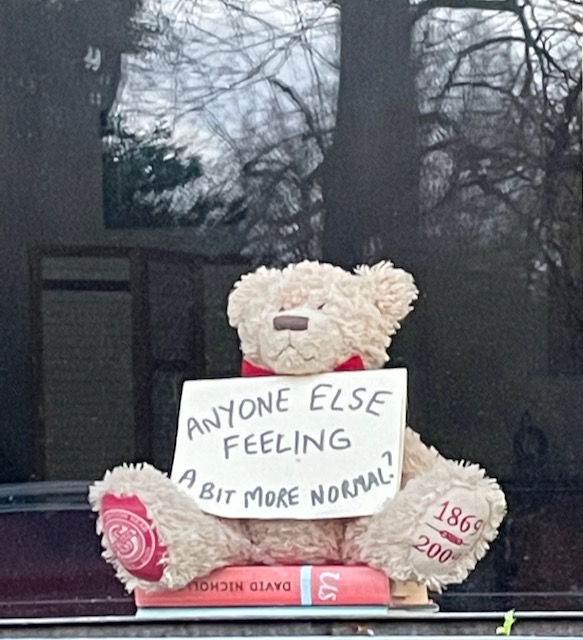
I saw this question being asked by a teddy bear in a window as I was out for a walk yesterday. I found it quite an arresting image, it made me stop and take a picture, and it also made me think am I feeling more normal now? My answer, well to be honest I’m not really sure.
I can’t remember if has ever been “normal” to put a teddy bear in your window asking deceptively simple questions. Since the first lock down, putting signs of support on windows has become normal. Starting with rainbows to support the NHS, and then various other campaigns such as Black Lives Matter. There was a reassuring and visible sense of community and collective hope and struggle in the variety, scale and at times imagination in these images. Particularly when we couldn’t mix with each other, and our “out door activity” was pretty much limited to walking in our local neighbourhoods. As lockdown measure have eased, these signs have become less commonplace. I kind of forgot about mine and eventually took them down.
But this in the window, the “cute” teddy, the apparently comforting but actually quite disturbing (for me anyway) question. This was a different experience from the lifting of spirits that a run of NHS rainbow windows gave me. So, of course I thought I’d share on social media to see what others thought. I got a quite a few likes on FB and just one comment /question “what is normal?”, LinkedIn similar, with someone telling me that they would feel normal when they got to Jamaica next week (I’m presuming for a holiday). Thank goodness for twitter – and thanks to everyone who responded. Elaine’s response resonated with my feelings
I was reflecting on this first thing this morning. Especially in terms of how, having gone through the pandemic, my perception of what is normal will be different from that I might have articulated two years ago.
Do we really understand what is “normal” now? Sui-Ming added to this with some really salient points about the realities that we face and the lack of meaningful contextual discourse around “normal”.
No, I feel *less* normal, having to listen to 'back to normal' discourse while managing the 100th week of hybrid juggling with many sick and isolating students and malfunctioning edtech
Despite political drives to “get back to normal”, COVID has not gone away. Tens of thousands of people are contracting it every week, and at least for the time being here in the UK, having to isolate. This makes “normal” teaching even more challenging, as Sui-Ming so succinctly highlighted. Consistency of experience for staff and students is constantly changing. The nuances of hybrid teaching are just starting to be understood. How to “normalise” it, imho is a huge challenge. Aileen also shared something that resonated
Nope. If anything I’m feeling less so. The days, weeks, months and now years are marching on and I feel like I’m on pause
I don’t know about you, dear reader, but I still feel quite on edge at times, not wanting to plan to much just incase another strain arrives and we go back to more limited/lock down measures. Mind you, in the current UK political context, any kind of restrictions are pretty much doomed to fail since it came to light that the UK PM was ignoring all of them all along.
I do think there needs to be a wider discussion that takes us beyond the “back to normal” rhetoric. We are now in a new phase of, well I’m not sure what, but of something that means we can’t go back to the perceived normality of life pre March 2019. Remember that version of normal wasn’t particularly inclusive so we really don’t want to go back there. We’ve all lived, worked, learned, taught from home (generally pretty successful) now. For many support staff in universities working from home was almost unthinkable 2 years ago. Do we want those “normal” attitudes surrounding presenteeism to take hold again? But maybe it’s already too late for that one . . . Similarly with learning and teaching, do we really need to go back to perceived normal of large lectures? Can’t we really take the opportunity to make some fundamental and necessary changes to our curricula that reflect the lived experiences of the past 2 years, are inclusive and accessible.
I wrote recently about recovery and the need for it in education. I think we are all going through a period of convalescence, but not admitting that we need to allow a period of recovery for ourselves, our organisations, our society to rebuild. We don’t actually have to go back to, for example exams, it actually doesn’t matter if you get to 17 and haven’t sat a “proper exam”. There are alternatives, that work just as well that involve far less stress.
So maybe the answer to the question am I feeling more normal now? is no, and I don’t want to. What do you think, would love to hear your thoughts in the comments.
I’ve been easing myself back into work mode this week. I’ve been “hangin’ around” twitter a bit more, trying to do a bit more formal and informal academic reading, trying getting my brain switched back into writing mode, having more meetings, speaking to people and generally doing “stuff” after work free festive break. I’ve also been trying not contain my rage about the current revelations around the UK govt actions during the first lockdown. I don’t know about you, dear reader, but I have been laughing a lot about #partygate, because if I let my thoughts and emotions go the other way my head might just explode with rage; or I would never stop crying thinking about the now over 175,000 people in the UK who died from COVID-19.
We have all been through so much in the past nearly 2 years now. Yet still our future seems to be firmly rooted in the past. Getting “back to normal” still seems to be the ultimate aim. Back to campus, back to exams, back to not having to consider how our actions could impact others health. In our rush to economic recovery (for ultimately that’s all our political leaders really care about) are missing out a vital step around human recovery and the need for a period of convalescence?
Just before Christmas I heard the poet (and COVID-19 survivor) Michael Rosen recommend book called Recovery, The Lost Art of Convalescense, by Dr Gavin Francis. Michael was in a COVID induced coma for many months, so the topic was particularly relevant to him. I was intrigued by his description of the the book so I bought it. It’s quite a slim volume and documents the experiences of one doctor (based with a western/global north medical tradition). The author describes it as “a series of explorations of recovery and convalescence.”
In the first chapter, the author shares his own childhood experiences of convalescence and recovery. He talks about the rehabilitation he went through after a serious knee injury, and the rehabilitation he went through. I was drawn to his description of rehabilitation
“the word rehabilitation comes from the the Latin habilis, ‘to make fit’, and carries the sense of restoration: ‘to stand, make, or be firm again.”
I think there is an an analogy here with what is happeing in education just now. There doesn’t seem to be space for any kind of rehabilitation after the roller coaster of covid infections isolations, lockdowns, continuted restrictions. It’s all full steam ahead for “back to normal”. I can’t help but think that this is a mistake. Staff and students need time to recover. Despite the urban myth that moving online wasn’t a real or proper education experience, and seen as an easy option, it was bloody hard work for thousands of staff. There has been a bit more focus on “well being” but that’s not really addressing some of the key issues. Is it too far beyond our imagination to acknowledge that we need to have some space for recovery to heal and regain strenght and perhaps a different perspective on how we actually do things. Gavin says in the book “the flow of my life had been stilled, but it was that stillness that allowed me to heal.“
Now, I’m not suggesting that everything stops, but I do think that it is possible to make some space for critical reflection on what has happened and what needs to be done next. Could we revisit notions of the sabbatical in terms of recovery to allow staff some dedicated time reflect, to engage with different pedagogical approaches, with (re)design, to have more opportunity to improve public engagement around online learning and teaching and assessment and maybe start to have an informed discussion about the apparent need for final summative exams? There could be cross disciplinary/institutional opportunities for sharing of ideas, practice whilst on sabbaticals which could then feed back into institutional developments. Every member of staff (academic and support) should be offered the opportunity too.
I’m still really thinking all of this through, however I do think there could be something about revisiting our notions of recovery and convalescence that could help us do more than just “get back to normal’ and actually allow us time to heal and so that our education systems, and more importantly the people who work in them can be restored, be fit, and firm again. Would love to hear your thoughts.
Dear Reader, I have to confess as we edge closer to the end of 2021 my relatively regular habit of blogging has lapsed. It’s been over a month since I last posted something here. Looking back over the year, I think my posts have been less frequent this year too. In 2020, and during the first lockdown I was pretty good at almost getting out posts weekly. Partly that was down to me wanting to share, to connect and I guess to ensure that I was doing all I could to maintain my online presence, and ensure that I was still getting work.
This year has been a bit different. It’s not that I don’t want to share , connect, to maintain my online presence. It’s more that some of the work I have been involved in hasn’t lent itself to sharing. That’s one of the sides to being a freelancer. So, although I still classify myself as an open educator, quite a bit of my work this year has been closed. That’s not to say I haven’t tried to support/instill/cunningly suggest open educational practices – it’s just that I can’t really talk about them at the time, or in some cases anytime.
My social media interactions continue to evolve. I am on Twitter less often. I feel the benefit of that. If I miss something, it’s fine. I’ve probably missed a lot this year. That said, it is still my “go to place” for connecting with my PLN, and I still find serendipitous connections and really useful stuff there. However, I have noticed that the tweets that I get most “engagement” from are the more shall we say, light-hearted, ones. That’s fine, I really enjoyed the international discussion about the best solutions to midgey bites in the summer! Some pretty heavy weight edtech people got very engaged with that. And of course, maybe my more “professional” tweets are a bit boring. To be fair, they probably are.
I think tho’, it might indicate something else. I know I look to Twitter for distraction and if I’m lucky inspiration. As we’re pretty much all still mainly working from home, I think Twitter this year has been more than ever that water cooler place. Somewhere you can escape the relentlessness of trying to get “back to normal” for a bit and reply to a random tweet about insect bites.
In contrast I have really noticed a change in my engagement with LinkedIn this year. Time for another confession, dear reader. To be honest, I always had a bit of a cavalier attitude to LinkedIn. I joined mainly because “everyone else was doing it”. I connected with people that I knew, but was never quite sure how to “use” it. The ability to share blog posts on my profile direct from WordPress was about as active as I ever got. As I moved to being a freelancer, that has changed. It is a professional space, and I have got work through people who have found me on it. But I have noticed over the last year in particular the LinkedIn App has got much better in terms of UI – I still find the web version quite frustrating.
I have noticed that I am getting (according to the stats it now shows me) a lot more engagement and views of my blog posts than I get on my actual blog site. So I have started to respond a bit more, and share more “stuff” there – yes those analytics have got me again! Maybe that’s the way it should be, and I’m glad that I can see the value of it now. But I have been struck by number of views on certain posts. Of course, I don’t know who accurate they are, and I haven’t tried to dig around to find out more. I wonder if you have noticed the same? Do we want to have “serious” conversations in “serious, professional” online channels? Ones that don’t involve midgey bites?
Also as my art practice grows, I am engaging with different networks in other channels such as Slack, and Instagram. I know that I am less engaged in some edtech/education communities than previously. The social media online presence for that is completely different and takes up time in a very different way. Open practice is different in that context too.
Professionally this has been a much better year than I expected. So thank you to everyone who has employed me. It’s been a joy to have been able work with former colleagues and friends like Helen Beetham, Phil Barker and Jean Mutton. It’s also been great to work with such a range of clients from UNESCO to UK universities to the IUA to smaller design companies. I’ve had some really fantastic opportunities this year and hopefully that will continue into 2022.
I will continue to share “stuff” here, but I am realising that my blogging is now evolving from my “professional memory”- before I became freelance, if anything important (to me) happened, I wrote a blog post about it – to something else. I’ll still share important to me “stuff’ but not everything that I am doing. It is an evolving practice to slightly misquote the very wise and wonderful Catherine Cronin’s description of open educational practice. Just what it is evolving into, I am still figuring out.
Thank you, dear reader, for your continued support over the year. I hope you and yours have a very Merry Christmas and a good, healthy and safe New Year and let’s see where 2022 brings us. I am making no predictions about that. I’ll end with some pointless distractions – some of the best bits from one of my favourite Christmas movies. Enjoy!