Author Archives: Nick Hood

A positive future for people and planet – Interdisciplinary Learning and Responding to Global Challenges.⤴

from @ The Interdisciplinary Learning Network

My preferred framing of the climate crisis comes from Mary Annaïse Hegler – “The thing about climate change is that you can either be overwhelmed by the complexity of the problem or fall in love with the creativity of the solutions.” It can be heartening to remember this in a world where we can seemingly be bombarded with negativity at every angle, particularly when empowering everyone with understanding and empathy for the Earth is what I, and the team at Dynamic Earth – the Edinburgh Science Centre and Planetarium, do every day.
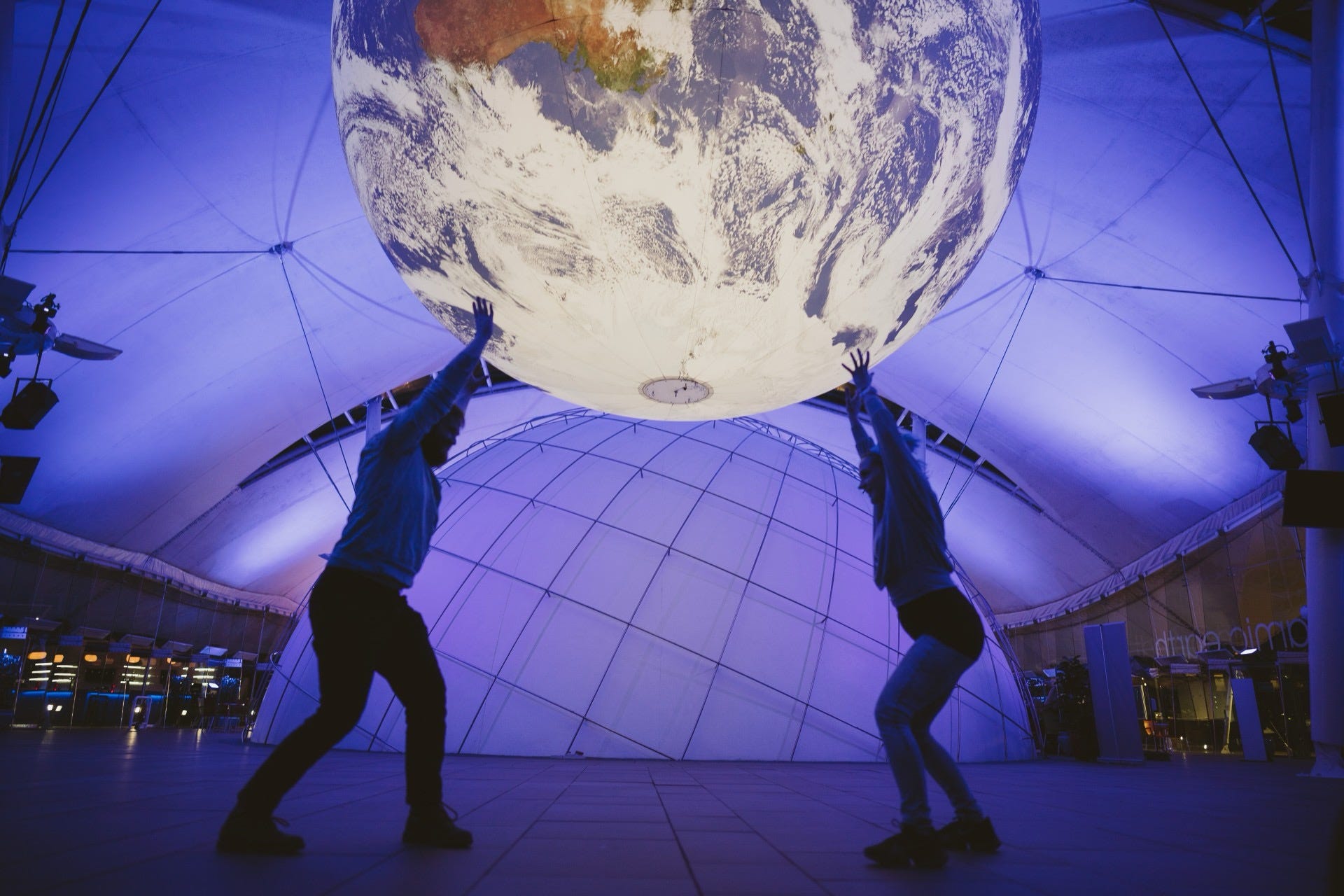
“Gaia” image courtesy Dynamic Earth

Our vision is of a positive future for us and our planet. Through a portfolio of compelling science engagement at our centre and nationally across Scotland, we are driven by a positive belief that people of all ages and backgrounds can be the problem-solvers of the future.

The words of Annaïse Hegler resonate so deeply with me because I believe we need a solutions-oriented culture when we’re facing global challenges — locally, nationally and internationally — that are complex and multifaceted, from the climate emergency to energy transitions, building sustainable cities and international food security — to name a few. Solving these challenges needs a joined-up strategic approach and demands that we collaborate and work together across boundaries and disciplines to create a positive future for people and planet.

One of the biggest considerations for me in my role at Dynamic Earth is how we best harness the full power and potential of interdisciplinary and project-based learning at our charity. The Science Centres & Museums of the Future Missions + Opportunities report highlighted that science centres have a key strategic role to play in creating future-ready citizens, offering lifelong learning opportunities and moments to use practice and question science and its connection to the world around them.

If Dynamic Earth is enabling a culture of problem solvers and solutions-oriented people, we’re ultimately helping shape a society of interdisciplinary thinkers. Our centre has a unique exhibition and broad portfolio of learning and engagement programmes for school learners, community groups and families, where we tell Earth’s story in immersive and interactive ways, dealing with a broad spectrum of issues, ideas and topics. It’s therefore unsurprising that we embrace an interdisciplinary approach in our storytelling at our science centre that connects topical and timely research with wider cultural lenses to show the relevance and importance of science in our everyday lives and futures. Examples include our Climate Justice workshop for secondary school learners which considers the socio-economic and health inequalities of climate change in a simulated interactive COP workshop, or in our tropical rainforest programmes which consider how rainforests worldwide have cultural, social, economic and political as well as scientific importance in the context of a global system.

Interdisciplinary learning is not a new concept, but what is clear from our teacher focus groups and networks is that it’s not necessarily being consistently understood and applied across all learning settings or stages across Scotland. What’s equally clear is that making time and space to learn differently across the curriculum – whilst easier said than done – has the potential to transform how learners learn across the country. It’s something they’re asking for – as evidenced in recent findings from Education Scotland’s EKOSGEN “structural barriers to participation in STEM” survey – and something they’re entitled to through IDL being one of the four contexts for learning in the Curriculum for Excellence. In the context of upcoming curriculum reform in Scotland there’s an enormous opportunity to embrace learning differently in both principle and practice, but practitioners across the country need support across the system to get there.

Science centres have enormous potential to support a national network of interdisciplinary learning opportunities across the country. Our programmes for learners ages 3-18 can be delivered consistently across all learning levels and stages as we’re not held to the same timetable barriers as school settings, and our Career Long Professional Learning (CLPL) opportunities give practitioners opportunities to evolve their knowledge, confidence and skills in creating and delivering interdisciplinary science in their own setting. We’re also charities that sit at the interface of research and non-specialist audiences, connecting visitors of all ages and backgrounds with real people working in cutting edge science in response to global challenges. At Dynamic Earth, we advocate that “you can’t be what you can’t see”. We are always looking for new ways to show how specialists across diverse disciplines and subject areas are working collaboratively to solve problems and help inspire the next generation of creative thinkers equipped to create a sustainable future.

With educational reform high on the agenda, it feels like we’re at an exciting point in Scottish education where there’s new potential to place interdisciplinary learning front and centre for learners across the country. I’m proud of the part Dynamic Earth and other science centres play in shaping and influencing the educational landscape to develop future-ready citizens who are equipped to write the next chapter of our planet’s story. Let’s keep the conversation going and drive forward evolutions together to ensure that IDL perspectives help us solve our global challenges.

You can find out more about Dynamic Earth’s interdisciplinary workshop programmes for school learners here.


Conor Ellis is Science Learning and Engagement Director at Dynamic Earth.
Life in the Universe⤴

from @ The Interdisciplinary Learning Network

The question, “are we alone in the universe?” has captivated the imagination of humans for generations. It is an alluring, existential question, able to provoke meaningful discussion among virtually anyone who considers it.

In this interdisciplinary unit for secondary school pupils, Marie Bernard sets out a plan to challenge learners to secure and apply knowledge from several subjects in order to:

  • Understand what “life” means, what it requires, and how we search for it

  • Understand the uniqueness and remoteness of Earth in the context of our universe

  • Appreciate how precious Earth’s suitability for life is, in order to motivate its long-term care & preservation

Life in the Universe
2.23MB ∙ PDF file
Download
PDF Poster containing unit design
Download

Over six lesson outlines, Marie takes the children on a journey connecting outcomes from mathematics, science and technology to social studies, literacy and expressive arts. There is a qualitative discussion of the Drake Equation to determine the number of intelligent alien species in the universe and great use of good science fiction to provoke thinking and understanding.

Gàidhlig Revival⤴

from @ The Interdisciplinary Learning Network

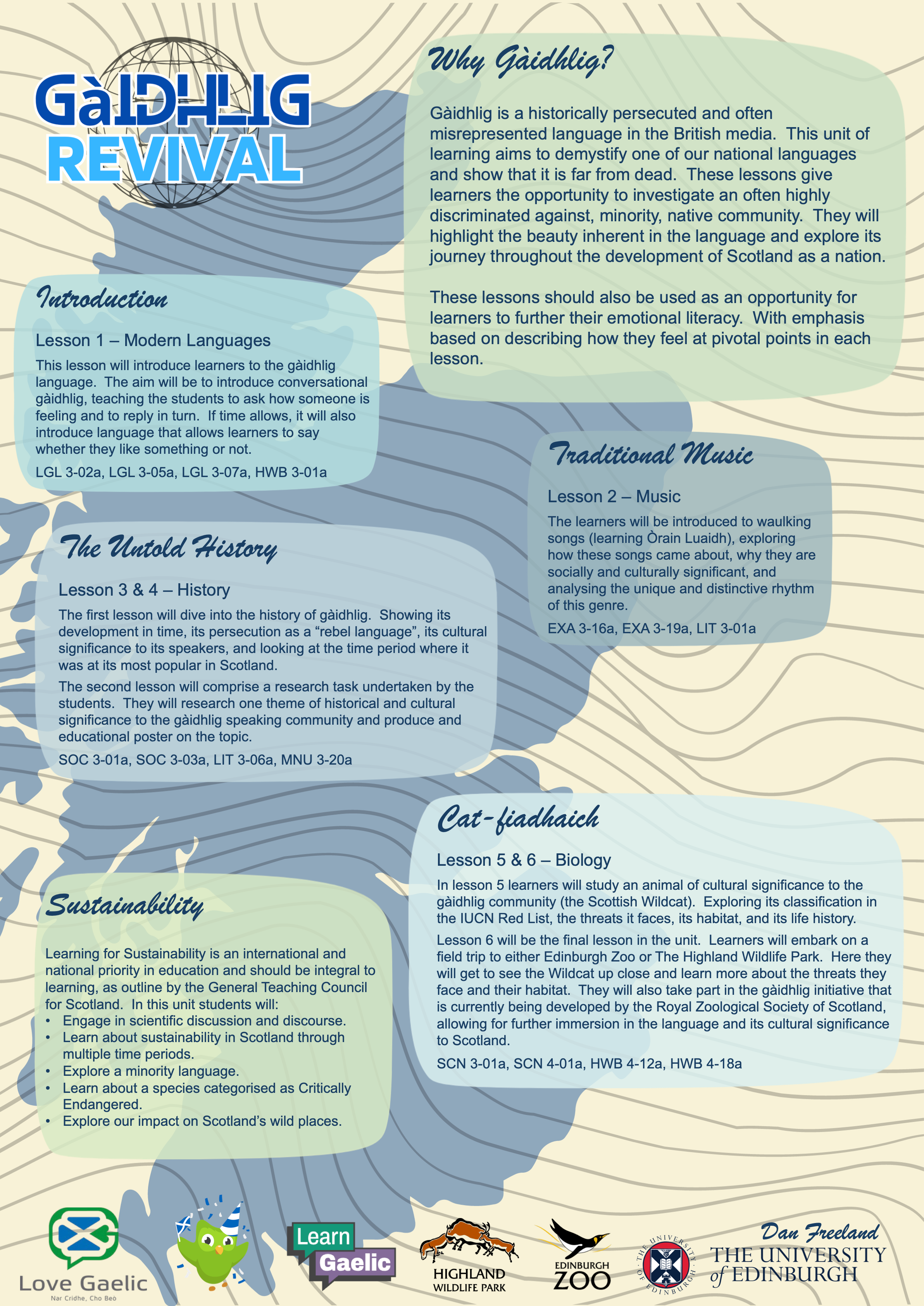
This unit of learning aims to demystify one of our national languages and show that it is far from dead.  These lessons give learners the opportunity to investigate an often highly discriminated against, minority, native community.  They will highlight the beauty inherent in the language and explore its journey throughout the development of Scotland as a nation.

These lessons should also be used as an opportunity for learners to further their emotional literacy, with emphasis placed on describing how they feel at pivotal points in each lesson.

In lesson 2, learners are introduced to waulking songs and their history; waulking (in Gaelic luadh) is the technique of finishing the newly-woven tweed by soaking it and thumping it rhythmically to shrink and soften it - all done by hand in the old days. The songs served to keep the rhythm and lighten the work. The historical story of the language is addressed, as is its cultural significance in the present day context through a study trip to meet the Scottish Wildcat (see also this unit from Dean Crawford).

Danfgaelicidl
5.92MB ∙ PDF file
Download
Download

Resources referenced in Dan’s poster for this unit include Scottish Gaelic language sites Love Gaelic, DuoLingo, and Learn Gaelic; also the Highland Wildlife Park and Edinburgh Zoo.

Seaweed: Scotland’s Sustainable Super-Plant⤴

from @ The Interdisciplinary Learning Network

Throughout history across cultures, seaweed is intertwined with human activity. Whether as a food source, a fertiliser, medicine or vital ingredient for industrial innovations it has played a somewhat forgotten central role in human life.

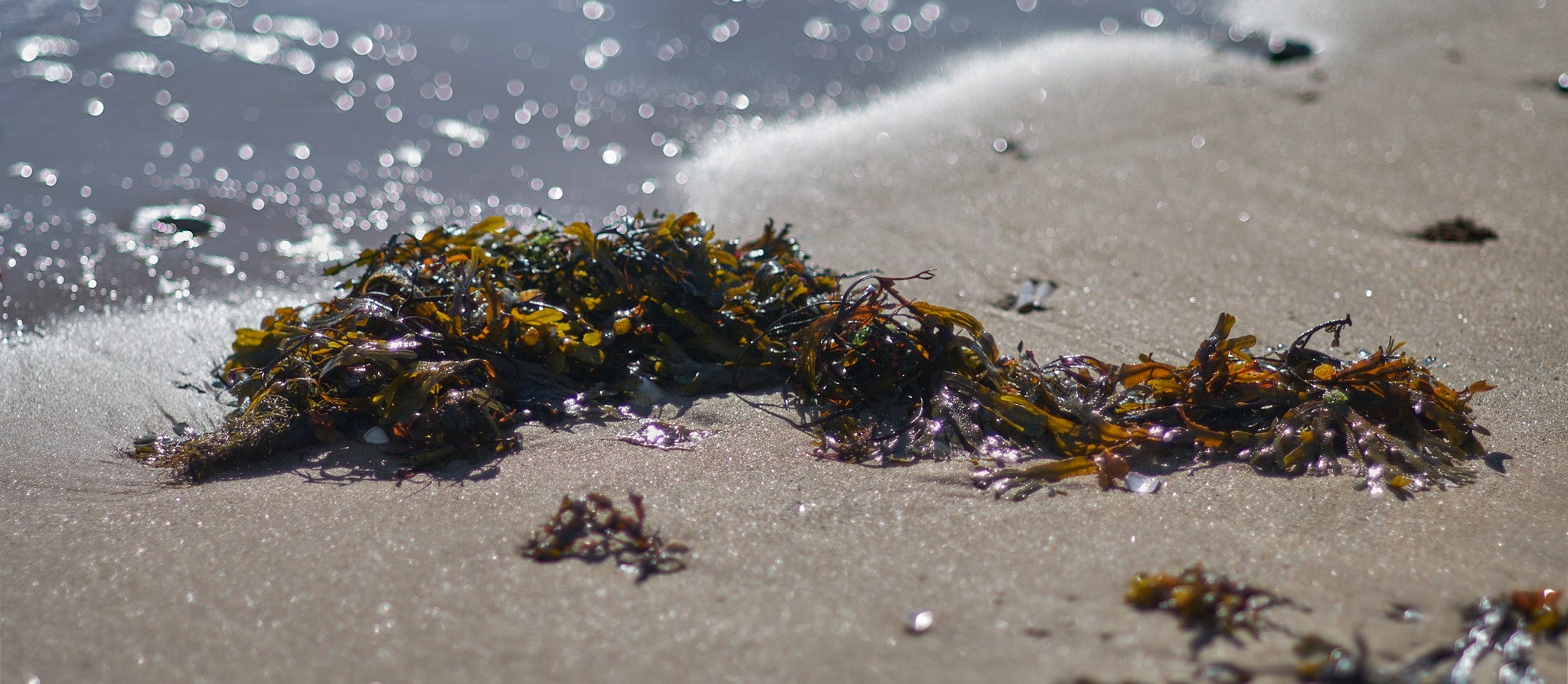
Seaweed at Lower Largo, Fife. Photo by Nick Hood @NixImagery

This scheme of work is built on the third level of Scottish Curriculum for Excellence and explores this fascinating organism in four phases; the role of seaweed in a marine ecosystem, its cultural history, and its industrial promise as a sustainable resource all framed within a Scottish context. In the final phase, students embark on a group enterprise project to develop a sustainable solution to food packaging using knowledge from the first three phases.

20231215 Seaweed Schemeofwork Gibbons Uoe Pgdegensci
122KB ∙ PDF file
Download
Download

The presentation given by Matt was not only the pdf above, but was also printed as a poster on paper made from seaweed by NotPla, the London-based packaging company whose website has this:

… seaweed is abundantly available and has near-magical material properties. In the quest to heal our ecosystems and food chains from the toxic waste of plastic packaging, it is the perfect companion species.

Matt’s interdisciplinary sequence offers you an opportunity to teach children about some of the work being done to mitigate the negative impact humanity has on our home.

Microbes on Trial: Villains or Victims?⤴

from @ The Interdisciplinary Learning Network

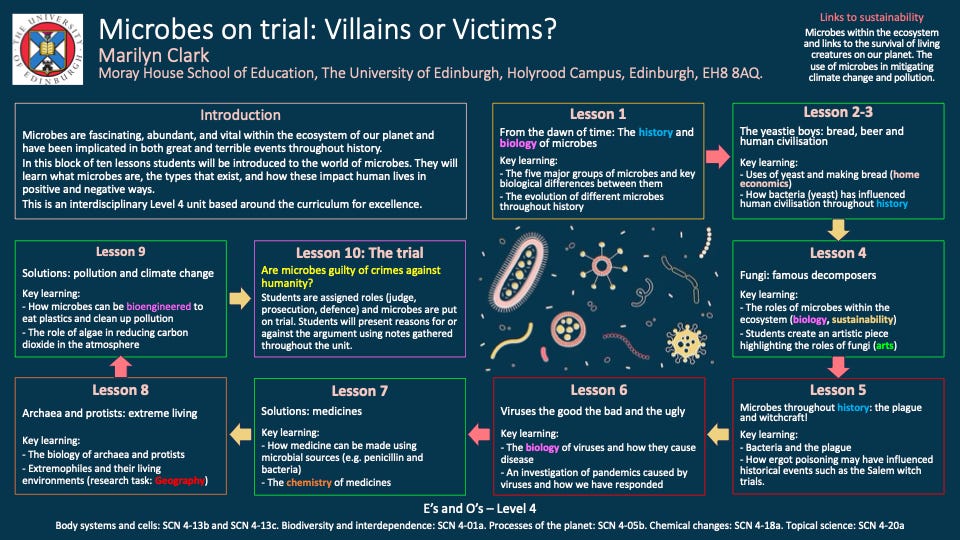
Microbes are fascinating, abundant, and vital within the ecosystem of our planet and have been implicated in both great and terrible events throughout history.

In this block of ten lessons students will be introduced to the world of microbes. They will learn what microbes are, the types that exist, and how these impact human lives in positive and negative ways.

This is an interdisciplinary Level 4 unit based around the curriculum for excellence.

Although the E’s and O’s listed are all within Science (SCN), you will links to other curricular areas including History, Home Economics, Arts, and Geography as well as sustainability. Notice the colour coding of the lesson outlines to show a balanced judgement of microbes — which are they — villains or victims? The students will decide, in the final session in the sequence, The Trial.

Microbes On Trial
293KB ∙ PDF file
Download
Download

The Natural Partners Project⤴

from

Some of our colleagues interested in IDL will be aware of the Natural Partners Project, an initiative started over a decade ago by Susan McLaren at Moray House, working with the Forestry Commission, to provide new teachers on PGDE Secondary the opportunity to learn through experience about outdoor learning and sustainability through interdisciplinary teaching. Over time, the project has evolved into a rich seam for Design & Technology and Science students to engage with as part of their initial teacher education at the University of Edinburgh.

As part of that commitment to sustainability and interdisciplinarity, students produce and present a design for a substantial unit of work for children around the Broad General Education stage of their schooling, which goes beyond the limits of their own subject disciplines and which addresses sustainability and or/STEM themes. Some of their work has been showcased at the naturalpartnersproject.org, as much to provide inspiration to future students as to encourage other teachers to adapt and use their ideas as a resource for their own planning.

We are pleased to share with the IDL network that these resources will begin appearing here within the IDL network, in a section of their own, for wider dissemination, and to celebrate some of the creativity shown by student teachers.

May I use this stuff?

Yes. You may download, copy and adapt this material free of charge provided that the material is used solely for non-profit educational purposes only, and that appropriate acknowledgement is given to the originator, who retains the copyright in the material. If the originator cannot be easily identified, then you must acknowledge this website as the source.

That’s my image!

Mistakes are sometimes made. If you think you have identified something here that you own the copyright to, please contact us and provide a link to the offending item and we will promptly remove it from this site.