Tag Archives: religion

Fair buzzing in Oban⤴

from @ blethers

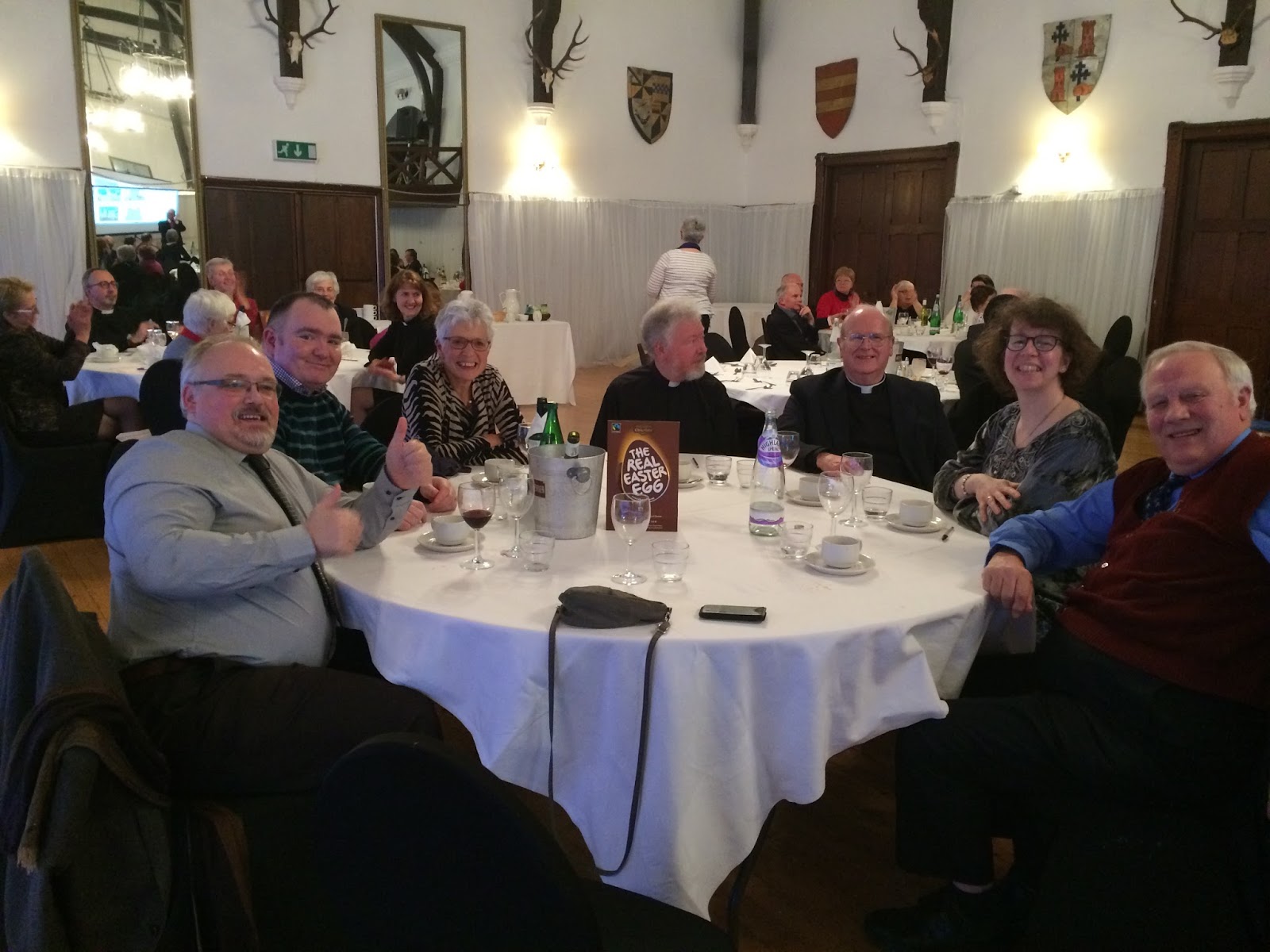
Victorious table at dinner
I've mulled it over for the past five days, but now I realise that Synod reports are being demanded - not, happily, from me - right left and centre and it's time I put down my take on the Argyll and The Isles Diocesan Synod. The main impetus, to be honest, came from two online sources: the Primus' blog, in which he said his synod had 'a buzz', and the commiserations of friends on Facebook that I should be enduring this thing.

I'll deal with the latter first. The only commiserations I might have deserved lay in the fact that the Synod itself was held in (yet another) windowless room on a gloriously sunny day in a location next to a sea loch and an attractively wooded shore line: I did get stir crazy, and spent the lunch break picking my way down to a beach and over dub and mire as the birds sang round me. The rest of the time I was really enjoying myself, both on the pre-Synod day (it's hardly worth it to bring people from such a far-flung area unless they get a decent shot at socialising) and during Synod itself.

And that brings me to the former stimulus: I don't know what caused the buzz at the St Andrew's Synod, but I have a good idea of what contributed to our buzz. (I'd really like to know, by the way, what manner of buzzing goes on elsewhere ...) First of all, of course, we have an extraordinary bishop who could cause a buzz in a morgue. He delivered an ode, for Heaven's sake. But actually it was more than this. I am convinced that the excitement arose from the fact that instead of sitting in stupor listening to presentation after presentation we were allowed to talk to each other, about everything from the balance sheets to the first time we'd encountered the Holy Spirit.

This was achieved by a variety of methods, but primarily by the fact that on the Pre-Synod day, reviewing our progress with Building the Vision, we had two facilitators making us mix - moving people from one table to another after the manner of a Snowball waltz, for instance. At Synod, each table had a facilitator (I was one) to get people talking, as at General Synod a couple of years ago. And yes, we talked about the accounts and as a result made demands for more detail, clarification, amplification ... Before anyone asks, I had a plant at my table, an accountant who could make more sense of a balance sheet than I care to, so that I could merely render into words the data he fed me.

By the end of the two days, I came to this conclusion: people are excited by what brings them together in a situation like this. They become animated by the chance to share it with others whom they don't really know - because this unlocks the kind of honesty you sometimes find in a hospital ward, the honesty of strangers, when inhibition and fear of something you say coming back to bite you can be cast aside. So that is what lay behind the astonishment of the imported facilitator when she remarked on the alacrity with which pairs and groups got to grips with the Big Questions - she couldn't believe how little fencing she met as she moved round.

I have to confess that I enjoy facilitating a group. I love being able to make people feel at ease with one another and with the topics they've been asked to consider. I love realising I've managed to break the ice without losing anyone under it.  It feeds all sorts of my own needs for interaction - and that's before we get on to the subject matter under discussion.

I haven't mentioned the other aspects of this meeting, that had me and others in Oban from late on Monday afternoon till late afternoon on Wednesday. I've not talked about a riotous dinner after the Synod Eucharist, nor about the quiz that my table won and the Bishop's Easter Egg (our prize) that I suspect may have vanished to Cumbrae. I've not mentioned the Monday night, the dinner on the pier with old and new friends, nor the delight of watching a first-time visitor grow in confidence as the days went on. I can't tell you how much I laughed, nor how much I was laughed at. It was all part of the whole.

So yes: there was an enormous buzz at the Argyll Synod. There was laughter, there were tears, there was pastoral work being done over lunch breaks, there was kindness, there were friendships rekindled. For me, there was also the knowledge that it was my last: I've served on General Synod for the past 10 years as alternate or elected representative, and it's time to step down. I'm not a committee person, and I hate being trapped indoors. But even with all that, I'm sure of one thing. I'll miss it.

All we go down …⤴

from @ blethers


I was at a funeral yesterday, not as a mourner but as a provider of music, one of a quartet singing the Kontakion for the Departed at the end of a service in the Cathedral of The Isles on Cumbrae. This was significant for me personally in one important feature: it was doing exactly that at my very first funeral in that same cathedral 42 years ago that convinced me of all that I now believe in, as a consequence of which I was confirmed 9 months later and as a further consequence of which I came to live in Dunoon. There were differences, of course - that first funeral was of a friend, it was a requiem mass, the coffin was between the choir stalls and therefore right on front of me.

So I'd actually have gone a long way to sing this music again in that place and with these same musicians. But another truth dawned on me yesterday as I sang, and after the plainsong Nunc Dimittis with which we finished. It was a truth about music - that kind of music, timeless and beautiful and still. For after all the words, the telling to God of the deceased's character (thou knowest, Lord, the secret of our hearts ... ) and the hymns that were deemed suitable, this was the moment when it seemed to me that the otherness of death came close, that the life of the world was dimmed and the life of heaven opened, and the possibilities of eternity were real and endless.

And weeping o'er the grave, we make our song: Alleluia, alleluia.

I would like to think that this music will be present for my end.

Tea-parties and bigotry⤴

from @ blethers

I've just been reading a most unedifying church magazine. It's called SATNav, and purports to help the good people of Ayr to navigate the life and witness of Holy Trinity Church in the centre of that town. The very first item is, unsurprisingly, the Rector's letter, which begins thus:

All scripture is inspired by God and is useful for teaching, for reproof, for correction, and for training in righteousness, so that everyone who belongs to God may be proficient, equipped for every good work.
2 Timothy 3: 16
The July/August edition of SAT Nav contained a press release about The General Synod of the Scottish Episcopal Church’s decision to move, over the forthcoming two General Synods, toward the introduction of same-sex marriage being permitted within the SEC’s churches. I thought it appropriate that I let you know my views on this matter…

... And then he reveals that he has signed the declaration of the statement of the Scottish Episcopal Evangelical Fellowship issued shortly after General Synod. This states:
In contrast to [the decision of General Synod to "delete any reference to marriage as being between a and a woman"], we reaffirm the doctrine of marriage as given in the Old Testament in Genesis 2:24, reaffirmed by Jesus in Matthew 19:5 and by Paul in Ephesians 5:31 - ‘For this reason a man will leave his father and mother and be united to his wife, and the two will become one flesh.’

At the end of the statement, he invites people to add their names to it by email. Lest they should hesitate over this step, he adds:
What General Synod has done then, is not only to take a major departure from authentic Biblical Christianity as practised by the overwhelming majority of churches worldwide, but to hasten the decline and possible final extinction of the SEC.

He backs all this up with this sweeping assertion:
As the SEEF statement makes clear above, God’s wish since the dawning of time for all humanity is that marriage between one man and one woman is the only place for sex to take place and that everyone else, irrespective of their sexual orientation, should lead a life of celibacy. That is because, in God’s design, through marriage, men and women are meant to complement one another in many ways, not just for reasons of procreation; ways that are just not possible in same-sex relationships.

I become terribly worried when people assert that they know God's wishes in this fashion. We could all do that, could we not? No. Surely such dogmatic insistence trivialises belief. For Christians like me, only one command comes through with that kind of clarity, and that is the demand that we love one another as God has loved us. Heaven knows, that's hard enough without adding man-made conditions (and yes, I mean man-made).

We are then assured that there will be no same-sex marriages in his incumbency, but that anyone who comes to the church will be loved and cared for regardless ... etc etc. Presumably his flock will conveniently forget that they will only experience this care up to a certain point - or might indeed simply note that no priest in the SEC is allowed at the moment to conduct such ceremonies and wonder what he's going on about.

The letter ends thus:
As a church, ahead of forthcoming Diocesan and General Synods, there will be plenty of opportunity to further discuss General Synod’s decision.

On an entirely different subject, I am looking forward to the Holy Trinity tea parties we'll be hosting at the rectory and in members’ homes from this month. (You'll find more about this on the back page.)

If you read my blog post of yesterday - which I wrote about an hour before seeing the above - you will know that the scones and stereotypes kind of mission is alive and well in Ayr, but that's a wry comment rather than the main point of my putting all this stuff here. What I'm asking is this: How would you feel if this arrived in your inbox, as a member of Holy Trinity Ayr? What happened to all the thoughtful discussion that went on at Synod? What happened to the care for ministry to all  that would prevent a rector from coming out with such a bold statement of personal prejudice? Did he, I wonder, tell the vestry who appointed him that he was mired in the first century and would admit of no further growth in understanding?

He refers to the imminent demise of the church if it chooses to remove the clause about men and women from the canon on marriage. Does he know that that specificity was a recent addition to the canon?

But I'm becoming incoherent. I'm putting this stuff here because I am realising what we're up against when it comes to moving forward in the church I want to remain in. The person who forwarded the newsletter to me did so with the comment that now I would know why she was never going back to Holy Trinity Ayr. She's not a stereotypical agitator - she's a straight woman in her 60s who is furious. How is she being ministered to? She can't just go down the road and find another church - it's not easy when a team rector's influence covers a wide geographical area.

I know how fortunate I am at the moment. My local church is ministered to by a thoughtful, forward-looking priest who is careful to take everyone with him and who thinks about the consequences of his words. This could change in the future, for clergy move on. But to my mind, tea-parties and bigotry make up the poison that is eating at the credibility of our church, and if numbers indeed flock to hear their ignorant prejudices confirmed on a weekly basis it's not a church that I want to have any part of.

So - a sour note to start the week after the exuberant joy of Saturday. God help us.

A glimpse of heaven⤴

from @ blethers


It is 4.15am when the phone rings. Our alarm call drags me from sleep in the strangely lucid state that such sudden awakenings sometimes bring and I am slathering on the Rid (an Aussie DEET preparation) almost before Mr B has put the phone back. By 5am our group is out of the hotel in the warm darkness heading for Angkor Wat, the largest religious monument in the world. I am hauled off the coach to have my photo taken, and return with an entrance card round my neck. The photo on it looks pale, wary. My photo.

Equipped with torches of varying efficiency, we are led through the dark. We concentrate mainly on our feet, and on not walking into the person in front. Beyond my pathetic circle of light, the blackness seems absolute. I cannot tell how many people are on this pilgrimage, but sense their presence.

My earpiece crackles. After sunrise, meet under that banyan tree. I can see our guide pointing left. The tree referred to is an intensification of darkness, nothing more. I have not the least idea of what a banyan tree looks like, having only encountered one in the rudimentary graphics of Jet Set Willy, but assume that in daylight I shall recognise my fellows if I see them.

We arrive in what feels like a wide open space. To my left, I realise there are lights, tables laid with some kind of biscuits in wrappers, bottles of fizzy wine, orange juice in cartons. Everywhere else it is still black Underfoot I can now see dusty yellow grass, and we stop. Apparently we have arrived at the vantage point.

And there we stand. Slowly, the sky turns grey. A dark red glow appears in front of us, and for the first time I am aware of the outline of pointed towers. I put my torch off, and can see my companions as vague outlines in the gloom. The light keeps growing, and we hold up phones and tablets like some primitive offering. At one point it is as if someone has thrown a switch, as millions of cicadas strike up with their own dawn chorus. A cock crows. We drink some tepid bubbly, eat a cracker or two, and continue our watch. Behind us, the moon sails above a tattered palm tree.

And then it comes. The sunrise is every bit as amazing as one could hope for. I can see the reflection of the temple in the pool which is now revealed in front of us, where the tiny ripples of visiting mosquitoes create their own beauty. I insert myself between two large people to take the photo at the top of this post. We watch until the sun is clear of the roofs, then retrace our path to find the banyan tree. It is, after all, entirely recognisable - and the only such tree to be seen.

We still have a visit to make - we are about to go inside the walls, ascend to the highest level, see the surrounding jungle in the golden morning light. We will learn that only the God can live in stone houses, and we will see amazing stone carvings. We will not end this visit till 9am, when the daytime crowds start to arrive. It will be amazing and memorable. But even without it I would have been content. I have seen the sunrise over Angkor Wat.