Tag Archives: curriculum design

Pedagogy, place and pragmatics⤴

from

Following on from the report that has just been published on Approaches to Curriculum and Learning Design in the UK HE sector, Helen Beetham and I are exploring some of the key issues that were highlighted through the survey and the interviews we conducted. Central to this are issues around time, space and place. Earlier this week we were able to start to share some of our initial thinking during a workshop at the Jisc Student Experience Experts Meeting.

In the interviews I conducted as part of the project, there was a general consensus that after the first lockdown most organisations were quite keen, even quite ambitious about their future plans for new approaches to learning and teaching. There was a sense of an appetite to embrace some the changes to practice that being forced off campus had brought about. Assessment was a huge part of that.

Rapid changes to assessments had to be introduced, along with rapid changes to assessment regulations. Student care was high on the agenda – a visible sign of that was the no detriment practices that many adopted. Again in the interviews, it was clear that lots of the changes from f2f exams to online submissions of various types including open book, authentic assessments have now been adopted.

In terms of wider curriculum change, it was also clear from the survey responses and interviews that the appetite for changes to other aspects of curriculum design and delivery had been divisively impacted by the UK Governments’ insistence that everyone needed to be back on campus, at lectures and doing “proper” in person exams. Never mind the lessons that had been learnt from students about the benefits of more flexible, accessible and inclusive approaches. Strategic statements were subtly altered to reflect as a pragmatic response to that political driver.

However, back in the real world, we can’t ignore that our understandings and use of the spaces, places (both physical and digital) and times for learning and teaching have been altered by the pandemic experience. Students have been off campus, on campus, off campus, on and off campus for a bit . . . and now on campus. Typical 1st and 2nd year students have had their final years of school turned upside down in the same way.

I think how “be” a student has changed, and that might be one of the reasons there have been so many issues around engagement. Where (and when) you actually need to be isn’t as clear cut as it was in the “before times”.

Going back to assessment, some of the comments student interns on the Irish EDTL project made during one of their webinars really struck me. Including the student who very eloquently shared how being able to take assessments off campus, in a space that was comfortable for them, massively reduced their stress levels; another who felt that the design of some of the online MCQs exams they had taken were “mean” as they didn’t allow you to go back to a question to answer it. That experience was making them want almost long for pen and paper exams. In the panel discussion at the experts meeting, Deborah Longworth from the University of Birmingham shared how some changes to assessment are now having impact on the mental health of students. She described how some students can think that a 72 hour open book exam means that they need to be working on it for 72 hours. Does this mean taking time to develop more scaffolding around time expectations, or is it an “in” to go back to fixed, in person exam that everyone understands the conventions of ?

Whilst terms such hybrid and hyflex are commonly used and, are they really fully understood by both students and staff? Do we really have effective examples of how these approaches work in practice. This is one area Helen and I want to explore from a pedagogical lens.

We are starting with time, and thinking in terms of synchronous and asynchronous. Then considering what types of activities/interactions that work best in these contexts, and then starting to map the spaces and places that students and staff need to be in as these activities are instantiated. In terms of broadening our approaches to learning design, do we need to be more explicit about time, space and place expectations in?

As the cost of living crisis starts to really kick in, what additional changes do we need/ are we making to make to our physical estate to support our students (and staff). Warm areas, areas with kettles? What choices might commuting students have to make about how many times a week they can be on campus?

As we discussed these issues in the meeting, a dose of pragmatism was injected into the conversation. Whilst it is often said that pedagogy should always come before technology, in reality it’s pragmatism, and the contextual constraints that everyone has to work with that really make have “the power”. Pragmatics always win over everything else.

I know I have run many learning design workshops where some really innovative approaches have been planned, only to find out that 2 weeks before the start of term, the plans have been changed because of timetabling issues or more commonly not enough staff resource or time.

As the sector moves forward is it just easier to cope with increases in student numbers, and the staff/studio ratio to just timetable in lectures? Is it just pragmatically more effective not to change workload models and notions of contact time to reflect the shifts in preparation/contact time and presence needed, and stick with the conventions we are all familiar and comfortable with?

Hopefully not, and that’s what we are working on now, to develop resources that can help provide guidance and exemplars of how the sector can, and is, evolving to allow us to think about pedagogy and place and hopefully start to change some of the pragmatics and constraints approaches to learning design, and in turn the student experience, exist in. I know Peter Bryant’s recent post on the “snapback” discusses many of these issues in more depth so is worth a look if you haven’t seen it yet.

So if you have any thoughts on this, or would like to share any examples, please do get in touch, or leave a comment. We want to provide spaces to have these conversations and hopefully provide some resource to help others have them in their contexts.

Reviewing curriculum and learning design podcast⤴

from

What with all the excitement of the recent ALT-C conference, I totally forgot to share the link to the Jisc Beyond the Technology podcast where Helen Beethman and I chatted with Sarah Knight about our recent review into curriculum and learning design in the UK HE sector. Apologies, dear reader, if you have seen the tweet already!

A report sharing details of the survey, interviews and desk review we undertook will be published in October but the podcast gives an overview into the key findings and some of the areas we feel need more research.

You can listen to the podcast from this link.

screen shot of beyond the technology podcast logo

Recording of ATU DigitalEd Conference Keynote⤴

from

Recordings from all the keynotes from the recent ATU DigitalEd conference, and many of the sessions are now available online . The talks from my fellow keynotes, Sue Beckingham, Phillip Dawson, Tony Bates and Meg Benke are all worth taking some time to watch.

Many thanks again to all the team at ATU for putting on such an informative and enjoyable conference and for sharing the resources with the wider community.

What’s going on with curriculum and learning design in UK HE? – help me to find out⤴

from

One of the great things about working freelance is that you get the opportunity to work with a range of people. Over the past three years I’ve been really lucky to have been able to work with some really fabulous people, and happily I’m in that situation again. For the next couple of months I am working with Helen Beetham on a review of curriculum and learning design across UK HE, commissioned by Sarah Knight at Jisc.

Helen, Sarah and I all worked on the Jisc Curriculum Design and Delivery programmes well over a decade ago. So it is great to come almost full circle with this piece of work. With everything that has happened over the past 2 years, I think this review is really timely. The pandemic and the subsequent “pivot” to emergency online teaching caused a huge cultural shift in learning and teaching practice. As we transition back to more on campus delivery, have the experiences of the past 2 years impacted practice and what are the main challenges facing the sector moving forward?

As part of the review we have developed a survey which had launched today and will be open until 13th June. We’re also looking for vignettes of effective practice, so if you would like to share more, then please do complete the survey and leave your contact details. Or if you want to find out more – just DM me.

We’ll be sharing the outputs of the review, including the survey results, in late summer.

You can access the survey from the link below. Thank you in advance if you are able to participate in this study.

https://jisc.onlinesurveys.ac.uk/curriculum-and-learning-design-survey

Universities and post pandemic digital praxis: critically reframing education and the curriculum: WIHEA seminar slides⤴

from

Just a short post to share the slides from a presentation Keith Smyth, Bill Johnston and myself gave at a webinar organised by WIHEA early this week. We took the presentation to further explore some of the issues we raised in a short post published last year by the Post Pandemic University to celebrate the centenary of Paulo Friere’s birth, and also to revisit our previous work around the concept of the digital university.

This is just a marker to share the slides as quickly as possible. During the session we got lots of feedback from delegates around changes they have experienced during the past 2 years and over the next couple of weeks we have agreed to analyse the rich feedback we got from participants during activities in the session, and publish a more in depth follow up post.

We were delighted with the open and thoughtful responses we received throughout the session, so thanks to Letizia Gramaglia and the team at Warwick for giving us the opportunity and platform to share our thoughts.

Do we need a period of convalescence in education?⤴

from

I’ve been easing myself back into work mode this week. I’ve been “hangin’ around” twitter a bit more, trying to do a bit more formal and informal academic reading, trying getting my brain switched back into writing mode, having more meetings, speaking to people and generally doing “stuff” after work free festive break. I’ve also been trying not contain my rage about the current revelations around the UK govt actions during the first lockdown. I don’t know about you, dear reader, but I have been laughing a lot about #partygate, because if I let my thoughts and emotions go the other way my head might just explode with rage; or I would never stop crying thinking about the now over 175,000 people in the UK who died from COVID-19.

We have all been through so much in the past nearly 2 years now. Yet still our future seems to be firmly rooted in the past. Getting “back to normal” still seems to be the ultimate aim. Back to campus, back to exams, back to not having to consider how our actions could impact others health. In our rush to economic recovery (for ultimately that’s all our political leaders really care about) are missing out a vital step around human recovery and the need for a period of convalescence?

Just before Christmas I heard the poet (and COVID-19 survivor) Michael Rosen recommend book called Recovery, The Lost Art of Convalescense, by Dr Gavin Francis. Michael was in a COVID induced coma for many months, so the topic was particularly relevant to him. I was intrigued by his description of the the book so I bought it. It’s quite a slim volume and documents the experiences of one doctor (based with a western/global north medical tradition). The author describes it as “a series of explorations of recovery and convalescence.”

In the first chapter, the author shares his own childhood experiences of convalescence and recovery. He talks about the rehabilitation he went through after a serious knee injury, and the rehabilitation he went through. I was drawn to his description of rehabilitation

“the word rehabilitation comes from the the Latin habilis, ‘to make fit’, and carries the sense of restoration: ‘to stand, make, or be firm again.”

I think there is an an analogy here with what is happeing in education just now. There doesn’t seem to be space for any kind of rehabilitation after the roller coaster of covid infections isolations, lockdowns, continuted restrictions. It’s all full steam ahead for “back to normal”. I can’t help but think that this is a mistake. Staff and students need time to recover. Despite the urban myth that moving online wasn’t a real or proper education experience, and seen as an easy option, it was bloody hard work for thousands of staff. There has been a bit more focus on “well being” but that’s not really addressing some of the key issues. Is it too far beyond our imagination to acknowledge that we need to have some space for recovery to heal and regain strenght and perhaps a different perspective on how we actually do things. Gavin says in the book “the flow of my life had been stilled, but it was that stillness that allowed me to heal.“

Now, I’m not suggesting that everything stops, but I do think that it is possible to make some space for critical reflection on what has happened and what needs to be done next. Could we revisit notions of the sabbatical in terms of recovery to allow staff some dedicated time reflect, to engage with different pedagogical approaches, with (re)design, to have more opportunity to improve public engagement around online learning and teaching and assessment and maybe start to have an informed discussion about the apparent need for final summative exams? There could be cross disciplinary/institutional opportunities for sharing of ideas, practice whilst on sabbaticals which could then feed back into institutional developments. Every member of staff (academic and support) should be offered the opportunity too.

I’m still really thinking all of this through, however I do think there could be something about revisiting our notions of recovery and convalescence that could help us do more than just “get back to normal’ and actually allow us time to heal and so that our education systems, and more importantly the people who work in them can be restored, be fit, and firm again. Would love to hear your thoughts.

Living and learning in a time of solitude: GMIT #DigitalEd keynote⤴

from

Earlier today,I was delighted to give the opening keynote for day 2 of GMIT‘s Digital Education Week. Despite not being able to all meet in person in Galway, it was fantastic to be able join so many people from across Ireland and the UK and be part of the event.

For my talk I wanted to reflect on what we have all experienced in the past year of living and learning through a global pandemic. To use the luxurious position of a keynote to ask some questions about our lived experiences, and what we need to think about going forward. I wanted to reflect on words like isolation, self isolation,solitary, quarantine. These words that are so commonplace now, but pre-pandemic were not really part of our everyday discourse and vocabulary.

What really struck me about the quotes I used at the start of my talk about solitude and being alone (and many others I didn’t use) is how out of time and context they seem right now. In all of them, there is a sense of almost noble sacrifice to solitude. Solitude is necessary for great (artistic) work.  It’s as if they all had to justify the right to be alone, to be solitary to achieve greatness, and an enhance sense of self worth. In our present day context, that seems to me like a very distant, privileged concept from a bygone era.  Enforced solitude is quite a different experience, as we all now know. It’s been hard enough to get out of bed sometimes, never mind reach the great heights of getting dressed!

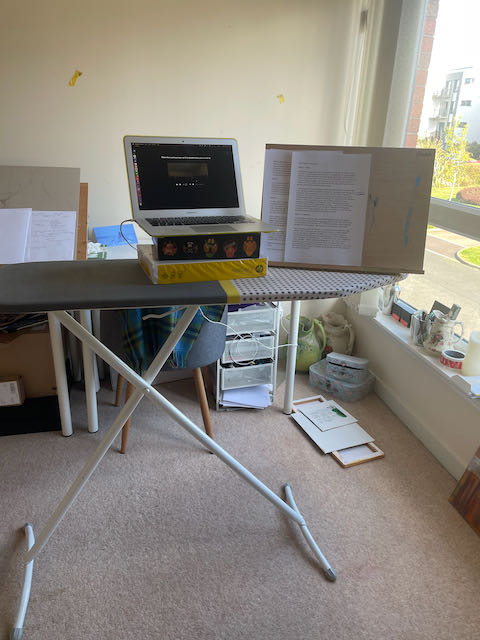
The realities of living, working and learning from home are bound as much by our physical spaces as our digital ones. I used some of the recent work of Professor Lesley Gourlay to explore this a bit more and talk about the entanglements of our phsyical and digital worlds, and the assemblages we have had to create to “be” at university. Today I thought I might stand to give the talk ( I don’t do much standing these days, do you?) so I created my own assemblage of a lectern using an ironing board, and some boxes. All a bit meta, but actually it work so I might do that again!

my standing desk!

The session was recorded so I will add a link to that when it is available, but in the mean time you can view my slides including feedback from participants here.

And here is a screen shot the wonderful sketch note of the talk by Maia Thomas.

Would taking a raft approach help us think about the transition back to campus?⤴

from

Photo by Tomasz Urbaszek on Unsplash

As we enter March this year, it is hard to believe that it’s almost been a year since we went into lockdown. Although we start this March with a bit more optimism particularly around vaccines, despite what many people want to think, “this” isn’t over yet. Over the weekend Auckland went back into a 7 day lock down.

I think this should sent a warning to us here in the UK. We have been no where near as successful as New Zealand in containing the spread of COVID-19. Yes, we are doing really well in terms of vaccine roll out, but that’s not a cure, there is still a lot of research to be gathered around the longer term impacts of the vaccines, their longevity and actual impact on transmission and suppression. Despite what many want to think, I don’t think we’ve seen the end of lockdowns.

As we prepare to move out of the highest levels of lockdown, schools here in Scotland have already started their phased return, and think about moving back on campus, the natural temptation is to plan for more face to face teaching, for that return to “normal”, to the spaces and places we’ve all missed for the last year. To bring our communities of learning back together in the “real” world.

However, I think it might be an idea to consider how to deal with short, sharp lockdowns and taking a what I’m calling a RAFT (rapid and flexible teaching scenarios) approach to design.

There is something in my head about a life raft metaphor too with this. Online learning has provided lots of learning life-rafts but there is the overwhelming desire to get back on to dry land. But as the lockdown in New Zealand (and there have been similar ones in other cities/countries) has shown we might have more shorter, local, lockdowns to come. So how can we deal with that?

Well maybe by simply by asking: could this activity/assessment/module be completed if we had to go back into lockdown at short notice? Are all the resources available online? Have I got at least 4 weeks teaching prepared in advance? Do students have clear signposting and support around what they are expected to do and where they should do it? Have I got established communication channels to let students know of any changes at short notice? Not rocket science, and a lot of this is already in place, so it would be tragic to loose what has been learned over the last year and just go back to “normal”. Let’s move forward with truly blended, flexible approaches.

Hope in a time of radical uncertainty⤴

from

I’m doing a short keynote/vision talk next week at the Digital Learning in the Pandemic and Beyond half day conference. The event has a focus on “looking at the practicalities, possibilities and potential pitfalls of online learning”, and has a great line of speakers looking at blended learning, copyright and accessibility.

I’m giving the opening talk and I think it is even more challenging right now to come up with something visionary, yet realistic given our current context. Just going to a conference is a wholly different contextual digital and material experience than from a year ago. We have gone through a radical change not just in education but across all aspects of our lives. I was struck by a quote in an article I read last week about not giving up hope taken from a 2014 paper on Climate Change,

“the context for hope is radical uncertainty” (McKinnon, 2014)

There is no doubt we have lived and continue to live in states of uncertainty. When schools/colleges/universities will fully open is just one of our current “known unknowns” – we have dates but nothing is certain.

We have experienced a radical change in the delivery of education. Arguably this might not have quite as much an impact on radically changing our education system for the future in the calls to “get back to normal” , but it has raised wider societal questions around the cost of data, equitable access to online learning, and the the limits of mobile devices for learning and teaching.

In an attempt to get a bit of community feedback before the event I put out a tweet yesterday asking people to share what if anything they had done since lockdown that they felt was radical in their teaching and learning. Thanks to everyone who responded.

From changes in access such as ports being opened so it was much easier to move in an out of institutional spaces, to making mix tapes for students to listen to as they explore resources, to creating OERs with students, to making more videos for students, to exploring with different design spaces, to getting access to more commerial courses, to choose your own adventure assignments, to using more creative pedagogies it was a very small slice of lots and lots of changes that could be having quite radical impacts on learning and teaching. I’ve collated all the responses into a wakelet shared below, but if you want to share something then please do leave a comment.

Now I am aware that some may not think of any of these as being “radical” but radical change can often be incremental starting with self awareness and having the agency to change the way you do things and look at the world. As we move forward I do think it is going to be really important to have some extended conversations between students, staff, management, government and our wider communities about what we really need to develop in order to develop our education systems to deal with the more uncertainty in equitable, open and accessible ways. And that is the kind of radical hope we all need in these uncertain times.

Bring your own device for learning or bringing learning to your device?⤴

from

Maybe it’s just the time of year, maybe it’s just the context of this year, maybe it’s just a sign of age, but I am finding myself getting more and more nostalgic as various online services “pop up” reminders of what I was doing at this time, last year, 2, 4 ,5, 7 years ago. This time last year I was still travelling across the country to run workshops . . .

Over the last few days I’ve been getting reminders of #BYOD4L (Bring your own device for learning). This was a week long open “event” for staff, students and the brain child of Chrissi Nerantzi, Sue Beckingham and David Hopkins. Along with Alex Spiers and Neil Withnell, I was part of the facilitation team that took over from the original team.

BYOD4L was always a brought a bit of focus and fun to gloomy January’s past. The structure of the event was based around the 5 c’s – connecting, communicating, curating, collaborating and creating. Each day focused on one of the “c’s”, and there were daily tweet chats each evening. Lots of us used the flexibility and open-ness of the concept to run face to face sessions (remember them?) in our institutions. It gave a focus to bring people together to share the ways they used technology in their learning and teaching.

It was also a really fantastic way to introduce people to twitter and connect to a ready made learning network. It was exhausting to facilitate but always great fun, and for me, a really positive learning experience. It was also a great incentive for writing blog posts!

Although BYOD4L was largely online, it enabled so many different face to face interactions. It was also predicated on the context that the majority of staff and students were travelling to campus, and so bringing their devices to those physical locations. Students and staff were accessing their “stuff” on the bus/train/car/tube where ever, as well as on campus/in class/in the library/in the refectory etc. But now, we’re all at home (or maybe in halls of residence, or maybe with very limited time on campus), so it’s not so much a case of bringing your own device for learning, rather bringing learning to your own device (BYOD2L instead of BYOD4L). That’s a subtle but important change of emphasis. And of course, access to “your own” device isn’t a given. The last year has certainly highlighted the digital divide around access to devices. Not all students (or teachers) have a laptop/computer/device that they can use, or afford the data allowance to engage with online learning. Having a mobile phone is one thing, but their limitations for learning have been well and truly exposed. We still can’t assume that they everyone has unlimited online access.

Over the last year a huge amount has been done by everyone in terms of moving to online learning and teaching and providing access to equipment and data. Back in the day, there were a core of #BYOD4L-ers who might have been seen as “outsiders” from the norm, as they were interested, and more importantly using technology actively in their learning and teaching and sharing that practice openly.

Looking back a the BYOD4L model, it still holds up. So I wonder if there is an opportunity to revisit it and use it as a way to focus on reflecting on what has happened over the last 10 months and help us focus on what should be our priorities (based on actual practice) for the foreseeable future? Although the event was designed with staff and students in mind, getting students involved was always a challenge and one I never managed to crack. But I think that might be different now, I think that this could provide a focus for student/staff engagement that is relevant to our current context.

This needs a lot more thought, but I’d love to know what you think.