Tag Archives: course data

On Talent Pipeline Management⤴

from @ Sharing and learning

I’m prompted by a #femEdTech tweet to write about some of the work I’m involved in regarding linking education to employment:

This is going to be a tricky topic to write about, if I get it wrong one way or another I will either offend people with whom I enjoy working or seem to be giving the opposite message to the one I intend.

The work in question is on Talent Signalling for the Job Data Exchange, but what I have in mind in particular is some of the wider context for that work, which goes under the banner of Talent Pipeline Management. Now, there is a lot that I don’t like about the rhetoric and metaphors here, I won’t dwell on them, if you’re likely to get it you won’t need it explaining. Once I got passed that, what  impressed me, was the idea brought in from supply chain management, explained to me by Bob Sheets, that if you want to go beyond a low quality commodity-like approach (by analogy cheap components  sourced with price as the only criterion) you needed to “go deep”. That is, you need to build a deep relationship to create understanding–it’s all social constructivism now–between those all involved education, training and learning, those involved in recruitment, and those involved in strategic planing for the local economy.

The approach seems much deeper than I have seen in the UK, for example in industry liaison committees at Universities, because it involves getting all levels & contexts of education provider together to work with industry and business on things like curricula and training opportunities. This is described in detail through the TPM Academy. Again, anyone from an education background will flinch at the industry-focused utilitarian view of education shown in how it is presented, but the underlying idea seems valuable.

So my current thoughts and questions are: how does this look from the learner/worker/job seeker point of view? [Quick note to self: check on whether they are included in the conversations defining curricula.] I think that is key to keeping this work on the right side of education being just about satisfying the need for cheap labour. Secondary question: is my glibly stated opinion that this goes deeper than approaches I’ve seen in the UK just an admission of ignorance? [Answers in the comments please!]

Going forward, my work will continue to look at the data that can be communicated through things like job adverts, course and qualification descriptions, trying to build the underlying infrastructure that allows “faster clearer signals” and stonger linkages between employment and education / training to help build these deeper relationships. I’m also getting involved in how  individuals’ acheivements can be represented semantically, so that will bring in a whole raft of questions about who controls the creation and dissemination of this data.

The post On Talent Pipeline Management appeared first on Sharing and learning.
Indiana Appathon Credential Data Learn and Build⤴

from @ Sharing and learning

This week I took part in the Credential Engine’s Indiana Appathon in Indianapolis. The Credential Engine is a registry of information about educational and occupational credentials (qualifications, if you prefer; or not, if you don’t) that can be earned, along with further information such as what they are useful for, what competencies a person would need in order to earn one and what opportunities exist to learn those competencies. Indiana is one state that is working with the Credential Engine to ensure that the credentials offered by all the state’s public higher education institutions are represented in the registry. About 70 people gathered in Indianapolis (a roughly equal split between Hoosiers and the rest of the US, plus a couple of Canadians and me) with the stated intentions of Learn and Build: learn about the data the Credential Engine has, how to add more and how to access what is there, and build ideas for apps that use that  data, showing what data was valuable and potentially highlighting gaps.

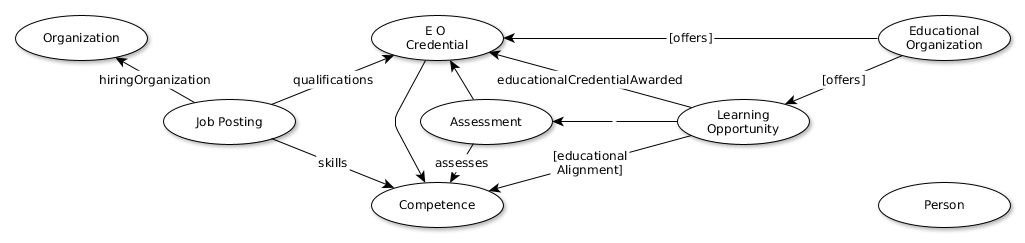
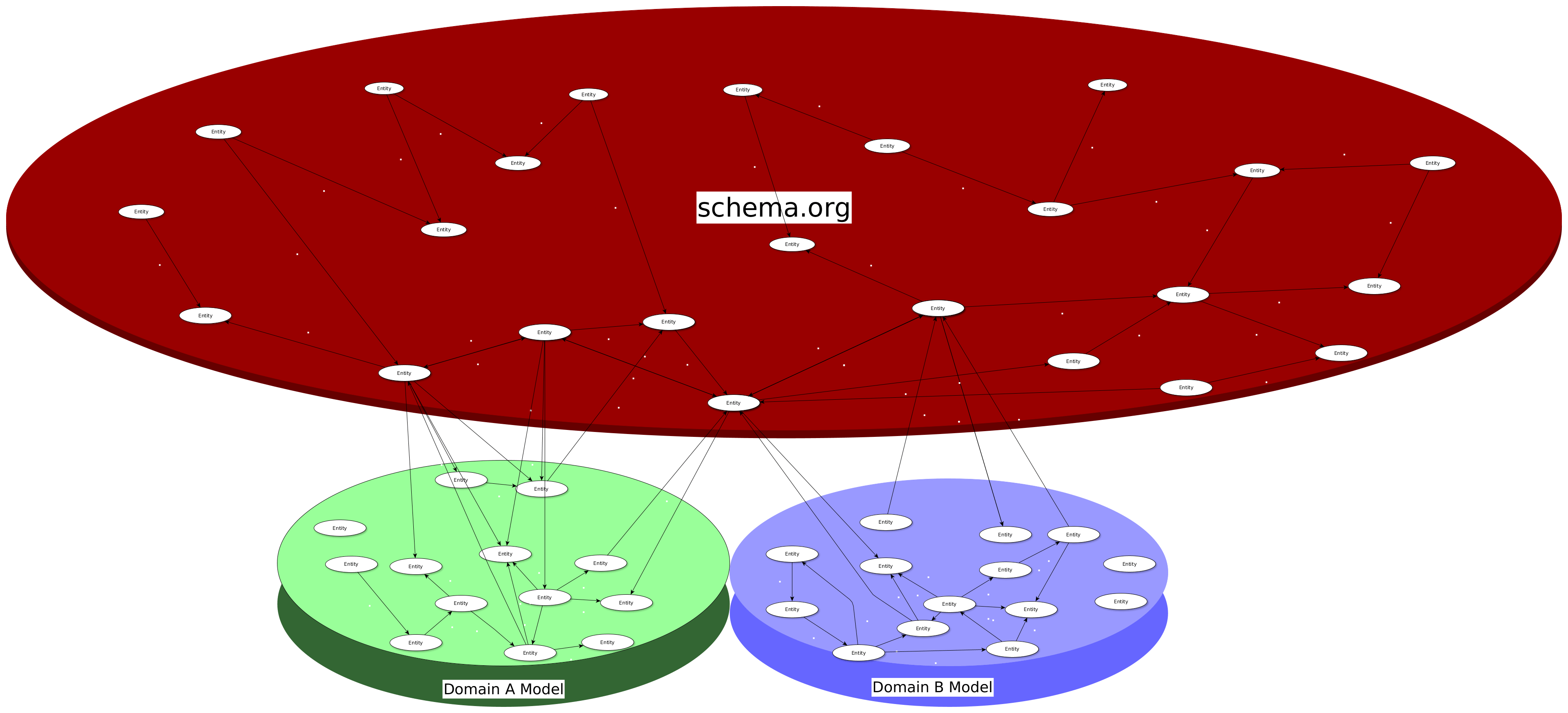
circles and lines representing entity-relationship domain modelsI was there as a consequence of my project work (supported by the Credential Engine) to represent Educational and Occupational Credentials in schema.org, with the aim of helping  people understand the benefits of putting credentials on to the open web. Cue my chance to reuse here my pictures of how schema.org can act as a cross-domain unifying schema for linked data and how different domains link together from Education to HR.

I’ve been involved in a few events where the idea is to try to get people together to learn/discuss/make, and I know it is really difficult to get the right balance between structure and flexibility. Too much pre-planned activity and delegates don’t get to do what they want, too little and they are left wondering what they should be doing. So I want to emphasize how hugely impressed I was with the event organization and facilitation: Laura Faulkner and colleagues at Credential Engine and Sonya Lopes and team at Learning Tapestry did a great job. Very cleverly they gave the event a headstart with webinars in advance to learn about the aims and technology of the credential engine, and then in Indianapolis we had a series of  activities. On day one these were: cycling through quick, informal presentations in small groups to find out about the available expertise; demos of existing apps that use data from the Credential Engine; small group discussions of personas to generate use cases; generating ideas for apps based on these. On day two we split into some ‘developer’ groups who worked to flesh out some of these ideas (while the ‘publisher’ group did something else, learnt more about publishing data into the Credential Engine, I think,–I wasn’t in that group), before the developer groups presented their ideas to people from the publisher group in a round-robin “speed-dating” session, and then finally to the whole group.

I went wanting to learn more about what data and connections would be of value in a bigger ecosystem around credentials and for the more focussed needs of individual apps. This I did. The one app that I was involved with most surfaced a need for the Credential Engine to be able to provide data about old, possibly discontinued credentials so that this information could be accessed by those wanting more details about a credential held by an individual. I think this is an important thing to learn for a project that has largely focussed on use cases relating to people wanting to develop their careers and look forward to what credentials are currently on offer that are relevant to their aspirations. I (and others I spoke to) also noticed how many of the use cases and apps required information about the competencies entailed in the credentials, quite often in detail that related to the component courses of longer programs of study. This, and other requirements for fine detail about credentials, is of concern to the institutions publishing information into the Credential Engine’s registry. Often do not have all of that information accessible in a centrally managed location, and when they do it is maybe not at the level of detail or in language  suitable for externally-facing applications.

This problem relating to institutions supplying data about courses was somewhat familiar to me. It seems entirely analogous to the experiences of the Jisc XCRI related programs (for example, projects on making the most of course data and later projects on managing course-related data). I would love to say that from those programs we now know how to provide this sort of data at scale and here’s the product that will do it.., but of course it’s not that simple. What we do have are briefings and advice explaining the problem and some of the approaches that have been taken and what were the benefits from these: for example, Ruth Drysdale’s overview Managing and sharing your course information and the more comprehensive guide Managing course information. My understanding from those projects is that they found benefits to institutions from a more coherent approach to their internal management of course data, and I hope that those supplying data to the Credential Engine might be encouraged by this. I also hope that the Credential Engine (or those around it who do funding) might think about how we could create apps and services that help institutions manage their course data better in such a way that benefits their own staff and incidentally provides the data the Credential Engine needs.

Finally, it was great to spend a couple of days in sunny Indianapolis, catching up with old friends, meeting in-person with some colleagues who I have only previously met online and doing some sightseeing. Many thanks to the Credential Engine for their financial assistance in getting me there.

Photo of brick build building next to corporate towers
Aspects of Inidianapolis reminded me of SimCity 2000
White column with statues
Monument in centre of town
plan of a city grid for Inianapolis
The original city design plan (plat)
Photo of indoor market
One of the indoor markets
Fountain and war memorial
The sign said no loitering, but I loitered. That, in the background, is one of the biggest war memorials I have seen


The post Indiana Appathon Credential Data Learn and Build appeared first on Sharing and learning.