TeachmeetBETT26: Twenty Years On and Still the Best Thing in the Room #TeachmeetBett26 #BettUK2026 #ALT #OpenEducation #openscot⤴

from @ ...........Experimental Blog


Twenty years. That's how long the Teachmeet movement has been rattling around in classrooms, conference halls, and the odd beermeet event and it shows absolutely no signs of slowing down.

The Teachmeet movement started in Scotland in 2006. A group of  Scottish teachers who wanted to share practice without the formality and expense of traditional CPD. No budgets, no keynotes charging four figures, no hotel conference suites. Just people who cared about learning, talking to other people who cared about learning. 

It spawned from a community around early Scottish Educational bloggers - Scotedublogs ( still going strong).  Over years  I offered sponsorship and venues when I could - though I did speak at a few and the teachmeet format moved around the world. 

But I do think we have stalled a bit in Scotland would be good to see much more grass roots activity. 

At the time and now,  it is refreshing to hear - fresh voices sharing their challenges and solutions.
 
For anyone who hasn't come across Teachmeet before, where have you been? The concept is beautifully simple.

  • Practitioners suggest they will  share something useful, interesting or half-baked in two minutes or seven minutes. 
  • These are added to the pot and then selected at random.
  • No PowerPoint decks full of bullet points. 
  • Perhaps an illustration or something to demo.
  • They stand up and use their allotted time.
  • Generally a safe space not usually live streaming.
  • If you take too long you get a cuddly toy hurled at you. 
  • Audience gets a useful link or idea to take away and look at later. 

No consultants selling you something. Just real people doing real things in real classrooms and colleagues, sharing what works and what doesn't. 

It's bottom-up professional development at its very best, and in an age where we are drowning in AI-generated content and slick vendor presentations, that authenticity matters more than ever.

What genuinely lifted my spirits at Teachmeet Bett 2026 was seeing new faces embracing the Teachmeet methodology. The audience was a good mix ; teachers, lecturers, learning technologists, people from schools, colleges and universities and the energy in the room was real. That's the thing about Teachmeet. You can't manufacture that energy. It either happens or it doesn't, and on that  Wednesday night it absolutely did.


It is simply great staff development. 
The presentations are all available here and there's also a lovely tribute to Teachmeet's twenty-year history worth exploring if you want to understand just how far this grassroots movement has come.

I used my two minutes to plug learning design, Open Education #openscot , and membership of ALT. I make no apologies for that. These are things I genuinely believe every college professional working with technology should know about. CMALT in particular remains one of the most underused professional development tools in Scottish further education, and events like Teachmeet are exactly the right place to spread the word.

A challenge 
  • At the end of the night, the challenge went out: organise one. Your college, your school, your academic team , your local authority, your professional network. It doesn't have to be big. It doesn't have to be slick. It just has to happen. 
  • I genuinely believe every college in Scotland — every college anywhere — should be running at least one Teachmeet a year. The cost is minimal it can be zero . The return in terms of practitioner confidence, professional community and shared ideas is enormous.
  • To Scottish teachers and lecturers it is hard making your voices heard but you need to be brave for your learners. Teachmeets and Scotedublogs are great vehicles to share open practice. There is a community you can be part of.   
In the background there is some work underway to restate some Teachmeet assets like original wiki to help keep global momentum going.

Hat doffed to all teachmeeters past and present. I am looking forward to meeting future generations. 

Twenty years of Teachmeet. Here's to twenty more. Hope to see you at #teachmeetBett27 #tmbett2027


Examples of prior games learning from Scottish schools⤴

from @ DigiLearn

Examples of learning from previous games live lessons back to Making Games A primary teacher from Rowantree Primary School in Dundee shared this with us: “My class recently attended the above session and following on from your email we were keen to share our learning. They really engaged well with the session and loved making …

About BAFTA Young Games Designer competition⤴

from @ DigiLearn

More about the BAFTA Young Games Designer competition back to Making Games YGD is “a chance for 10–18-year-olds to design, develop and present new game ideas”.  The competition is now open and the closing date for entries is 12th March 2026.  Children and young people will need an account on BAFTA to enter the competition …

Purposes of Education⤴

from @ Memory and Metacognition Updates

Hello! I hope you are doing okay. Today I want to (briefly) step back from the concept of memory to consider the broader purposes of education. I’ll soon circle back to more familiar issues.

Education

First, it’s worth mentioning that education, as a concept, can mean a lot more than schooling, and is not confined to formal education, either. Books educate us, for example, as do films, conversations with friends, parenting, and much more (see this post by one of my colleagues for more).

Within the realms of formal education we can have an interesting conversation about purpose, given that these forms of education are set up and (typically) funded by the public.

Here’s a quote I shared in a previous post on transfer:

“ … much of the financial and human investment in education has been justified on the grounds that formal schooling helps inculcate general skills that transfer beyond the world of academia...”

(Barnett & Ceci, 2002, p. 613)

So, what are schools, universities and colleges for? No doubt they have purposes that are not strictly educational such as their childcare function. I won’t get into those issues here.

However, at least if curriculum documents are to be believed, a major goal of the endeavour as a whole lies in the need to develop and equip (future) citizens. That is, helping learners to develop the knowledge and skills that they will need as useful members of society.

Understandably, this is sometimes expressed in terms of certain dispositions or capacities; learners should become creative, critical thinkers, reflective learners, motivated and curious, and so forth.

Memory does not tend to be the focus of such documents or discussions, except perhaps as something that we need to get away from – boring, passive memorisation, and so forth.

However, I think this just reflects a rather simplistic and inaccurate view of what memory is. At least according to mainstream psychological definitions of the term, anything that we learn and retain is represented in long-term memory. This means that any educational experience that causes learners to become more curious, reflective etc must, somehow, impact on memory. If you get better at a skill, that depends on memory, too!


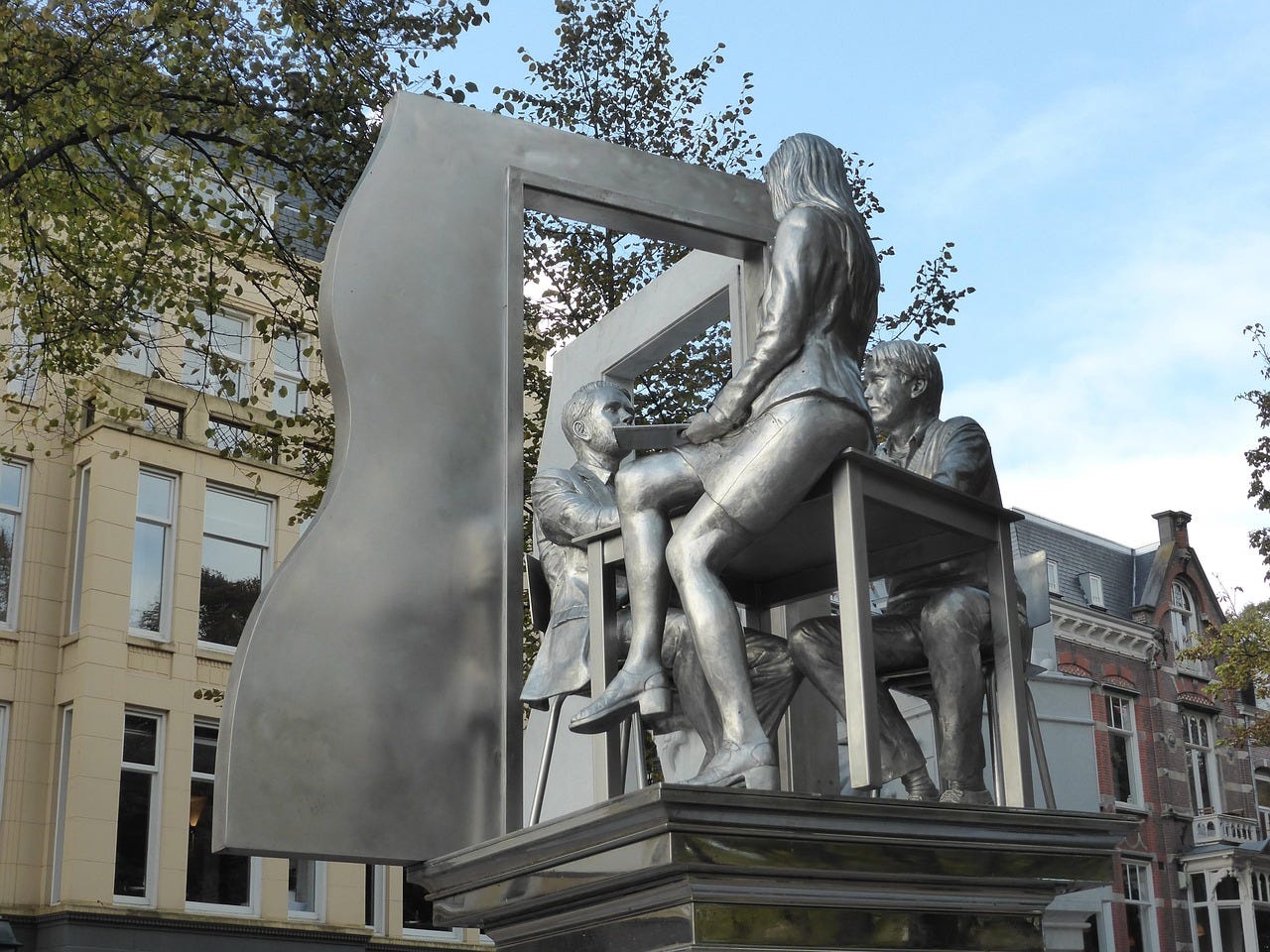
A silver modern art statue of three people around a table, European-style city buildings in the background
Image via Pixabay

What’s more:

  • It’s impossible to think critically without retaining relevant knowledge in memory (Willingham, 2008). For example, how could someone critique a conspiracy theory about vaccines unless they had retained the relevant scientific facts?

  • Thinking reflectively is a form of metacognition. Indeed, expecting people to be reflective learners without teaching them how is wishful thinking, and may be setting learners up to fail. There is ample evidence that learning the strategies involved in reflection is valuable; this, of course, is part of metacognition.

  • None of the capacities get us anywhere unless they transfer to other situations, as stated in the quote I included near the start. We can never ensure transfer, but we can make it more likely to occur via the design of learning experiences that involves certain types of practice (including practice with desirable difficulties – see update #99), as well as – you guessed it – knowledge in one’s long-term memory, and metacognition (Bransford et al., 2000).

Overall, I don’t object to any of the broader goals of education. Indeed, I very much subscribe to the value of things like creativity and critical thinking. It’s just a mistake, in my view, to neglect the discussion of how these things operate on a cognitive level.

In terms of critical thinking, there is a lot about this that we don’t know for sure, but there is some really promising research on how we can support our learners to be critical thinkers. I’ll delve into this next time!

All the best for the coming week,

Jonathan


A reminder of my CPD session on evidence-informed classroom questioning: Evidence-Informed Classroom Questioning – 19 February, Glasgow


Last time: Interleaving, Metacognition and Children

I hope you are enjoying Memory and Metacognition Updates. Subscribe for free to receive new posts and support my work – and consider sharing it with colleagues!! Thank you!

Please note that my slides and similar materials are shared under a CC BY-NC 4.0 license. This means you can use or adapt them with attribution for non-commercial purposes. If you wish to use my materials for other purposes, feel free to get in touch.