
Frogs at Tintagel⤴
from NomadWarMachine
view: full | short | titles only
from NomadWarMachine
from NomadWarMachine
TDC5301 says:
Austin Kleon weighs his notebooks before and after finishing them. What silly rituals do you have to make your work seem more like play?
Here’s mine – I make pretty icons for my To Do lists and colour them in as I complete each task

To do list flickr photo by NomadWarMachine shared under a Creative Commons (CC BY-NC-SA 4.0) license
from NomadWarMachine

Tintagel flickr photo by NomadWarMachine shared under a Creative Commons (CC BY-NC-SA 4.0) license
In this article, Joanna Stell follows up on her previous post on the IDL network with her own experience of classroom interdisciplinarity at her school near Cambridge. Her rationales and resources are easily accessible and hugely useful for teachers in any setting looking at IDL for their own practice.
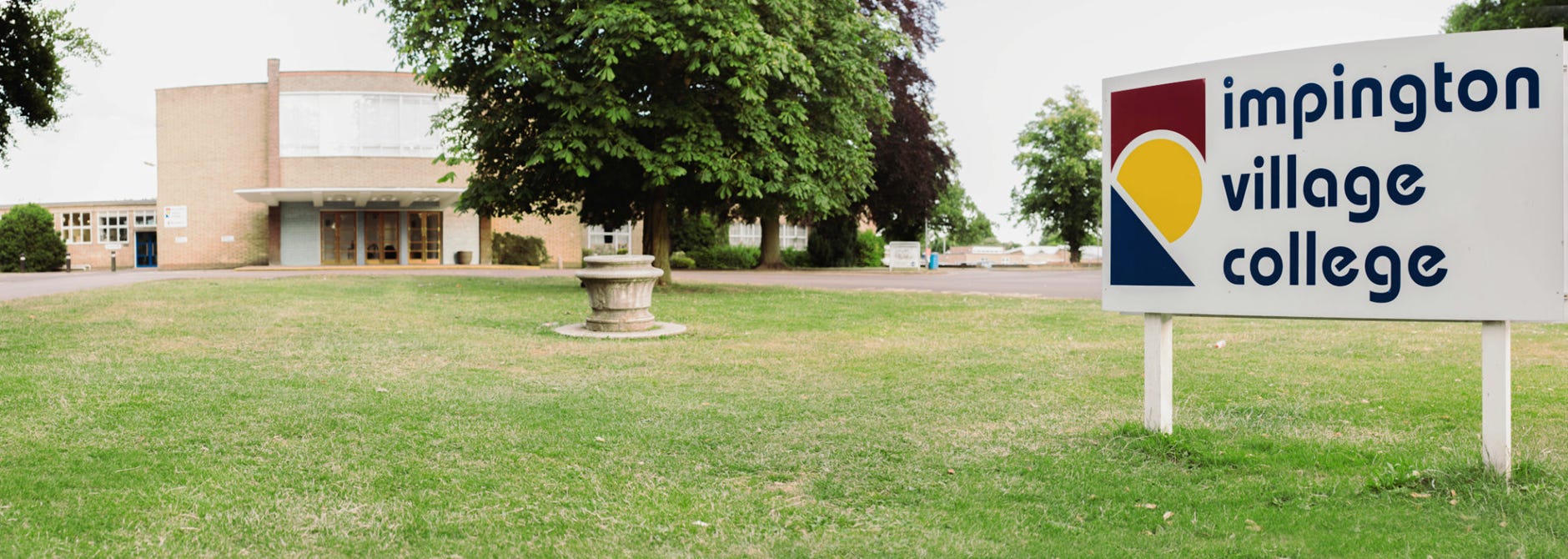
I’m a secondary school maths teacher. But I’ve had a dream since I was a student myself to step beyond the maths and run interdisciplinary workshops. This term, I finally had the opportunity to do so. The setting: a 45-minute session to groups of our incoming, unsuspecting, year 12s here at Impington Village College (also known as Impington International College to our IB-studying sixth formers). The challenge: how could I set both myself and our soon-to-be sixth form students up for synthesising success in just a 45-minute session? The literature was stacked against me, telling how hardly any schoolteachers are trying this, and those who are trying this aren’t having much luck. But with countless excellent university examples behind me and a truly wicked problem up my sleeve, here’s how it went…
This was the question that met our future students as they entered the room. Inspired by ARU’s Ruskin Modules, I wanted a question that was painfully pertinent and likely to create quite the stir. Which it did. Once this stir was settled, students were introduced to:
i) what interdisciplinarity can do (mainly: solve wicked problems);
ii) what it is not (mainly: synthesis-less multidisciplinarity or subject-less project based learning);
iii) where they’ll meet it (mainly: within the International Baccalaureate Diploma Programme through Theory of Knowledge and an Interdisciplinary Extended Essay);
iv) and finally what it is (mainly: the integration of disciplinary perspectives).
TEACHING NOTE: I’d made the conscious decision to use “subject” and “discipline” interchangeably throughout the session using phrases such as “subject specialist” and “disciplinary perspective” in parallel. Some readers might have strong thoughts on that, but my strong reasoning was that this might actually be the first time students were hearing “discipline” and I needed them to associate it as quickly as possible to “geography”, “psychology”, “maths” and not “punishment”, “detentions”, “strict”.
With our question and our principles established, I briefed students on how we would be approaching interdisciplinarity. For this, I drew on Repko in the form of Utrecht University’s Four Stage Model of Interdisciplinarity.
As you’ll realise, this was already done. It’s the one that met students when they entered the room
For this, conceptually, a “spokes model” was used whereby the problem is placed in the centre and different perspectives come from this, similar to the spokes of a bicycle wheel:
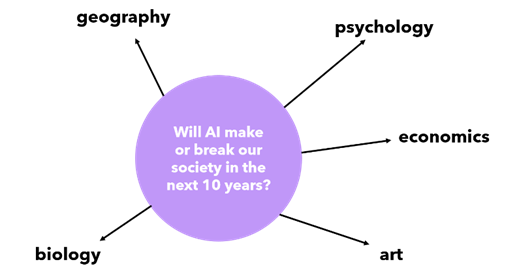
Logistically, this meant that students chose a source pack (containing three different articles, reviews, or academic study summaries) from art, biology, economics, geography or psychology. Then for some movement, with students joining the other “subject specialists” on a table. Here, they got 5 minutes of independent reading before 5 minutes of discussing their chosen disciplinary perspective as a group.
TEACHING NOTE: as a classroom teacher, I knew that students can’t simply choose a group scribe autonomously. No, the disciplinary-tables were given the challenge of figuring out who’s name came first alphabetically (remember, these are incoming students and thus total strangers to each other) with this person becoming the involuntary scribe.
In true Repko style, next came the messy beginnings of reconciling the differing disciplinary perspectives. For this, students returned to their original tables, and each had 30 seconds to stand up in front of their group as they summarised their discipline’s perspective.
Finally, it was time to attempt that integration. With a new scribe (first birthday of the calendar year), groups picked 2 of the 4 disciplines represented to begin “synthesising” to create an integrated viewpoint on AI’s future. The room was buzzing. After just 5 minutes, a spokesperson was chosen (last name of the group alphabetically) who had just 45-seconds to state their group’s chosen disciplines and the headline of their interdisciplinary perspective.
SPOILER: we didn’t really seem to reach “synthesis”, but that doesn’t mean that we hadn’t covered valuable ground towards it. And as the students presented their 45-second headline, four different levels of interdisciplinary processing emerged, the gradual steps that students had taken towards a synthesised response.

These were the explicit cognitive labels that students gave their thinking. “We’ve linked geography and biology…”, “By comparing psychology and economics…”, “A connection between art and psychology…”. Each time I heard one of these verbs my heart sank: ah, the students haven’t quite understood the brief, they’ve gone for the wrong cognitive process. Or maybe it wasn’t wrong, it’s just not yet complete. Maybe students naturally start by comparing, contrasting, and connecting. Our job as teachers is then to push them further towards “synthesising” and “integrating”.
Moving beyond just the cognitive label, students’ linguistic choice of connectors revealed arguments built on parallel perspectives. “AI supports developments in both health research and also in town planning”. I was impressed by this astute ability to identify identical arguments which appeared in multiple perspectives but stumped as to how to encourage these parallel lines of reasoning to converge into an integrated response.
A possible route to convergence is one I’ll name here “Conceptual Hooks”. What these parallel perspectives seemed to speak of was shared concepts or themes, present across the disciplinary perspectives, which may be the stepping stone to an integrated approach to the problem. Students began discussing concepts that were present within the perspectives of multiple disciplines, such as: responsibility, human expression, efficiency, quality of life. Could such conceptual hooks be used to further drive integrated perspectives?
In truth, my initial spoiler may actually be underselling what the students achieved in those brief 45-minutes.
“AI poses a threat to emotional expression” (art and psychology)
“AI may diminish individuals’ quality of life” (geography and economics)
“AI usage raises issues as to who should take the credit / blame for new knowledge and decisions” (art, geography, biology, psychology)
This is what 16-year-olds are capable of in just under an hour. They may only be headlines, but each carries such power and such potential. What could they achieve in a 6-week programme? On a year long course? During 7-years of secondary school education?
What was so wonderful about this workshop was that, despite being totally new to interdisciplinarity (even featuring some questionable spellings of “disciple” and “prospectus”), students all had something to say, and they kept on talking! But there were several things missing.
First, we needed models or at least scaffolding of what an “interdisciplinary perspective” actually looks like. How is it structured? How does it use language? And how does it not use language? The students wanted to know what they should be saying, and I didn’t know exactly how to respond without simply telling them an answer.
Next, we needed holistic disciplines. Despite my previous calls to feature collaboration across multiple subject teachers when designing interdisciplinary programmes, my only external “experts” when planning this workshop were the various sources that Google and Copilot (ironic, I know) had sourced for me. I fear that this led to our subjects feeling flat. As incoming IB students, this is no significant worry as all our students will soon critically analyse each discipline, its content, methods, and perspectives, during their Theory of Knowledge lessons. But in a typical state comprehensive, how are we ensuring that students appreciate subjects beyond exam syllabi?
Finally, I know that there were absent disciplinary perspectives. One group’s thinking on the legal implications of discoveries made using AI was crying out for a political perspective whilst another discussion on optimising efficiency versus climate impact needed a suitable mathematical model to graph the options. This openness to adding further disciplinary perspectives, a reactionary and reflexive process, feels messy and daunting but is probably a necessary consideration.
With these possible edits in mind, I’m excited to run this session again, and again, and again, to any year group and any school that is crazy enough to give interdisciplinarity a try. Because, as I said to each group of students as our session drew to a close: this is how to future-proof our education.
For further details and access to the resources used in this workshop, please contact jstell@ivc.tmet.org.uk
References:
ARU’s Rusking Modules: https://www.aru.ac.uk/student-life/support-and-facilities/careers-and-employability/developing-your-employability/ruskin-modules
Utrecht University’s Four Stage Model (adapted in this blog!): https://www.uu.nl/en/education/educational-development-training/knowledge-dossier/a-four-stage-model-for-interdisciplinary-learning
IB’s Theory of Knowledge: https://ibo.org/programmes/diploma-programme/curriculum/dp-core/theory-of-knowledge/
IB’s Extended Essay: https://ibo.org/programmes/diploma-programme/curriculum/dp-core/extended-essay/
from NomadWarMachine
For today’s TDC I created this poster. Apparently it’s HAL, but the reference is lost to me as I haven’t seen the film. (Not even my beloved Daily Create is going to make me start watching films! Look, I get it – you all think I am missing lots of cultural references, but I have tried, and I just don’t watch after the first few minutes.)

You can do it poster flickr photo by NomadWarMachine shared under a Creative Commons (CC BY-NC-SA 4.0) license
from NomadWarMachine

Mugdock Loch flickr photo by NomadWarMachine shared under a Creative Commons (CC BY-NC-SA 4.0) license
from John @ Glow Blog Help
There has been a new release on Glow Blogs, dealing with some issues and updating themes and plugins.
A security issue has developed with this plugin. We have temporarily patched(fixed) the problem for sites already using the plugin. We have also prevented the plugin from being installed on sites. If you remove the plugin, you will not be able to install it again. We hope there will be an update to the plugin soon. There is no issue with running the patched plugin.
A problem with widgets developed which affected new classic themed sites. To fix this issue we have moved to using Widget blocks in the Widget area of the dashboard and the Customizer in classic themed sites.
This will bring editing widgets in line with modern WordPress editing. There are many advantages to this:
The Widgets page of the help will be updated to reflect the changes.
An issue where the correct template was not applied in the site editor has been fixed.
The following plugins have be updated to newer versions.
The updates should not affect how you use these plugins.
The following themes have been updated:
Twenty Twelve, Twenty Thirteen, Twenty Fourteen, Twenty Fifteen, Twenty Sixteen, Twenty Seventeen, Twenty Nineteen, Twenty Twenty, Twenty Twenty One, Twenty Twenty Four, and Twenty Twenty Five.
If you are considering a theme change we would encourage you to read Theme Retirement News | Glow Blog Help. In general choosing one of the Twenty themes is a good idea.
As always please get in touch if you need more information.
from NomadWarMachine
July weather is unpredictable, from sweltering heatwaves to torrential rain. I take my chances where I can and step outside to enjoy my garden. At the moment my geraniums are glorious – shaded from the worst of the heat by the forsythia above, spreading out across the garden. Today they are shining in the sun.
On a sunny day
Flowwers turn their faces up
Basking in the light

189/365 Geraniums flickr photo by NomadWarMachine shared under a Creative Commons (CC BY-NC-SA 4.0) license
from NomadWarMachine
Today’s TDC asked us to use digital erasing to remove a phone from an image. Now, once upon a time this took skilz, but with the new tools in my Android phone it’s far too easy. I took a pic of myself holding my phone and automatically loaded up GIMP to edit it out. But then I remembered the Android ‘magic eraser’ so I used that instead. I will say that it sort of upsets me that it is so easy to do – but it consoles me that it’s not perfect – the corner of the picture it’s filled in doesn’t actually look like that.
If I’d had more time I’d have done more with the cut out image, but it’s a work day and I had a long list of things to get done. So here it is. Original, GIMP edited and Android edit.

removed flickr photo by NomadWarMachine shared under a Creative Commons (CC BY-NC-SA 4.0) license
Hello! As I am shortly going to be spending some time away with my family, I’ll take a few weeks away from these updates, returning in August. It’s also an opportunity to recap the topics covered over the past academic year, sharing any that you might have missed.
Some highlights include a series of posts on learning myths, a few posts on interleaving and spacing, a couple of recent ones on potential areas of confusion in cognitive science. Most recently, as you may have seen last Monday, I shared the first co-authored post that I have done here (on variation and creativity).
There were a few posts on a Higher Education theme, including on lecturers’ understanding of learning and on university study skills. I also shared a couple of more philosophical updates, including a pair of posts about the purposes of education about potential misconceptions of cognitive science.
There were also posts on teacher research, digital distractions, classroom questioning, and more!
So, these are the posts since last summer, in order, oldest first:
Update 121: Combining retrieval practice and generative learning
Update 122: Retrieval practice and generative learning: Classroom implications
Update 123: Getting to grips with cognitive science and education
Update 125: Combining Interleaving and the Spacing Effect, Part 1
Update 126: Combining Interleaving and the Spacing Effect, Part 2
Update 127: What makes a difficulty desirable? Philosophical reflections
Update 129: More on the learning styles myth: Classroom Implications
Update 131: Promise and pitfalls of practitioner action research
Update 132: Welcome back to memory and metacognition updates
Update 136: Applying cognitive science to questioning – timing
Update 137: Does retrieval practice work in real classrooms?
Update 143: Desirable difficulties, variation and creativity
So, what next? Even just listing the posts reminds me of a few things that I’ve been meaning to get around to, but now it will have to wait until after the summer!
In particular, there are two posts where I am planning to write one or more follow-up pieces. As already mentioned recently, I have more areas of confusion in cognitive science to cover. I also plan to revisit the topic promise and pitfalls of practitioner action research, which I had intended as a 3-part post, with the second part delving more into the pitfalls, and the final one suggesting some guidelines.
Other areas I plan to get to after the summer include
Episodic and semantic memory – a very well-established idea in the science of long-term memory, but rarely covered in CPD for educators;
Flawed applications of metacognition. I often hear about schools setting metacognition as one of their learning goals or policies, but the specifics often leave a lot to be desired. Likewise, I’d like to share more practical guidance on study skills.
So, all in all, lots to think about and write about!

My other immediate plan is to disappear on holiday. I’ll be staying in Scotland, and plan to go to Arran (shown in the image above) – a magical place, and one that my wife’s family have a very long connection with.
Other than that, I will be pressing on with various research projects, including the school-university transitions work that I mentioned recently.
I’m also nearing the final stages of my Psychology of Education textbook (currently working through some edits following feedback on the first draft). I’ll share more info on that next month.
Before I sign off, just to mention that I am running a 1-day seminar in Glasgow on the theme of memory and education (broadly defined!). Somewhat philosophical in tone, but very much open to cognitive science issues, too. Are you interested in presenting or just coming along for the day? It’s free to attend. More info below:
I hope you get a break at some point, and have a great time if so. Thanks again for reading!
All the best for the coming week,
Jonathan
I hope you are enjoying Memory and Metacognition Updates. Subscribe for free to receive new posts and support my work – and consider sharing it with colleagues!! Thank you!

Please note that my slides and similar materials are shared under a CC BY-NC 4.0 license. This means you can use or adapt them with attribution for non-commercial purposes. If you wish to use my materials for other purposes, feel free to get in touch.