In this article, Joanna Stell follows up on her previous post on the IDL network with her own experience of classroom interdisciplinarity at her school near Cambridge. Her rationales and resources are easily accessible and hugely useful for teachers in any setting looking at IDL for their own practice.
I’m a secondary school maths teacher. But I’ve had a dream since I was a student myself to step beyond the maths and run interdisciplinary workshops. This term, I finally had the opportunity to do so. The setting: a 45-minute session to groups of our incoming, unsuspecting, year 12s here at Impington Village College (also known as Impington International College to our IB-studying sixth formers). The challenge: how could I set both myself and our soon-to-be sixth form students up for synthesising success in just a 45-minute session? The literature was stacked against me, telling how hardly any schoolteachers are trying this, and those who are trying this aren’t having much luck. But with countless excellent university examples behind me and a truly wicked problem up my sleeve, here’s how it went…
Will AI make or break society in the next 10 years?
This was the question that met our future students as they entered the room. Inspired by ARU’s Ruskin Modules, I wanted a question that was painfully pertinent and likely to create quite the stir. Which it did. Once this stir was settled, students were introduced to:
i) what interdisciplinarity can do (mainly: solve wicked problems);
ii) what it is not (mainly: synthesis-less multidisciplinarity or subject-less project based learning);
iii) where they’ll meet it (mainly: within the International Baccalaureate Diploma Programme through Theory of Knowledge and an Interdisciplinary Extended Essay);
iv) and finally what it is (mainly: the integration of disciplinary perspectives).
TEACHING NOTE: I’d made the conscious decision to use “subject” and “discipline” interchangeably throughout the session using phrases such as “subject specialist” and “disciplinary perspective” in parallel. Some readers might have strong thoughts on that, but my strong reasoning was that this might actually be the first time students were hearing “discipline” and I needed them to associate it as quickly as possible to “geography”, “psychology”, “maths” and not “punishment”, “detentions”, “strict”.
With our question and our principles established, I briefed students on how we would be approaching interdisciplinarity. For this, I drew on Repko in the form of Utrecht University’s Four Stage Model of Interdisciplinarity.
Step 1: Start with a problem that lies beyond a single subject
As you’ll realise, this was already done. It’s the one that met students when they entered the room
Step 2: Explore this problem from multiple disciplinary perspectives
For this, conceptually, a “spokes model” was used whereby the problem is placed in the centre and different perspectives come from this, similar to the spokes of a bicycle wheel:
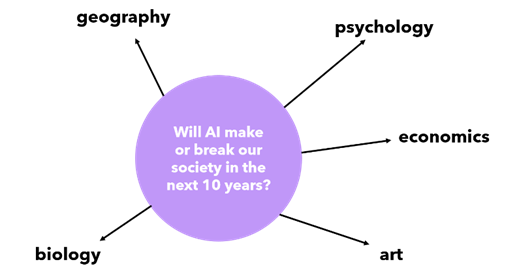
Logistically, this meant that students chose a source pack (containing three different articles, reviews, or academic study summaries) from art, biology, economics, geography or psychology. Then for some movement, with students joining the other “subject specialists” on a table. Here, they got 5 minutes of independent reading before 5 minutes of discussing their chosen disciplinary perspective as a group.
TEACHING NOTE: as a classroom teacher, I knew that students can’t simply choose a group scribe autonomously. No, the disciplinary-tables were given the challenge of figuring out who’s name came first alphabetically (remember, these are incoming students and thus total strangers to each other) with this person becoming the involuntary scribe.
Step 3: Finding Common Ground
In true Repko style, next came the messy beginnings of reconciling the differing disciplinary perspectives. For this, students returned to their original tables, and each had 30 seconds to stand up in front of their group as they summarised their discipline’s perspective.
Step 4: Synthesising Perspectives
Finally, it was time to attempt that integration. With a new scribe (first birthday of the calendar year), groups picked 2 of the 4 disciplines represented to begin “synthesising” to create an integrated viewpoint on AI’s future. The room was buzzing. After just 5 minutes, a spokesperson was chosen (last name of the group alphabetically) who had just 45-seconds to state their group’s chosen disciplines and the headline of their interdisciplinary perspective.
SPOILER: we didn’t really seem to reach “synthesis”, but that doesn’t mean that we hadn’t covered valuable ground towards it. And as the students presented their 45-second headline, four different levels of interdisciplinary processing emerged, the gradual steps that students had taken towards a synthesised response.

Student Step 1: Linking, Comparing, and Connecting
These were the explicit cognitive labels that students gave their thinking. “We’ve linked geography and biology…”, “By comparing psychology and economics…”, “A connection between art and psychology…”. Each time I heard one of these verbs my heart sank: ah, the students haven’t quite understood the brief, they’ve gone for the wrong cognitive process. Or maybe it wasn’t wrong, it’s just not yet complete. Maybe students naturally start by comparing, contrasting, and connecting. Our job as teachers is then to push them further towards “synthesising” and “integrating”.
Student Step 2: Parallel Perspectives
Moving beyond just the cognitive label, students’ linguistic choice of connectors revealed arguments built on parallel perspectives. “AI supports developments in both health research and also in town planning”. I was impressed by this astute ability to identify identical arguments which appeared in multiple perspectives but stumped as to how to encourage these parallel lines of reasoning to converge into an integrated response.
Student Step 3: Conceptual Hooks
A possible route to convergence is one I’ll name here “Conceptual Hooks”. What these parallel perspectives seemed to speak of was shared concepts or themes, present across the disciplinary perspectives, which may be the stepping stone to an integrated approach to the problem. Students began discussing concepts that were present within the perspectives of multiple disciplines, such as: responsibility, human expression, efficiency, quality of life. Could such conceptual hooks be used to further drive integrated perspectives?
Student Step 4: The Integrated Headlines
In truth, my initial spoiler may actually be underselling what the students achieved in those brief 45-minutes.
“AI poses a threat to emotional expression” (art and psychology)
“AI may diminish individuals’ quality of life” (geography and economics)
“AI usage raises issues as to who should take the credit / blame for new knowledge and decisions” (art, geography, biology, psychology)
This is what 16-year-olds are capable of in just under an hour. They may only be headlines, but each carries such power and such potential. What could they achieve in a 6-week programme? On a year long course? During 7-years of secondary school education?
So, where next?
What was so wonderful about this workshop was that, despite being totally new to interdisciplinarity (even featuring some questionable spellings of “disciple” and “prospectus”), students all had something to say, and they kept on talking! But there were several things missing.
First, we needed models or at least scaffolding of what an “interdisciplinary perspective” actually looks like. How is it structured? How does it use language? And how does it not use language? The students wanted to know what they should be saying, and I didn’t know exactly how to respond without simply telling them an answer.
Next, we needed holistic disciplines. Despite my previous calls to feature collaboration across multiple subject teachers when designing interdisciplinary programmes, my only external “experts” when planning this workshop were the various sources that Google and Copilot (ironic, I know) had sourced for me. I fear that this led to our subjects feeling flat. As incoming IB students, this is no significant worry as all our students will soon critically analyse each discipline, its content, methods, and perspectives, during their Theory of Knowledge lessons. But in a typical state comprehensive, how are we ensuring that students appreciate subjects beyond exam syllabi?
Finally, I know that there were absent disciplinary perspectives. One group’s thinking on the legal implications of discoveries made using AI was crying out for a political perspective whilst another discussion on optimising efficiency versus climate impact needed a suitable mathematical model to graph the options. This openness to adding further disciplinary perspectives, a reactionary and reflexive process, feels messy and daunting but is probably a necessary consideration.
With these possible edits in mind, I’m excited to run this session again, and again, and again, to any year group and any school that is crazy enough to give interdisciplinarity a try. Because, as I said to each group of students as our session drew to a close: this is how to future-proof our education.
For further details and access to the resources used in this workshop, please contact jstell@ivc.tmet.org.uk
References:
ARU’s Rusking Modules: https://www.aru.ac.uk/student-life/support-and-facilities/careers-and-employability/developing-your-employability/ruskin-modules
Utrecht University’s Four Stage Model (adapted in this blog!): https://www.uu.nl/en/education/educational-development-training/knowledge-dossier/a-four-stage-model-for-interdisciplinary-learning
IB’s Theory of Knowledge: https://ibo.org/programmes/diploma-programme/curriculum/dp-core/theory-of-knowledge/
IB’s Extended Essay: https://ibo.org/programmes/diploma-programme/curriculum/dp-core/extended-essay/