1. Consider this list of "changes" that one might make as a teacher in order to improve one's effectiveness: "write a new course", " read about and implement a different approach to marking homework ", " change one's beliefs about the potential of one's students", "reflect on the language one uses with students, consider the extent to which it empowers or belittles them, and make changes", " go to a sharing-good-practice session and implement something from the session in your classroom", "invite a colleague to observe a lesson and give you feedback about your 'way of being' with the students", " flip your classroom", "reflect on your body language in the classroom and improve it"...
2. Add some more to the list yourself.
3. Write each of the "changes" on post-it notes, and give each a mark out of ten for the potential they have to improve outcomes for learners in your classroom.
4. On a board, draw a wee picture of yourself in the middle, and place each of the changes on the board, depending on how personal they feel: "be a different person" would be right on top of you and "perform an administrative task" would be far away.
5. Step back and survey your creation.
I'm not really expecting you to do this (though it might make an interesting task for an in-service session), but as a thought experiment I hope it illustrates why I believe that school transformation requires the personal transformation of its staff - teachers and leaders.
Author Archives: Robert Jones
An exercise to explore school improvement⤴
1. Consider this list of "changes" that one might make as a teacher in order to improve one's effectiveness: "write a new course", " read about and implement a different approach to marking homework ", " change one's beliefs about the potential of one's students", "reflect on the language one uses with students, consider the extent to which it empowers or belittles them, and make changes", " go to a sharing-good-practice session and implement something from the session in your classroom", "invite a colleague to observe a lesson and give you feedback about your 'way of being' with the students", " flip your classroom", "reflect on your body language in the classroom and improve it"...
2. Add some more to the list yourself.
3. Write each of the "changes" on post-it notes, and give each a mark out of ten for the potential they have to improve outcomes for learners in your classroom.
4. On a board, draw a wee picture of yourself in the middle, and place each of the changes on the board, depending on how personal they feel: "be a different person" would be right on top of you and "perform an administrative task" would be far away.
5. Step back and survey your creation.
I'm not really expecting you to do this (though it might make an interesting task for an in-service session), but as a thought experiment I hope it illustrates why I believe that school transformation requires the personal transformation of its staff - teachers and leaders.
Handling Student Choices with Forms⤴
from Robert Jones @ The Digital Depute
In this post I'm going to explain how I use Google Forms and Sheets to complete in a couple of hours a task which used to take several days.
At my school, we run "enhancement" classes for all S2 students twice a week. Each of the two sessions has a list of available classes - ranging from games development to crocheting and bushcraft - and we ask students which of the classes they would like to attend, then allocate them to classes (bearing in mind that some classes will inevitably be over-subscribed). If you have to deal with a similar administrative task you may find this post useful. My solution uses Google forms and Google sheets, and relies on some spreadsheet formulas.
In an ideal world, this task would be completed for me by someone else! In reality the wonderful office staff in my school are already working at full capacity; truth be told they are over-worked and under-paid. And so I need to sort it out. If you are a depute reading this and have managed to avoid all administrative work, please get in touch and tell me your secret!
The previous depute used to give every S2 student a paper form with all the choices on it, and have them write 1, 2, 3 or 4 beside their preferences. He would then spend a weekend (or more) shifting these bits of paper around until he had created classes. He had to complete this sorting task twice - once for each of the two enhancement sessions in the week. The piles of paper would then be taken and typed up for entry into our MIS.
As this task approached, I considered how I might use IT to improve the process. I hoped to save time, and to ensure fairer allocations.
I realised that Google forms would do the job, and created this form for the students to complete:
The original form, created in my school's Google Apps for Education account, used the option to require login and collect usernames, so it didn't actually matter whether the students gave me their names. Once the students had completed this form, I had all their choices in a Google sheet (this sheet is created automatically). At this point it looked something like this (I've cleared the names):
Because I knew I would be repeating this task every year, I decided it would be worth putting a bit of time into streamlining the process, and so I took a copy of the sheet and did the following:
I inserted two columns before the choices, into which the "choice number" allocated to a student would go. For example, if the first student had the number 1 in column F, that would mean they were doing "Ace of Cakes". I then added another two columns which converted the choice numbers into the actual choices in words. This was the tricky bit. The following formula went into cell G2:
This gave me a spreadsheet like this one:
When a number is changed in column F, the corresponding words in column G change. You can try this for yourself by following the link, as I've made the spreadsheet editable (play nicely!)
This made life much easier for me. All I needed now was a summary of how many students would be in each class, based on the choices they had been allocated. I have exactly that on the second worksheet in the sheet. It looks like this:
This summary automatically updates as I make changes in column F. The formula in cell B1 is
Having completed the allocations, I had them all in the spreadsheet so could easily print out class lists for entry into our MIS.
Forms and spreadsheets rule!
At my school, we run "enhancement" classes for all S2 students twice a week. Each of the two sessions has a list of available classes - ranging from games development to crocheting and bushcraft - and we ask students which of the classes they would like to attend, then allocate them to classes (bearing in mind that some classes will inevitably be over-subscribed). If you have to deal with a similar administrative task you may find this post useful. My solution uses Google forms and Google sheets, and relies on some spreadsheet formulas.
In an ideal world, this task would be completed for me by someone else! In reality the wonderful office staff in my school are already working at full capacity; truth be told they are over-worked and under-paid. And so I need to sort it out. If you are a depute reading this and have managed to avoid all administrative work, please get in touch and tell me your secret!
The previous depute used to give every S2 student a paper form with all the choices on it, and have them write 1, 2, 3 or 4 beside their preferences. He would then spend a weekend (or more) shifting these bits of paper around until he had created classes. He had to complete this sorting task twice - once for each of the two enhancement sessions in the week. The piles of paper would then be taken and typed up for entry into our MIS.
As this task approached, I considered how I might use IT to improve the process. I hoped to save time, and to ensure fairer allocations.
I realised that Google forms would do the job, and created this form for the students to complete:
The original form, created in my school's Google Apps for Education account, used the option to require login and collect usernames, so it didn't actually matter whether the students gave me their names. Once the students had completed this form, I had all their choices in a Google sheet (this sheet is created automatically). At this point it looked something like this (I've cleared the names):
Because I knew I would be repeating this task every year, I decided it would be worth putting a bit of time into streamlining the process, and so I took a copy of the sheet and did the following:
I inserted two columns before the choices, into which the "choice number" allocated to a student would go. For example, if the first student had the number 1 in column F, that would mean they were doing "Ace of Cakes". I then added another two columns which converted the choice numbers into the actual choices in words. This was the tricky bit. The following formula went into cell G2:
=INDIRECT(concatenate("R",row(F2),"C",F2+9),false)
This gave me a spreadsheet like this one:
When a number is changed in column F, the corresponding words in column G change. You can try this for yourself by following the link, as I've made the spreadsheet editable (play nicely!)
This made life much easier for me. All I needed now was a summary of how many students would be in each class, based on the choices they had been allocated. I have exactly that on the second worksheet in the sheet. It looks like this:
This summary automatically updates as I make changes in column F. The formula in cell B1 is
=countif('Form responses'!G:G,A1)Once I had this set up, it only took me about half an hour to sort all the allocations. I started by putting 1 all down column F. This gave me a summary of how many students had picked each class as a first choice. Some of these totals were fine, but some were over-subscribed. For these, I sorted the first sheet to see all the students who had chosen this, and selected at random however many I had to shift to their second choices. I just changed their 1s to 2s and the job was done!
Having completed the allocations, I had them all in the spreadsheet so could easily print out class lists for entry into our MIS.
Forms and spreadsheets rule!
The Challenge of Integrity as a School Leader (or anyone else for that matter)⤴
I'm currently reading Theories in Practice by Argyris and Schön. It is a remarkable, thought-provoking work, exploring the inconsistencies between the things people claim to value and the things they actually value; between the theories they claim to have about how changes occur and the theories they actually use to direct their actions. It is easy to reflect on how these inconsistencies are evident in the words and actions of others - much harder to see our own inconsistencies.
As school leaders, we say we seek to increase the effectiveness of our schools. But what do we mean by effectiveness? Do the things we claim to care about improving match the things we actually demonstrate caring about by our actions - the things we actually care about improving? And how do we claim to be going about effecting improvement - what are our espoused theories of improvement? Do we use these espoused theories to guide our actions, or do we actually operate according to different theories, of which we may or may not be consciously aware?
These questions are difficult but worthwhile, particularly if we are feeling frustrated by our attempts at school improvement. Frustration arise when things don't go the way we hope or expect. We are in big trouble if we try to analyse such failures by looking at our espoused theories, when in fact we aren't using them! And doomed to disappointment if the things we claim to be trying to improve aren't actually the things we value.
I'm thankfully not feeling frustrated in my school-improvement efforts, but I do see inconsistencies in myself. For example, I espouse a non-judgemental, growth-mindset, coacherly approach to raising the capacity of colleagues, but have been guilty on occasion of operating on the assumption that colleagues are incapable of changing. I espouse an open, consultative style of leadership, but have been guilty of making assumptions about the motivations of colleagues then failing to check these assumptions with them.
I'm not beating myself up here. I'm just curious about how to become a better leader, and this seems like fertile ground.
Teachmeet+⤴
Fearghal has asked on his blog if we should be doing something collectively in Scotland to re-energise the Teachmeet movement.
I've attended and presented at several Teachmeets over the years, and found them uplifting, energising experiences. I don't think, hand on heart, that I have adopted long-term very many of the good practices being presented by others. This isn't because I didn't consider them worthwhile. It's just that they didn't quite match my context, or I just forgot about them in the daily maelstrom of the classroom.
I suspect that most participants would say the same, or something close to it. Now maybe the point of Teachmeet is to embed the good practices in the classroom of the presenters themselves. This seems more likely. I think that might apply to me. If so, we should return to the principle that Teachmeets are for presenting, not for listening.
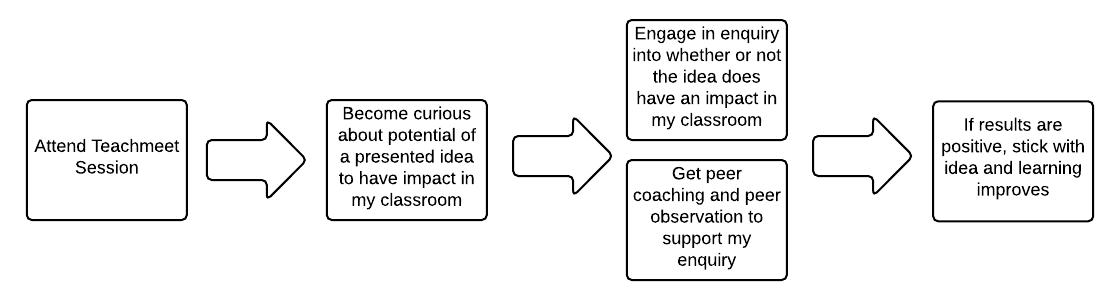
If we want the audience to get something out of Teachmeet that will lead to positive impacts on their learners, we need to consider how that is going to happen. Is our theory something like this?
If so, we are likely to be disappointed. As I said before, the chances of a sustained change in practice are low. And even if the new practice is implemented, who is to say that it will actually make a positive difference for my learners in my situation?
I would propose this as a more likely path to impact:
I don't have an answer to how we support that path, but I'm interested in trying to work it out!
Report Comments⤴
As I proof-read sets of reports, I wonder if we should only make a comment if we would be willing to state its opposite:
| Joe is a bright and very pleasant pupil | Joe is a dim or very unpleasant pupil |
| Joe is making excellent progress with this course | Joe is making poor progress with this course |
| Joe is highly motivated | Joe is unmotivated |
| It is a pleasure teaching Joe | I am not enjoying teaching Joe |
| Joe is an excellent student | Joe is a poor student |
| Joe always acts on advice | Joe sometimes fails to act on the advice I give him |
| Joe is very capable | Joe is not very capable |
| Joe is a hardworking boy | Joe is a lazy boy |
We would happily state some of these "opposites", but some seem completely inappropriate!
Actually it seems to me that we are happy to make positive statements about the identity of a person - they are bright, excellent, intelligent, capable, hardworking etc., but much more reticent about making matching negative statements. We couch them in process language, so the opposite of "Joe is a hardworking boy" becomes "Joe needs to put more effort into his classwork" rather than "Joe is…". The thing is, you can't have one without the other. In a world where there are "bright" students, there are also "dim" students. In a world where there are "pleasant" students there are also students who are "unpleasant". Our statement of the former acknowledges the existence of the latter.
I draw no conclusion - I'm just taking a break, having read 20 sets of reports. 45 to go.