Author Archives: Robert Jones

Clash Tables in Google Sheets⤴

from @ The Digital Depute

If you are organising exam diets, it is useful to know which exams you can schedule together without clashes. For this, you need a clash table. The starting data will be a list of all the pupils class enrolments. It'll look something like this, where each row is one pupil's courses:


And your clash table will look like this:


We can see that nobody is taking Spanish and German so we could schedule those exams together.

To construct this clash table, the formula in cell L2 is:

=ifna(query($B$2:$F$5,"select count(B) where (B='"&$K2&"' or C='"&$K2&"' or D='"&$K2&"' or E='"&$K2&"' or F='"&$K2&"') and (B='"&L$1&"' or C='"&L$1&"' or D='"&L$1&"' or E='"&L$1&"' or F='"&L$1&"') label count(B) ''"),0)

Replace the 5 in $F$5 with a bigger number to cover all the rows of your pupil data.

If you paste this into your sheet in your equivalent of L2, then copy right and copy down across your clash table you'll be done.

Let me know if you can see a more efficient way to achieve this.


Learning styles are a myth and I am not an auditory learner⤴

from @ Learning Stuff About Stuff

I switched on Radio 6 this morning, and the track they were playing had a drum sound which caught my ear. It reminded me of a rototom - a tuned drum which was quite popular in the 80s. I had a set of three in my drum kit.

Rototom 1

I doubt many listeners would have made that connection. I suspect many listeners would not even have particularly distinguished that drum sound. I think many people just hear songs in a much less differentiated way, unless they make a real effort. I, like most musicians, tend to hear the guitar, the drums, the bass, the keyboard and the vocals separately.

In other words, I am extracting more information from the audio than some might.

It would be tempting to imagine, therefore, that I would learn better through hearing than through other senses. But that is nonsense. Imagine trying to learn about the physical geography of a country through hearing about it without a map!

But this is exactly the argument made by people who insist they are "visual learners" despite all the research showing that learning styles are a myth (and it's always "visual" isn't it?). Just because you see ten colours where I see three, and see a rich tapestry of symbols and allusions where I see a table with some fruit on it, it doesn't mean you learn better through seeing stuff than through your other senses.

Sacrifice and Memory⤴

from @ Learning Stuff About Stuff

I'm reading Jordan B Peterson's "12 Rules for Life" - got to keep my finger on the pulse!

He offers an analysis of how ritual sacrifice arose in societies, which I find fascinating and utterly convincing. His contention is that it arose after our ancestors developed the capacity to think about the future, and therefore began to realise that delaying gratification could deliver longer term benefits. In other words, that sacrificing something of value in the present could lead to good things in the future. Having discovered this, it is a small step to imagine that sacrificing something of value, like a goat, might also lead to good things happening in the future.

This link between delaying gratification, personal sacrifice and ritual sacrifice had never occurred to me before. It now seems obvious. Perhaps it was already obvious to most people.

I am absolutely certain that I will never forget this. I may review it if I am presented with a different analysis which challenges Peterson's view. But I will never just forget it, and return to not seeing the connection.

I wonder how this fits into the models of memory developed by cognitive psychologists. Is there a place, in the world of forgetting curves, for concepts and connections which, once realised, can never be forgotten?

Some Thoughts about Skills-Based Curricula⤴

from @ Learning Stuff About Stuff

I hear a lot of talk about skills-based curricula in Scotland these days, with the general vibe being that skills-based curricula are a Good Thing™. I'm not entirely clear what people mean by a skills-based curriculum, because it is one of those phrases which has slipped into the common parlance of educators without any clear definition (see also "learner conversations"). Try searching on the Education Scotland website for "skill based curriculum" and you'll draw a blank. I guess it means a curriculum defined in terms of the competencies being developed by our learners: a curriculum defined in terms of the things we want our learners to be able to do, rather than what they know.

I can see the appeal of this, but I am wary. Here are a couple of things which would worry me if they were true:

1.  Is this curriculum seeking to develop generic, transferable skills?

If so, we really need to distinguish between actual skills which are applicable in a range of contexts (such as being able to speak clearly, spell accurately, read well, be punctual, perform arithmetic, understand basic statistics etc.) and so-called "generic transferable skills" such a problem solving, critical thinking or creativity. The former are vital and should rightly be prioritised in a curriculum. The latter don't exist outwith specific domains of knowledge. If you are surprised to hear that, read this.

2. Does this curriculum prioritise skills development above the building of long-term knowledge?

If so, it fails to recognise that "in every domain that has been explored, considerable knowledge has been found to be an essential prerequisite to expert skill"? ("Expert and Novice Performance in Solving Physics Problems" -- Larkin, McDermott, Simon and Simon -- 1979-1980). Skills such as problem solving, creativity and critical thinking do, of course, exist. But they are developed by individuals within specific domains of knowledge, and rely upon the development of a considerable body of knowledge within that domain. It is nonsense to imagine that the expert problem solving skills I have developed within the domain of mathematics will in any way equip me to be a good problem solver in the world of graphic design, say. This article by Daniel Willingham looks at the challenges of teaching critical skills. If the curriculum recognises the importance of knowledge acquisition, focuses on that and then proceeds to provide learners with opportunities to apply their knowledge meaningfully, then it has a good chance of genuinely developing skills.

I am all in favour of a curriculum which focuses on the things learners end up being able to do, but such a curriculum must recognise that the principal means of increasing skill is to increase domain-specific knowledge. It is interesting to note that this message is entirely commonplace and mainstream in England, but is rarely voiced in Scotland.

Much of the work in Scotland on skills development is entirely rational and worthwhile. Take this example from Castlebrae, for example. The programme clearly understands that skills exist within domains of knowledge, and seeks to clarify what these important skills are, so that teachers can provide opportunities to develop them. The cross-curricular skills it identifies relate to literacy, numeracy and health-and-wellbeing. These all fall into the "former" category I identified earlier.

But schools only have 27.5 hours per week. Time spent on try to develop skills such as critical thinking in the abstract rather than within a specific domain of knowledge is time wasted, and there is no time to waste.

Knowing and Understanding in Mathematics⤴

from @ Learning Stuff About Stuff

In order to investigate the current debate about knowing and understanding sparked by David Didau's post, I want to examine one small part of mathematics, which I happen to be teaching to a Higher maths class at the moment: finding the point which divides a line segment in a given ratio.

One way to approach this is to teach a formula:

The position vector of P, where P divides AB in the ratio m:n, is given by p=(na+mb)/(m+n)

If you know
  • how to convert a position vector to a coordinate
  • the convention that capital letters represents points and bold lower case letters represent corresponding position vectors
  • how to multiply or divide a vector by a scalar
  • how to add vectors together
then can probably now solve a problem such as:

Given that the point P divides S(3,4,-1) and T(5,8,11) in the ratio 3:1, find P.

At this point, a student knows how to find a point which divides a line segment in a given ratio. They may have no idea why this rule works. They may have no idea what a position vector is. They may have no idea what a ratio is. They may have no idea about the 3D coordinate system. Do they understand the rule?

In maths, it seems to me, knowing means being able to recall a particular mathematical result, such as the formula given above. Understanding means grasping to some extent the chain of previously established facts and causal links which lead to the given mathematical result being true. In this sense, knowing and understanding are different in maths.

You might say the "understanding" I describe is just more knowing. I disagree, because there is a categorical difference between knowing a particular fact, or set of facts, and understanding why that fact is true. The litmus test, for me, is that anyone could remember the formula given above. Most people could be trained to apply the rule to solve problems using the formula, provided the problems were stated in a fairly standard way. Only those who have already mastered a sufficient body of knowledge and understanding in maths would be capable of understanding what the formula is actually about, and why it works.

I suppose I am saying that understanding is about the connectedness of one's knowing. Maths is a domain in which this distinction is particularly evident, because it is relatively easy to learn a fact which has no connection to anything else you know. For example:
A Hermitian manifold is a complex manifold with a smoothly varying Hermitian inner product on each (holomorphic) tangent space.
I could memorise that, and regurgitate it. I have no idea what any of the mathematical words in the definition mean, apart from "complex" and a very vague recognition of "manifold". I don't understand this definition because it does not connect to anything else I already know (and understand through connections to other knowledge) in maths.

The Scottish Curriculum: A Beginner’s Guide⤴

from @ Learning Stuff About Stuff

There is no universally agreed meaning for the term "curriculum" as applied to the education of children and young people. In academic circles it is a highly contested concept, and covers everything experienced by children and young people, within or without formal education. To an average parent, I guess it means "the stuff schools are going to teach children and young people". From this perspective, Scotland has no national curriculum. Scotland has no national framework which spells out explicitly what knowledge schools should teach children and young people. We used to have one, called 5-14, but it was decided that this was too prescriptive.

Instead, the Scottish Curriculum for Excellence has a series of statements called the Experiences and Outcomes, which make vague, implicit references to the knowledge we expect young people to acquire, wrapped up in highly general statements about what we expect young people to be able to do, and what we expect them to experience. The general vibe in our curriculum is that specific facts are unimportant - temporary stepping-stones to be skipped over on the way to developing generic transferable skills such as "creativity" and "problem solving". The curriculum is blind to the widely recognised fact that such generic, transferable skills do not exist.

Here is an example, from the Social Studies E&Os:
I can explain why a group of people from beyond Scotland settled here in the past and discuss the impact they have had on the life and culture of Scotland. [SOC 3-03a]
When teachers across Scotland first saw these E&Os they were, of course, aghast, and began creating local "schemes of work" or "progression frameworks" which did actually spell out what they were going to teach. In some areas, this work - the work of actually creating a curriculum - was undertaken at a local authority level, whereas in others it was left to individual schools, departments and even teachers.

As far as I am aware, no work has ever been undertaken nationally to audit these local curricula. No one knows the extent to which pupils across Scotland are being taught the same or different things.

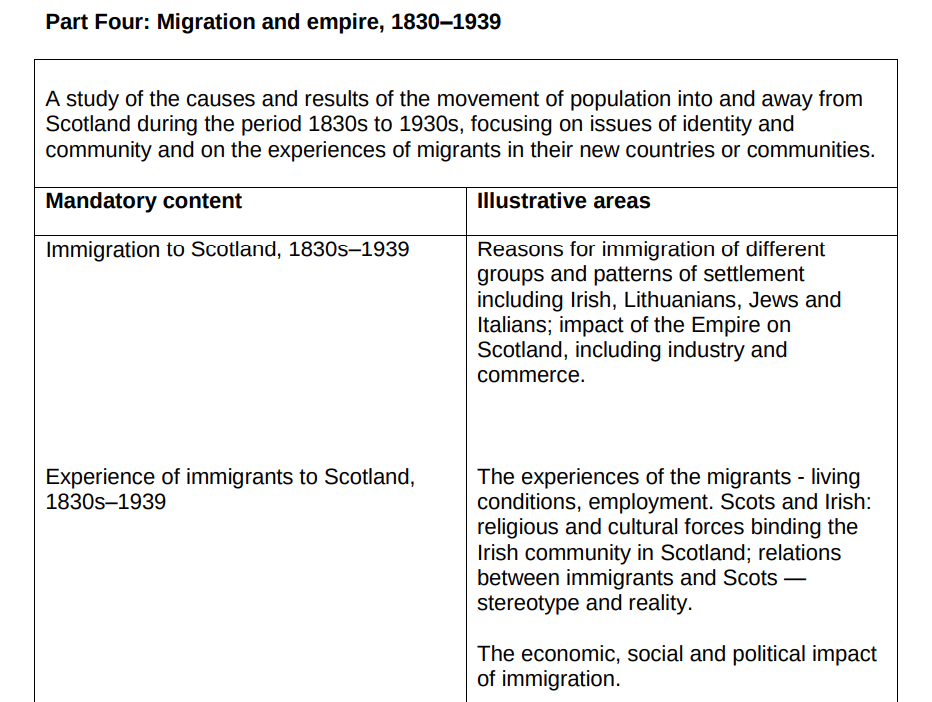
Thankfully, some sanity was restored when it came to the creation of the new qualifications (the Nationals and rewritten Highers) which pupils sit from the age of 16. These eventually spelled out content, albeit somewhat sparsely and grudgingly amongst the pages of talk about the development of higher-order thinking skills:

Teachers were then able to refine the curricula they had created for younger pupils, by working backwards from these somewhat-clarified endpoints. The sparse nature of the content documentation explains why it is considered so valuable for Scottish teachers to become exam markers - they are then privy to more detailed discussions about exactly what constitutes assessable knowledge, what constitutes a valid explanation etc. The rest of us have to reverse engineer this detailed information from the published marking schemes of past papers.

Latterly, John Swinney, the Education Minister, has attempted to streamline Scottish Curriculum documentation by the creation of "Benchmarks". These are supposed to be more explicit and useful than the E&Os. Judge for yourself - here are the relevant benchmarks relating to the Social Studies E&O above:
  • Provides at least two simple explanations as to why a group of people from beyond Scotland settled here 
  • Describes at least two impacts immigrants have had on life and culture of Scotland.
To describe this approach as problematic would be charitable. We are still left wondering which immigrants, which explanations and which impacts we should teach. Our "curriculum" is mute.

With the publication of the benchmarks, the politicians now seem to feel our curriculum is fixed, and we are moving on to a major reorganisation of governance structures for schools. We are fiddling while Rome burns.

Assessment Through The Looking Glass⤴

from @ Learning Stuff About Stuff

The old 5-14 assessments used to give robust, consistent answers to specific questions. The questions were of the form "what percentage of P7 students have managed to score at least 15 marks in one of a specific set of nationally generated assessment instruments". We thought that the questions were of the form "what percentage of P7 students have passed level D mathematics", but of course that isn't what we were measuring. We were measuring performance in tests. The mistaking of test performance for evidence of "passing a level" was bad, but we were right in thinking that we compared like with like as we looked at performance data from across Scotland.

Now we have abandoned national tests, and have moved towards measuring "passing a level" based on a combination of a rich bundle of assessments and teacher professional judgement. But what does it actually mean to have passed level 3 in numeracy? CfE documentation talks about assessing breadth of learning, level of challenge and ability to apply learning in unfamiliar contexts. But just how broad? How much challenge? How unfamiliar? None of these things are made clear (nor could they be), but this problem is supposedly addressed by the magic bullet "moderation". But moderation is not a magic bullet. No amount of moderation will allow us to reach a consensus on where the fundamentally vague boundary between levels lies, let alone how we can measure which side of the boundary any student sits at any given time. England stopped reporting on levels for good reason. You can read the report from the Commission on Assessment without Levels (published in September 2015) here. It says

Despite being intended only for use in statutory national assessments, too frequently levels also came to be used for in-school assessment between key stages in order to monitor whether pupils were on track to achieve expected levels at the end of key stages. This distorted the purpose of in-school assessment, particularly day-to-day formative assessment. The Commission believes that this has had a profoundly negative impact on teaching... Levels also used a ‘best fit’ model, which meant that a pupil could have serious gaps in their knowledge and understanding, but still be placed within the level. This meant it wasn’t always clear exactly which areas of the curriculum the child was secure in and where the gaps were. 

And yet we persist, and find ourselves in the Alice-in-Wonderland situation where schools are expected to provide data to the Government on the levels achieved by students in Reading, Writing, Listening-and-Talking and Numeracy, with this data being robust enough to allow us to measure progress over time. 

Of course we know where this is heading. Standardised tests are coming, and these will be used to determine the level achieved by pupils. The rhetoric is that we will use a combination of "teacher professional judgement" and the results of the tests. But it is categorically impossible for the former to generate anything resembling robust or consistent data. And so, over time, we will quietly drop the teacher judgement element and return to where we started in 5-14, measuring progress through the proxy measure of performance in national tests. I don't see anything particularly bad about this end-point, but it depresses me how many thousands of teacher-hours will have been wasted along the way. 


Assessment Through The Looking Glass⤴

from @ Learning Stuff About Stuff

The old 5-14 assessments used to give robust, consistent answers to specific questions. The questions were of the form "what percentage of P7 students have managed to score at least 15 marks in one of a specific set of nationally generated assessment instruments". We thought that the questions were of the form "what percentage of P7 students have passed level D mathematics", but of course that isn't what we were measuring. We were measuring performance in tests. The mistaking of test performance for evidence of "passing a level" was bad, but we were right in thinking that we compared like with like as we looked at performance data from across Scotland.

Now we have abandoned national tests, and have moved towards measuring "passing a level" based on a combination of a rich bundle of assessments and teacher professional judgement. But what does it actually mean to have passed level 3 in numeracy? CfE documentation talks about assessing breadth of learning, level of challenge and ability to apply learning in unfamiliar contexts. But just how broad? How much challenge? How unfamiliar? None of these things are made clear (nor could they be), but this problem is supposedly addressed by the magic bullet "moderation". But moderation is not a magic bullet. No amount of moderation will allow us to reach a consensus on where the fundamentally vague boundary between levels lies, let alone how we can measure which side of the boundary any student sits at any given time. England stopped reporting on levels for good reason. You can read the report from the Commission on Assessment without Levels (published in September 2015) here. It says

Despite being intended only for use in statutory national assessments, too frequently levels also came to be used for in-school assessment between key stages in order to monitor whether pupils were on track to achieve expected levels at the end of key stages. This distorted the purpose of in-school assessment, particularly day-to-day formative assessment. The Commission believes that this has had a profoundly negative impact on teaching... Levels also used a ‘best fit’ model, which meant that a pupil could have serious gaps in their knowledge and understanding, but still be placed within the level. This meant it wasn’t always clear exactly which areas of the curriculum the child was secure in and where the gaps were. 

And yet we persist, and find ourselves in the Alice-in-Wonderland situation where schools are expected to provide data to the Government on the levels achieved by students in Reading, Writing, Listening-and-Talking and Numeracy, with this data being robust enough to allow us to measure progress over time. 

Of course we know where this is heading. Standardised tests are coming, and these will be used to determine the level achieved by pupils. The rhetoric is that we will use a combination of "teacher professional judgement" and the results of the tests. But it is categorically impossible for the former to generate anything resembling robust or consistent data. And so, over time, we will quietly drop the teacher judgement element and return to where we started in 5-14, measuring progress through the proxy measure of performance in national tests. I don't see anything particularly bad about this end-point, but it depresses me how many thousands of teacher-hours will have been wasted along the way.