Tag Archives: Innovation

OER16 Open Culture Conference – Open as in Open⤴

from @ Open World

In keeping with the ethos of open education, the OER conferences have always made an effort to be as diverse, inclusive and, well, open as possible and OER16 Open Culture is no exception.

The draft conference programme has recently been announced and we’re delighted to have accepted 101 papers and panels from 29 different countries.
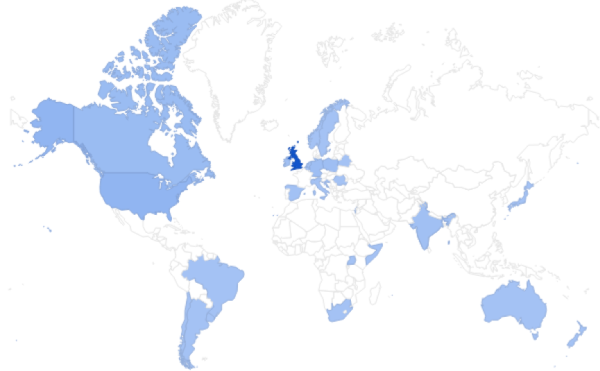
oer16_diversity

OER16 presenters will come from 29 countries around the world

Bearing the recent #allmalepanels meme in mind, we’re also aware of issues relating to gender balance and diversity and we’re very pleased to have almost 50/50 representation. Of over a hundred lead authors who recorded their gender along with their submission, 49% are female and 51 % male, and our keynotes are similarly balanced.

Although the University of Edinburgh is clearly a popular destination for delegates, not all of our presenters and participants are able to travel to Scotland for a wide range of reasons, so we are happy to facilitate remote presentation. One OER16 presenter Maha Bali, associate professor of practice at the Center for Learning and Teaching at the American University in Cairo, has previously written in the Chronicle of Higher Education about her own experiences as a remote conference presenter

“I am finding more and more conferences willing to accommodate me as a virtual presenter. This is probably happening more to me than other people because of my travel restrictions (mom of a young child living halfway across the world from most conferences I want to attend and where most of my collaborators reside), coupled with my refusal to ignore the potential social capital I can gain from presenting internationally, that is different from everyday online interactions. There are many reasons why a conference might want to welcome virtual presenters (diversity and equity being two)”

Hospitality for Virtual Presenters by Maha Bali
Chronicle of Higher Education, January 26, 2016

In relation to OER16, Maha also commented:

“Presenting virtually at conferences allows me to have a voice in the field. How often do people in ed tech get to hear the perspective of Arab Muslim women who live in the Arab World? Presenting coupled with virtually connecting conversations allows me to feel more of an equal to my Western peers with whom I collaborate year-round.”

In order to ensure that OER16 is inclusive and accessible, we have aimed to keep the conference fee as low as possible for full delegates. However if cost is a genuine barrier, ALT have a small amount of limited funding available to subsidise registrations for presenters who are students, school teachers, who work in small FE institutions, adult or community education or are members of the public with a special interest in OER. Subsidised places have already been offered to fourteen presenters and applications of funding close on the 6th March.

OER16 also offers many opportunities for remote participation, the majority of which are completely open and free of charge. All five keynotes by Catherine Cronin, Jim Groom, Melissa Highton, John Scally and Emma Smith will be streamed live on ALT’s dedicated youtube channel, and will also be available to view after the conference. There will be a wide range of social media channels including twitter feeds, blogs, hang outs and internet radio broadcasts, facilitated by the ALT Open Education SIG, Radio EDUtalk, Virtually Connecting and others, which will enable remote participants to engage with and contribute to the conference. Remote participants will only be required to register their details if they wish to comment on the main conference platform hosted by ALT, although registration will be required, this facility is still free of charge, all other remote participation channels are both free and open, and yes, that really is open as in open.


Thoughts on Amazon Inspire⤴

from @ Open World

Earlier this week EdWeek Market Brief reported that Amazon is developing a platform to “allow schools to upload, manage, share, and discover open education resources”.  Amazon Inspire, which appears to be aimed squarely at the US K-12 education sector / market (you decide) will enable users to

“to add ratings and reviews, and to receive recommendations based on their previous selections. Educators will be able to curate open resources, self-publish material they have developed, and put a school’s entire digital library that is open and freely available online.”

Although Amazon admit they haven’t nailed down a business model to ensure the platform’s financial sustainability, harnessing the company’s formidable recommender system to sell products that complement lessons and resources, is likely to feature prominently somewhere along the line. Amazon are sufficiently confident that they can guarantee the platform’s sustainability that Andrew Joseph, vice president of strategic relations for Amazon Education stated

“We’ve made a commitment that we will never charge for this,” Joseph said, noting it will be “a completely free, open platform for free resources.”

I’m tempted to say “we’ve heard that before”, but that would be cynical of me.  And of course “free” and “open” aren’t quite the same thing, but lets come back to that in a minute.

Of course Joseph doesn’t miss an opportunity to take a pot shot at Google

“teachers spend 12 hours a week on content creation and sharing on their own,” said Joseph, using Google Drive or shared folders within a district. “If you think about those resources, they’re not all that discoverable or sharable.”

Quite.

Unsurprisingly, this announcement has already sparked considerable discussion online.  Stephen Downes was one of the first to comment on this development, noting that Amazon already has a significant presence in the education sector, providing access to tools, a grant programme and cloud services. Matt Reed of Inside Higher Ed was generally enthusiastic about the development, speculating that Amazon Inspire could do for OER what iTunes did for podcasts. He does add a note of caution though, asking

“Are they trying to kill commercial publishers? Harvest student data? Commission hagiographic treatments of the life of Jeff Bezos? Amazon isn’t known for philanthropy.”

Like many commentators Reed focuses on the potential ability of OER to reduce the astronomical cost of textbooks in the US.  While I agree that reducing the cost of textbooks is undoubtedly a Good Thing, (though of considerably less benefit to education in the UK), focusing on this as the primary benefit of OER, rather misses the much wider potential of open education. Replacing a paid thing with a free thing, is certainly good, but does little to challenge the commercialisation of the education, particularly if the free thing is being provided by a commercial behemoth. This is a point that Jim Groom raised on twitter.

And then there’s the whole issue of open and free. Will the resources hosted on Amazon Inspire really be open?  Or will they be free?  The EdWeek report makes no mention of whether resources will carry a CC licence, in fact there is no mention of licensing at all. If they don’t use CC licences can Amazon really market this as OER ? Pat Lockley thinks they can.

Whatever Amazon Inspire transpires to be, it’s certainly an interesting development at a time when the sustainability of open educational resources and OER repositories, or lack thereof, is an increasingly pressing topic.  This is an issue that Viv Rolfe, David Kernohan, Leo Havemann, Pat Lockley, Simon Thomson and I will be exploring in a panel session at OER16 called Web Today, Gone Tomorrow: How can we ensure continuing access to OERs? and I suspect it’s an issue that will surface repeatedly during the conference.  If sharing OER through web platforms such as YouTube and Flickr is already common practice, would sharing them through Amazon really be problematic?  I don’t know. Without knowing more about the platform and the business model it’s too early to judge.

One final point…I was very interested to note that Amazon Inspire will be partially based on the Learning Registry, but that’s a topic for another blog post.

Links


Growing open educational practice in Scotland: Open Scotland and the Scottish Open Education Declaration⤴

from @ Open World

Towards the end of last year I was interviewed by the OEPS Project as part of their series of case studies on open education practice in Scotland.  During the interview I spoke about the Open Scotland initiative, the Scottish Open Education Declaration, OER16, open education initiatives at the University of Edinburgh and the continued need to raise awareness of open education within the Scottish Government and at senior management level.  Here’s a little quote from the interview:

“…there has been a danger in some quarters to expect OER alone to transform education … some people have expected that simply resources to be transformative… that’s not the case. OER is simply content with an open license, that’s all it is. And that alone will not transform education, as part of the wider open education landscape, I think it will, and I feel very, very strongly that there are moral reasons, there are ethical reasons, why publicly funded educational content should be available under an open license. And I think particularly in a country like Scotland, which has a very strong tradition of education, that I kind of find it odd that open education has never quite slotted in at the government vision level.”

You can read the rest on the OEPS website here: http://www.oeps.ac.uk/create-your-own/growing-open-educational-practice-scotland-open-scotland-and-scottish-open-education


Cultural Heritage Sparks⤴

from @ Open World

I recently went along to the first meeting of the Digital Cultural Heritage Research Network here at the University of Edinburgh. The aim of the network is to

“bring together colleagues from across the University to establish a professional network for researchers investigating digital cultural heritage issues, seeking to include perspectives from diverse disciplines including design, education, sociology, law, cultural studies, informatics and business. Partners from the cultural heritage sector will play a key role in the network as advisors and collaborators.”

~ About DCHRN

Anyone who follows this blog will know that I have a bit of a thing about opening access to digital cultural resources so I was pleased to be able to contribute a lightning talk on digital cultural heritage and open education. This was one of an eclectic series of lightning talks that covered a wide range of subjects and topics.  I live tweeted the event and Jen Ross has collated tweets from the day in a Storify here: Digital Cultural Heritage Research Network, Workshop 1 and has also written a recap of the workshop here Recap of Workshop 1: Cultural Heritage Sparks.

My EDINA colleague Lisa Otty kicked off the day talking about the Keepers Extra Project which aims to highlight the value of the Keepers Registry of archiving arrangements for electronic journals, to libraries, preservation agencies and publishers through national and international collaboration. Lisa noted that only 17% of journals are archived in the Keepers Registry and asked the very pertinent question “do we trust publishers with the stewardship of electronic journals?” I think we all know the answer to that question.

I confess I rehashed a previous presentation on the comparative dearth of openly license cultural heritage collections in Scotland which allowed me to refer for the millionth time  to Andrew Prescott’s classic blog post Dennis the Paywall Menace stalks the Archives.  This time however I was able to add a couple of pertinent tweets from the Digging Into Data Round Three Conference that took place in Glasgow earlier in the week.

did_tweet_1 did_tweet_2

One lightning talk that was particularly close to my heart was by Glyn Davis who spoke about the ‘openness’, or lack thereof, of gallery and museum content, and reflected on his experience of running the Warhol MOOC.  Glyn noted that license restrictions often prevent copyright images from being used in online teaching and learning, however many of the students who participated in the Warhol MOOC understood little about copyright restrictions and simply expected to be able to find and reuse images via google, so lots of discussion about open access was required as part of the course.

Other highlights included Jen Ross‘ talk on Artcasting a project which is exploring how digital methods can be used inventively and critically to reimagine complex issues. The project has built an app which engages audiences by allowing them to capture images and decide where to send them in time and space and time, while also retrieving data for evaluation.  Bea Alex introduced the impressive range of projects from the Language Technology Group, including historical text projects, which aim to use text mining to enrich textual metadata with geodata from the Edinburgh Geo Parser. Stephen Allen spoke about the MOOC the National Museums of Scotland created to run in parallel with their Photography – A Victorian Sensation exhibition.  The museum now hopes to reuse content from future exhibitions for more MOOCs. Rebecca Sinker presented a fascinating keynote on Tate’s research-led approach to digital programming which prompted an interesting discussion on how people engage with art now that so much of it is available online. Angelica Thumala spoke all too briefly about her research exploring emotional attachment and experience of books in different modalities, and left us with one of the loveliest quotes of the day

“Books are constant companions, people carry them around and develop physical and emotional attachments to them.”

The workshop ended with four group discussions focussing on issues raised by participants; openness and preservation; participation and interpretation; semantic web and curation; and how can DCHRN create a sustainable interdisciplinary network.  These and other issues will be picked up in the next workshop Research that matters – playing with method, planning for impact takes place in March

DCHRN is coordinated by

  • Dr Jen Ross, Digital Education
  • Dr Claire Sowton, Digital Education
  • Professor Sian Bayne, Digital Education
  • Professor James Loxley,  Literatures Languages and Culture
  • Professor Chris Speed, Design Informatics

On a side note, it’s a while since I’ve done a lightning talk and I’d forgotten how difficult it is to put together such a short presentation. Seriously, it took me most of an afternoon to put together a 5 minute talk which really is a bit ridiculous! Seems like I’m not the only one who struggles with short presentations though, when I mentioned this on twitter, a lot of people replied to say that the shorter the presentation, the more preparation was required. Martin Weller reminded me of the quote “If I had more time, I would have written a shorter letter”, while Kevin Ashley invoked Jeremy Bentham who was allegedly happy to give two hour speech on the spot, but a fifteen minute talk required three weeks notice.  I’m with Bentham on that one!


OER16 Registration Open!⤴

from @ Open World

I’m delighted to announce that registration for the the OER16 Open Culture Conference is now open! The conference, which is being co chaired by Melissa Highton and I, is coordinated by ALT, and will take place at the University fo Edinburgh on the 19th and 20th April 2016.

Register for OER16

The conference schedule will be announced shortly and it promises to be an eclectic and international programme.  Over 130 papers, panels and poster proposals were submitted in response to the conference call and we owe a huge debt of gratitude to the OER16 Programme Committee for their efforts in reviewing the submissions over the Christmas period.  In particular I’d like to take this opportunity to thank our emergency reviewers who stepped in at the last minute – you know who you are, and our indefatigable Submissions Review Team who coordinated the entire process so efficiently; Frances Bell, Kirstie Whitaker, Ken Baur and Anna Davidge. Thank you all!

oer16_logo


Scottish Engineering Special Leaders Award – Niall Caldwell⤴

from

Small- SESLA Niall CaldwallJoin us for the first opportunity to chat to an engineer who can help you as part of this year’s Scottish Engineering Special Leaders Award – Niall Caldwell.

Niall Caldwell is the Managing Director of Artemis Intelligent Power Ltd., which is a company based in Loanhead (near Edinburgh). They develop and commercialise our unique Digital Displacement (R) fluid power technology, an innovation which combines mechanisms with computers and electronics to make the world’s biggest and most efficient fluid power machines.

These days Niall spends a lot of time on the business management of the company, but he still finds time to do some technical work. He builds and tests mathematical computer models to predict how our machines will work when installed, for instance in a wind turbine. Using these models he can design the control system and predict the behaviour in all the different situations which can happen (for instance start up, shut down, emergency stop) before they actually build the machine. He makes these models by combining his understanding of the physics and mathematics of the machines with the results of experiments, to make a model which is complex enough to be realistic – while being simple enough to give an answer quickly. But no matter how much he thinks it through, when the machine finally starts working…there are always surprises!

Join Niall on Wednesday 3rd February at 11am to ask your questions and find out more!
Sign up now in Glow TV – Scottish Engineering Special Leaders Award – Niall Caldwell

If you unable to join us for the live event you can always catch up with the recording at another time – Glow TV’s Watch Again.

The Cost of Freedom – What is Open?⤴

from @ Open World

Another gem from The Cost of Freedom project, this time by Richard Goodman (@bulgenen), my partner in crime from the ALTC-2016 social media team.  I was chuffed to bits when Rich decided to write something for the project.  You can read his poem What is Open? here.

As part of disquiet Junto Project 0202 Text-to-Speech-to-Free Rich’s poem has also been recorded by Michel Banabila who created this amazingly atmospheric remix.

Links


The Cost of Freedom – The Open World⤴

from @ Open World

Based on an original painting by Omar Ibrahim, designed by Julien Taquet.

Based on an original painting by Omar Ibrahim, designed by Julien Taquet.

Towards the end of last year, following an invitation from Adam Hyde of booksprints.net, I wrote a contribution for a free and open online book called The Cost of Freedom.  The book is dedicated to Syrian internet volunteer and open knowledge advocate Bassel Khartabil, باسل خرطبيل‎, who has been detained in Syria since March 2012. On the 3rd October 2015 Bassel’s name was deleted from the Adra Prison’s register where he was detained and no further information has been obtained about his whereabouts.

The Cost of Freedom is not a statement about freedom and culture — it is a primal scream — the sum of our questions and desires. It is the raw expression of our lives. It talks about what is ultimately made through the dream of free culture: us.

~ The Cost of Freedom

The book was written in Pourrières in France during a five day book sprint in early November 2015, with additional contributions being submitted by writers from all over the world. Here’s my contribution, a personal reflection on what openness means to me.

"Bassel Khartabil (Safadi)" by Joi Ito - http://www.flickr.com/photos/joi/4670781482CC BY 2.0

“Bassel Khartabil (Safadi)” by Joi Ito – http://www.flickr.com/photos/joi/4670781482 CC BY 2.0

The Open World

In Open is not a License Adam Hyde has described openness as

‘a set of values by which you live…a way of life, or perhaps a way of growing, an often painful path where we challenge our own value system against itself.’

To my mind, openness is also contradictory. I don’t mean contradictory in terms of the polar dichotomy of open vs. closed, or the endless debates that seek to define the semantics of open. I mean contradictory on a more personal level; openness raises contradictions within ourselves. Openness can lead us to question our position in the world; our position in relation to real and perceived boundaries imposed from without and carefully constructed from within.

In one way or another I have worked in the open education space for a decade now. I have contributed to open standards, created open educational resources, developed open policy, written open books, participated in open knowledge initiatives, facilitated open events, I endeavour to be an ‘open practitioner’, I run a blog called Open World. However, I am not by nature a very open person; my inclination is always to remain closed. I have had to learn openness and I’m not sure I’m very good at it yet. It’s a continual learning experience. Openness is a process that requires practice and perseverance. (Though sometimes circumstances leave us with little choice, sometimes it’s open or nothing.)

And of course, there is a cost; openness requires a little courage. When we step, or are pushed, outside our boundaries and institutions, it’s easy to feel disoriented and insecure. The open world can be a challenging and unsettling place and it’s easy to understand the impulse to withdraw, to seek the security of the familiar.

When large scale open education funding programmes first started to appear, (what an impossible luxury that seems like now), they were met with more than a little scepticism. When a major OER funding initiative was launched in the UK in 2009 (UKOER), the initial response was incredulity (OER Programme Myths). Surely projects weren’t expected to share their resource with everyone? Surely UK Higher Education resources should only be shared with other UK Higher Education institutions? It took patience and persistence to convince colleagues that yes, open really did mean open, open for everyone everywhere, not just open for a select few. One perceptive colleague at the time described this attitude as ‘the agoraphobia of openness’(1).

Although open licences and open educational resources are more familiar concepts now, there is still a degree of reticence. An undercurrent of anxiety persists that discourages us from sharing our educational resources, and reusing resources shared by others. There is a fear that by opening up our resources and our practice, we will also open ourselves up to criticism, that we will be judged and found wanting. Imposter syndrome is a real thing; even experienced teachers may fail to recognise their own work as being genuinely innovative and creative. At the same time, openness can invoke a fear of loss; loss of control, loss of agency, and in some cases even loss of livelihood. Viewed through this lens, the distinction between openness and exposure blurs.

But despite these costs and contradictions, I do believe there is inherently personal and public value in openness. I believe there is huge creative potential in openness and I believe we have a moral and ethical responsibility to open access to publicly funded educational resources. Yes, there are costs, but they are far outweighed by the benefits of open. Open education practice and open educational resources have the potential to expand access to education, widen participation, and create new opportunities while at the same time supporting social inclusion, and creating a culture of collaboration and sharing. There are other more intangible, though no less important, benefits of open. Focusing on simple cost-benefit analysis models neglects the creative, fun and serendipitous aspects of openness and, ultimately, this is what keeps us learning.

In the domain of knowledge representation, the Open World Assumption ‘codifies the informal notion that in general no single agent or observer has complete knowledge’. It’s a useful assumption to bear in mind; our knowledge will never be complete, what better motivation to keep learning? But the Open World of my blog title doesn’t come from the domain of knowledge representation; it comes from the Scottish poet Kenneth White (2), Chair of 20th Century Poetics at Paris-Sorbonne, 1983-1996, and a writer for whom openness is an enduring and inspiring theme. White is also the founder of the International Institute of Geopoetics, which is ‘concerned, fundamentally, with a relationship to the earth and with the opening of a world’ (3). In the words of White:

no art can touch it; the mind can only

try to become attuned to it

to become quiet, and space itself out, to

become open and still, unworlded (4)

disquiet ambient/electronica have recorded a number of the contributions to the book, including mine, which you can listen to here.

References

  1. I cannot remember who said this, but the comment has always stayed with me.
  2. White, K., (2003), Open World. The Collected Poems, 1960 – 2000, Polygon.
  3. White, K., (2004), Geopoetics: place, culture, world, Alba.
  4. White, K., (2004), ‘A High Blue Day on Scalpay’ in Open World. The Collected Poems, 1960 – 2000, Polygon.

Links


How to be a Brilliant Conference Chair⤴

from @ Open World

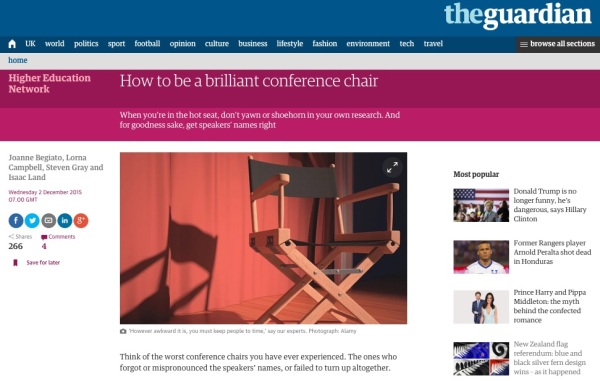
The recent Guardian article that Joanne Begiato, Steven Gray, Isaac Land I I wrote on The Six Best Conference Questions turned out to be so popular that we decided to write another one! This time about conference chairing. An edited version of this article appeared in the Guardian Higher Education Network on the 2nd December, but here’s the full director’s cut.

conference_chair

How to be everyone’s favourite Conference Chair

By Joanne Begiato, Steven Gray, Lorna M. Campbell and Isaac Land

We’ve all got an anecdote about the worst conference chair we have ever experienced. The chair who forgot or mispronounced the speakers’ names, or (horrors!) forgot to turn up altogether, leaving the bewildered speakers to introduce themselves. The chairs who let questions ramble on through self-interested thickets or didn’t notice the shy hand raisers, only seeing the professor of gesticulation. Or how about the occasional chair who takes the chance to tell the audience about his/her fascinating research and superior knowledge? And don’t we all dread the chair who can’t tell the time, appears not to care that the audience is gasping for a drink, or lets that awkward silence drag on once all the questions have dried up. The painfully self-aware among us know in our heart of hearts that we have all been that chair at one conference or another (possibly after a late night at the conference dinner, not entirely unrelated events). Although such chairing debacles are something of a scholarly rite of passage, which help us to hone our chairing and facilitation skills, our aim here is to help you avoid these pitfalls and offer a six-point check-list so you can become everyone’s favourite conference chair.

Be Prepared and Organised

Make sure contact your speakers in advance, either at the conference or via email, to ask for a short biography or check if they’re happy for you to use their biography and title from the conference programme (quite often people change the focus of their paper by the time they come to present). Then, find your speakers at coffee before the session so you can introduce yourself, find out how they prefer to be addressed and check how to pronounce their names writing them down phonetically if necessary. If needs be, ask whether presenters will be using the conference PC or their own laptop, and make sure you know where to find the tech support to get them connected. In order to assure seamless transitions, ensure that presentations are preloaded, and check that your speakers know how to find and open their own presentations. And if the tech gods let you down, know how to contact the IT support.

Be Fair and Inclusive

When introducing the speakers do not give one of them more prominence than the others, whoever they might be, and highlight each speaker’s key publications and achievements equally. Be prepared for the eventuality that when you open the floor for questions you are met with stony silence, by preparing your own question for each speaker. Nonetheless, if there is a flurry of hands, don’t hog the questions or abuse the chair’s prerogative. Prevent questioners from dominating, bullying, or patronising speakers by courteously reminding them to come to the point and you scan the audience to ensure early career researchers and more reticent colleagues have an opportunity to address the panel. Where possible, try to make sure that all the speakers get and least one comment or question so that none of them leave vowing never to give another paper again.

Be Impartial and Selfless

Keep anecdotes about your own research to coffee time and let the speakers take the spotlight. If you have found links with your own work, or know of references that might help inform speakers’ research, talk to them or email them later and focus on their own findings during the session. Be sensitive and helpful and encourage early career researchers and new speakers and boost their confidence by thanking them for their presentation and showing an interest in their work. Know when to save your own questions for another time because the audience has a lot to ask.

Be Visibly Attentive

You are the chair, on full view and managing the panel, so listen attentively to the speakers, and take notes on relevant points that might be used for questions later. Save your knitting, crocheting, nail filing, and yawning for your evenings in front of the TV. Sit on the podium without fidgeting, or in the front row where you can maintain eye contact with your speakers. When its time for questions, stand to the side of the podium scanning the audience for questions, leaving centre stage for your speakers. If multiple audience members raise their hands, make eye contact with each and nod discretely so they know you have seen them and you return to them to invite them to ask their questions when the opportunity arises.

Be Polite but Firm

Always begin promptly and make sure you time each speakers’ slot individually, so that each has his/her fair share of the session. However, awkward, you must keep people to time because the alternative is unfair. Be prepared to tackle a speaker even if s/he is higher up the academic ranks, self-important, or simply stubborn enough to ignore you. To achieve this difficult task, agree with your speakers in advance what sign you will use to alert them that they must begin drawing their talk to a close, such as a note or finger gesture (no, not that one). If necessary, know when to stop believing the speaker’s promises that they are about to conclude and stand up and inform them firmly that you will have to stop them there in order to introduce the next presenter. By the way, for all speakers reading this, let’s make the chair’s life more comfortable by ending when asked!

You Know When to Finish

When you get to question time, it is your responsibility to lead the discussion by encouraging dialogue between audience and speakers. Questions at the end of a paper can be the most rewarding part of the session; otherwise speakers may as well have stayed at home and read their paper to the cat. Do this simply by ensuring that everyone who wants to speak has the opportunity to do so, and try to read faces and feel the silences. This way you know when the questions have dried up and it’s time to thank the speakers and the audience, and say how great the session has been. Even if there are more questions, when the time for the panel to end arrives, tie things up neatly, thereby allowing everyone to happily head for tea and biscuits or, better still, the pub (where they won’t talk about you, because you did your job well).

Oh, and we were very pleased that this article was the editor’s top pick in last week’s Higher Education Network Newsletter :)

conference chair editors pick


Researching Marginalised Groups Symposium⤴

from @ Cat's eyes

It’s been a while since my last post – embarrassingly long. Full time work and a hefty commute have eaten up any available time I had to do this, but in trying to sort out my notes from some recent conferences, I took the plunge and got back on the blog-wagon. This might be interesting if you are working with either ethnographic approaches or marginalised/marginalising groups. It was a cracking day for me – lovely people and great discussions.

This symposium gave me an opportunity to find out more about ethnographic methodologies and about research project that had take place in the SoE. The following scholars gave accounts of their chapter in a recent co-authored book of the same title.

Marginalised and silenced voices were surfaced. Extremist groups also considered within this definition as they are ones who marginalise and we need to understand what they do and how the operate as well.

Kalwant Bhophal raised pertinent methodological questions: no matter who we are we affect the groups we research (her area of research interest is travellers and Roma communities).

How have we used the respondents?
have we unconsciously exploited them?
How do we affect the communities?
Our subjectivity affects our research

Research should always make a difference even if. It’s small.

Ethics – compromises are sometimes necessary. Discourse is often nebulous . Needs to be more transparent – duty to respondents, university, disciple.

ACCESS- problematics rapport an trust are key.

Openness and recognition of the right time to stop when dealing with students  are essential!.

Member checking –  giving transcripts back to respondents to check is an important part of trust building process – before data is analysed or used. This is important esp with marginalised groups.  Reflexivity and positionality – power is dynamic, not static: it will change throughout  the research process.

Gavin Bailey: Research Associate, University of Leicester

Interested in the ones who do the marginalising – the extremist groups within working class communities. Are hard to reach groups really hard to reach or are the just hard to hear?

Researches extremism in a community context.

What happens if the residents assoc happens to be run by BNP ACTIVISTS?

Extremism and how it is conceptualised in research Community as a key analytical object.

Stereotypes are dominant representation of these extremist group- see Jeremy Paxman griffiths interview: the way demonstrationss are represented in media is always as confrontational.

Being on Paxman – this is not being marginalised , this is mainstream media- doing the marginalising. The doer and the subject – needs to b broken down a bit.

GB’s study avoided the public representation and focused on what they do in their day jobs the extremist groups are the unit of analysis . Beware the focus on the spectacular groups- counter terrorists focusing on different groups who actually do violence Are they unreformable? Is that why they are ignored?

Activists have chosen to become activists – lots haven’t but are still in the dynamic Geographies of danger of otherness- community and culture as explanation. In this paradigm the research starts with these places. But often activists drive into perform activism and drive away Assumptions are being recreated – seek and you will find Stigmatising communities some objects become indicators of extremism- we know what it looks like and where to find it – so they think anti fascist or anti racist- what was the question again? Is it part of this older debate Where is the concern with white middle class attitudes and actions?

Try the implicit association test – see link.

Tiago Neves

This I found really challenging. Tiago completely overturned my assumptions about researching people and asked lots of awkward questions like – are these extremist groups really hard to reach? They are easy to reach them compared to bankers!

Ethnographic work – non intrusive or the most intrusive?

You study people – that’s ugly! To put them under the microscope , intrude in their lives is disturbing. We go into places we don’t know much about and try to make sense of what they do. Maybe we should make sense of out own lives? !Intrusion can cause deception – definition Impression management – the work of successfully staging a character(see Goffman). In ethnography we intentionally create a character in order to pry into people’s lives- that’s the ugly bit ethnography: it can blur the divide between a social encounter and a sociologically useful encounter.

The naturalism of the ethnographer is an artificiality What is reciprocity ? – an illusion? Who reaps the benefits or should we base this relationship on something else? Relational quandary. There are different motivations What can we do – get real – no person is perfect so no researcher is either Get real – there will always be betrayal, hands will get dirty Get ample – write about all our experiences detail context sensitive accounts of ethical matters as they pose themselves in the field.

Emiliano Grimaldi

Positionality symbolic violence and critical ethnography Foucauldian influences Experienced uneasiness- chapter draws on critical moments reflecting this in two research projects. Foucault – power and knowledge are mutually constitutive fieldwork has an inherently political nature – symbolic violence is inherent in fieldwork? Every time we engage – esp with marginalised groups – we exercise symbolic violence. See chapter on symbolic violence. This author gave a worrying account of some researchers’ interview data with Roma groups in Italy. Their responses were counter-indicative to the researchers’ expectations, and the manipulation, constant rephrasing, rewording reiterating on the part of the researchers was blatantly driving at a pre-determined conclusion; the participants were making it very difficult for them to arrive at it. A lesson in interviewing.

Stephen Locke

This was the least helpful presentation for me – it was lacking a bit of coherence, although it was on an interesting question of giving a face to those we study. Should we be protecting identity or giving a voice? What are the barriers to making visible those who are invisible, and how seriously do we take this ethical question – does protecting identity deny voice and agency to some respondents?

Questioning the IRB ethics boards:

Institutional control of knowledge/ legalistic nature of IRB/ conflicting ideas of informed consent: these are represented differently in north south divide between USA and South America. As an illustration of this in reviewing ethics guidelines, the US took 130 pages to explain their guidelines compared to 13 pages for Costa Rica and they were mostly concerned with science.

Am I more or less ethical after this?
This symposium has extended my knowledge and interest in ethnographic approaches, and certainly raised some very probing ethical questions . My area of research interest is teacher professional learning. I’m not sure how easy or relevant ethnographic approaches are to this subject area, but the ethical questions raised here are valid for any methodology involving people.

Follow-up:

Goffman,
Gold’s typology of participant observation 1958
RossDeuchar
Hammersley on ethical absolutism.